 and a simple
closed curve
and a simple
closed curve  , the number of zeros of
  inside is equal to
the winding number of
inside is equal to
the winding number of  around 0.
- Show that this is also true for a general analytic function
 which is analytic on a disk containing . There are at least
two approaches:
which is analytic on a disk containing . There are at least
two approaches:
- ``Factor out'' the zeros of to get another
function
 and show that the winding number of
  around 0 is equal to 0; or
- Show that
and analyze the behaviour of
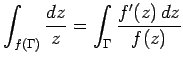
 near a zero of .
(There is also a topological proof in Needham, Section 7.IV, which looks at what is true for more general maps of the plane to itself, and what is special about the case of analytic functions. That proof is well worth reading if you have a topological bent.)
- ``Factor out'' the zeros of
- Define the ``inside'' of a general curve to be the set of
points
 so that
 . Show that, under the
assumptions above, every point in the inside of gets mapped to
the inside of
. Show that, under the
assumptions above, every point in the inside of gets mapped to
the inside of  .
.
- Show how this result generalizes the Maximum Modulus principle.
be an arbitrary function on
 with values in
with two continuous (real) derivatives. In other words, near each
with values in
with two continuous (real) derivatives. In other words, near each
 ,
,  can be written as

 .
.
Define the Laplacian of f as

- Show that
where

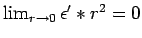 .
.
- Show that if is harmonic, then
 is identically 0.
- Conversely, use the factorization
to show that if

 , then there exist analytic functions
and
, then there exist analytic functions
and  so that
That is, the only harmonic functions are sums of analytic and anti-analytic functions. (Hint: Start by showing that
so that
That is, the only harmonic functions are sums of analytic and anti-analytic functions. (Hint: Start by showing that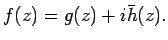
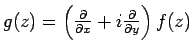 is analytic.)