 has a pole at
every integer
has a pole at
every integer  with residue 1. One natural approach to constructing
such a function is to consider a sum over the integers of a function
with a pole at : consider
with residue 1. One natural approach to constructing
such a function is to consider a sum over the integers of a function
with a pole at : consider
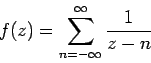
- Show that this approach does not work, by showing that the sum
above diverges for all
 .
.
(Recall that a sum
 converges if and only if
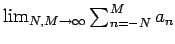 exists, which in turn is true if and only if there is a value
  so that for every
  ,
there are
,
there are  and
and  so that, for
  and
and  ,
,
 is within
  of the limiting value .)

- Show that the sum in (2) converges, and that
the result is an analytic function with a pole at every integer
with residue 1 which satisfies
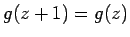 .
.
- Evaluate the sum to show that, in fact,
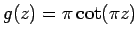 .
.
is not the only function with a
pole of residue 1 at each integer, it is in some sense the most
natural one.
 has a pole at every integer,
with a residue at of
has a pole at every integer,
with a residue at of  .
.