 and
analytic function
and
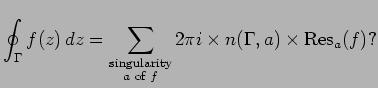
analytic function  with isolated singularities, why is
Mathematics 113
October 23, 2003
On Wednesday (October 22), we had a class discussion about the residue theorem and why it is true (as opposed to a proof that it is true). There were a lot of good reasons given, but they came somewhat out of order; this is my attempt to organize them into a logical order according to which question they try to answer.
Some of these questions will seem completely intuitive and not in need of an explanation to some of you, but I wanted to be as complete as possible. It is my hope that you will gain an intuition for analytic functions so that all of the questions seem obvious!
Please let me know if I missed anything, or if you come up with some new answers to these questions that aren't listed!
and
analytic function with isolated singularities, why is
There were two basic approaches to this question suggested.
 coefficient at
that singularity, times
coefficient at
that singularity, times  .
.
Of course, this reason naturally raises two other questions: ``Why can
we deform the curve?'' (Question 2) and
``Why does the integral around a small circle pick out the
coefficient?'' (Question 4).
, so
we can split into an analytic function  and a principal
part for each singularity. The integral of the analytic function
vanishes, and the integral of a function with a single
singularity picks out the residue at the singularity times the
winding number.
and a principal
part for each singularity. The integral of the analytic function
vanishes, and the integral of a function with a single
singularity picks out the residue at the singularity times the
winding number.
Again, we have two subsidiary questions: ``Why is the integral of an
analytic function on a closed curve zero?''
(Question 3) and, again, why we get the
residue in particular (Question 4).
along the two curves will be the sum of the
integrals along the boundary of these crescent-shaped regions; but
the integral of an analytic function , defined on a
simply-connected region  , along the boundary of is equal to zero.
is analytic in a disk, then there is a function  so that
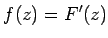
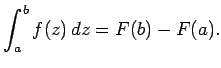
 to
to  , as long as we stay within a region for which
is defined.
, as long as we stay within a region for which
is defined.
along a simple
closed curve equal to 0 (as long as is analytic in the
whole interior of )?
is a disk, which is simply-connected, so we can
find an anti-derivative to the function  defined on the
interior of as well as itself. But then, by the Fundamental
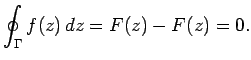
Theorem of Calculus (as in Reason 2.2), if
runs from the point
defined on the
interior of as well as itself. But then, by the Fundamental
Theorem of Calculus (as in Reason 2.2), if
runs from the point  back to ,
For all the above reasons, we reduce the original question to an
integral around a single singularity. For simplicity, let's suppose
that we're integrating around a circle  of radius
  that winds once
counterclockwise around a singularity at 0.
that winds once
counterclockwise around a singularity at 0.
has an isolated singularity at 0, why is
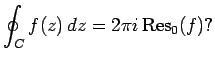 times the coefficient
of ?
times the coefficient
of ?By linearity of the integral, we can reduce this question to the integral of a simple power:
 equal to 0 if
  , and equal to if
 ?
?
We came up with many different answers to this question, addressing
different possible values of  .
.
 ,
,  is analytic on the disk, and so the integral
around a closed curve is 0 as in Question 3.
is analytic on the disk, and so the integral
around a closed curve is 0 as in Question 3.
, has an antiderivative defined on
 ,
namely
,
namely
 , and so the integral of around a
closed curve is 0 by the Fundamental Theorem of Calculus, as in
Reason 3.1.
, and so the integral of around a
closed curve is 0 by the Fundamental Theorem of Calculus, as in
Reason 3.1.
, as we integrate around the closed circle, the angle of
 is
is
 and the angle of
  is
is  ; adding these
up, we find that
; adding these
up, we find that
 has a constant angle of
  , so we
don't get any cancellation and the integral is at angle , i.e.,
some multiple of
, so we
don't get any cancellation and the integral is at angle , i.e.,
some multiple of  .
For , the angle of is
.
For , the angle of is  so the angle of
  is
is
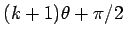 , which rotates as we go around the circle (with
  increasing from 0 to
  ). Since the magnitude of the vectors we
add remains constant, the integral is 0 for .
). Since the magnitude of the vectors we
add remains constant, the integral is 0 for .
, we expect that
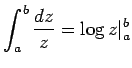 in polar coordinates, we have
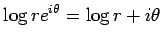 is only defined up to adding a multiple of
, and if we move around the circle counterclockwise starting
at 0, the angle increases continuously from 0 up to , so
is only defined up to adding a multiple of
, and if we move around the circle counterclockwise starting
at 0, the angle increases continuously from 0 up to , so

,
 , consider taking the original circle
and shrinking it down until it has radius
, consider taking the original circle
and shrinking it down until it has radius  .
The length of the curve we integrate along scales down by a factor
of , while the function
.
The length of the curve we integrate along scales down by a factor
of , while the function
 which we
are integrating scales up by a factor of
which we
are integrating scales up by a factor of
 . These two
cancel out, so the integral seems to stay constant, and it is
reasonable to suppose that the magnitude of the integral is equal to
the length of the original curve, which is .
. These two
cancel out, so the integral seems to stay constant, and it is
reasonable to suppose that the magnitude of the integral is equal to
the length of the original curve, which is .
, if we shrink our original contour to a circle of small
radius , the length of the curve scales down by a factor of
while the value of the function scales down by a factor of
 (or remains constant, if
  ). By the M-L theorem, the
total integral is bounded above by some constant times
). By the M-L theorem, the
total integral is bounded above by some constant times  ;
since can be as small as we like, the integral must be 0.
;
since can be as small as we like, the integral must be 0.
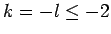 , if we expand the original contour to a large
circle of radius , the length of the contour scales up by a
factor of while the function
, if we expand the original contour to a large
circle of radius , the length of the contour scales up by a
factor of while the function  scales down by
a factor of
scales down by
a factor of  . The scaling down of beats the scaling
up of the length of the curve, so by the M-L theorem the integral is
bounded above by a constant times
. The scaling down of beats the scaling
up of the length of the curve, so by the M-L theorem the integral is
bounded above by a constant times  , which can be made as
small as we like for sufficiently large.
, which can be made as
small as we like for sufficiently large.
 , consider perturbing the function a little bit:

 .) The perturbed function has a simple pole with
residue
.) The perturbed function has a simple pole with
residue
 at
at
 and a simple pole with residue
 at
at
 . For
. For  sufficiently small, both poles
will be contained inside our circle , but since the two residues
have equal magnitude but opposite signs, the integral around any
loop that encloses both poles will be 0. (This argument is closely
related to the electric field of a dipole, written in terms of the
fields of two close and opposite-charged particles. A similar
argument works for any
sufficiently small, both poles
will be contained inside our circle , but since the two residues
have equal magnitude but opposite signs, the integral around any
loop that encloses both poles will be 0. (This argument is closely
related to the electric field of a dipole, written in terms of the
fields of two close and opposite-charged particles. A similar
argument works for any  .)
.)