 intersect for some x0 between 1 and 2. Do the graphs
ever intersect for
intersect for some x0 between 1 and 2. Do the graphs
ever intersect for  ?
?
Calculators are not used in this course, they are not needed to solve any homework or exam problems, and their use is not permitted on exams or on homework. If you want to know why this policy being used, please read the rest of this handout.
Part of the reason for the vast range of applications of calculus (and mathematics in general) is that a handful of general concepts can be used to describe many different kinds of phenomena. However, the ability to use general principles in practical settings depends upon understanding how to properly apply such principles and what kinds of difficulties might arise. This understanding is something which cannot be told to you by a machine. Once you understand a fundamental idea, it is usually a simple matter to learn how to use a calculator or a computer to apply the idea in a concrete numerical setting. The purpose of this course is to teach you the hard part: understanding the concepts and the methods of computation.
Computers and calculators are wonderful and powerful tools for carrying out difficult numerical tasks, but if you are unable to think about and work with concepts in the absence of a machine, then your ability to intelligently confront new problems will be severely restricted. It is for this reason that calculators are not permitted in this course.
The following example illustrates the right way and wrong way to use a calculator:
Problem:
The graphs of
y = x1/10 and
intersect for some x0 between 1 and 2. Do the graphs
ever intersect for ?
Bogus Solution: Graph on a calculator, and it
looks like x1/10 is always smaller than  for and x1/10 seems to grow more slowly as well (try
it!). Thus, the graphs never cross for
for and x1/10 seems to grow more slowly as well (try
it!). Thus, the graphs never cross for  .
.
This solution is wrong for several reasons.
First, although it is true that
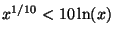 over the range of that you are likely to
consider on a
graphing calculator, and moreover the rate of
growth of x1/10 is less than that of over such ranges as well, the conclusion is actually incorrect.
Since the range of a calculator is limited,
the fact that the calculator fails to show something does
not imply that it can't happen, even if the problem (such as the above one)
seems to only involve ``small'' numbers. Two examples are
the ``facts'' that the graphs do not cross for and that lower graph,
y = x1/10, is
growing more slowly than the higher one,
.
How do we know
that these trends will continue forever? It turns out that they don't!
over the range of that you are likely to
consider on a
graphing calculator, and moreover the rate of
growth of x1/10 is less than that of over such ranges as well, the conclusion is actually incorrect.
Since the range of a calculator is limited,
the fact that the calculator fails to show something does
not imply that it can't happen, even if the problem (such as the above one)
seems to only involve ``small'' numbers. Two examples are
the ``facts'' that the graphs do not cross for and that lower graph,
y = x1/10, is
growing more slowly than the higher one,
.
How do we know
that these trends will continue forever? It turns out that they don't!
Let's now consider the bogus solution in more detail.
It is certainly true that if
x1/10 is smaller than
at some point, such as at x = 2,
and always grows more slowly beyond this point,
then the graphs never cross again. This is
is the type of conceptual explanation that is expected when you
are justifying an answer, so the bogus solution would have been
fine if
the hypothesis about growth rates were correct, as the calculator appears
to suggest. Is is true that for large x,
the function x1/10 always grows more slowly than
? Let's
compute the derivatives!

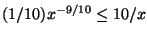 always true for ?
Multiplying through by 10x, our inequality is
equivalent to
always true for ?
Multiplying through by 10x, our inequality is
equivalent to
 , or
, or
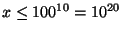 .
No wonder the calculator graph showed what it did: you have to
go all the way to
x = 1020 = 100000000000000000000 to see
the growth rate of x1/10 overtake that of
. Aha, so perhaps something does eventually happen ...
.
No wonder the calculator graph showed what it did: you have to
go all the way to
x = 1020 = 100000000000000000000 to see
the growth rate of x1/10 overtake that of
. Aha, so perhaps something does eventually happen ...
Solution without Calculator: Make
the change of variable
z = x1/10 to get rid
of the fractional exponents, so we are considering
the functions z and
 ,
for
,
for  . From basic
facts about the rate of growth of polynomials and
logarithms, we know that polynomials always grow much
faster than logarithms when the variable is large.
Thus,
. From basic
facts about the rate of growth of polynomials and
logarithms, we know that polynomials always grow much
faster than logarithms when the variable is large.
Thus,
 for large z.
Since we have
for large z.
Since we have
 for z = 2, by
the intermediate value theorem there is a solution to
for z = 2, by
the intermediate value theorem there is a solution to
 with
z > 2 > 21/10.
Thus, there is a solution to
with
z > 2 > 21/10.
Thus, there is a solution to
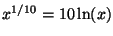 with
x1/10 > 21/10 (i.e., with x > 2).
with
x1/10 > 21/10 (i.e., with x > 2).
Can we solve it with a Calculator? It is possible to use a calculator to correctly solve the problem (instead of appealing to the intermediate value theorem), but we will now see that such a solution requires the same insight that we needed to solve the problem without the calculator, namely a clever choice of change of variable. The use of a calculator does not enable us to abandon the need to think about what we are doing.
We saw by a consideration of
growth rates in the bogus solution
that we need to consider x beyond
10010 = 1020.
In order to bring such large numbers ``into range'' on the
calculator, it is easier to graph functions
in terms of the variable
z = x1/10 rather than x.
For example, when
x = 10010 (a very large number) we have
z =
x1/10 = 100(a much smaller number).
Since
x = z10, we see that
 .
Thus, we want to graph z and
.
Thus, we want to graph z and  and see
if there is an intersection for .
Put another way, we are trying to solve the
equation
, or
and see
if there is an intersection for .
Put another way, we are trying to solve the
equation
, or
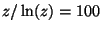 , with z large.
Graphing
, with z large.
Graphing
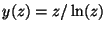 , the calculator finds
an approximate
z0 = 647.27751 where
y(z0) = 100.
Since
x = z10,
raising z0 to the 10th power gives the approximate
x-coordinate
, the calculator finds
an approximate
z0 = 647.27751 where
y(z0) = 100.
Since
x = z10,
raising z0 to the 10th power gives the approximate
x-coordinate
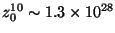 of a point of intersection of the original graphs
y = x1/10 and
.
This coordinate is out of the range in which a student
would look.
of a point of intersection of the original graphs
y = x1/10 and
.
This coordinate is out of the range in which a student
would look.
This looks rather complicated (and it is, compared to the conceptual solution without the calculator), but the essential idea of the solution (change of variable) is still the same. The moral of the story is that the calculator is very good at finding explicit numerical solutions, but in order to avoid errors, one often needs the same level of understanding that is required if one tries to avoid the use of a machine.