 .
.
April 17-21: §10.1 in Anton, pages 1-10 in the Supplement
.
1. Graph f(x) = (x+3)2(x-1) (justify!).2. Assume that P = P(t) is a function of time t which satisfies
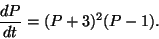
3. Graph the particular solutions P(t) with P(0) = -4, -2, 2, and label all equilibrium solutions, indicating for each whether or not it is stable.
4. For which real numbers a is the solution P with initial value P(0) = a an increasing function of t?
5. By using the identity

find an explicit formula for the time t in terms of the value of P(t) (i.e., given the value of P at some time, give a formula which computes what time it is). Your formula should depend upon the initial condition value P(0), which you should assume is not equal to -3 or 1. How does this formula relate to the sketches in the third part of the problem? You may not use this formula in any other part of the problem.
 .
.
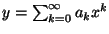
1) Given that y(0)=1, y'(0)=0, and y''(0)=0, what can you say about the values of a0, a1, and a2.
2) Assuming the same initial conditions as in part 1, find the general form of the coefficient ak. (That is, write a formula for ak in terms of k.)
3) Verify that the series with the coefficients you derived in part 2 has infinite radius of convergence.
4) Check that the function
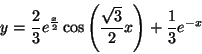
is a solution to the differential equation y'''=-y with y(0)=1, y'(0)=0, and y''(0)=0.5) Use the uniqueness of the solution of the differntial equation y'''=-y with the given initial values in order to deduce the MacLaurin series for the function
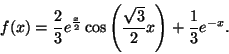
(Note that it would have been considerably more difficult to compute the entire MacLaurin series for this function directly.)