|
GPS in two dimensions
Assume you sit at a point X and know the positions of three
satellites in P,Q,R in the plane. Each satellite has a built
in atomic clock and sends periodically signals. The receiver at
position X does not contain an accurate clock and can not
determine the distance to each satellite. But it can compare
the arrival times from two different satellites and therefore find the
distance difference to two satellites.
The set of points with fixed distance difference to two
points P,Q is a hyperbola XP,Q.
Similarly, one defines a hyperbola XQ,R.
These two hyperbola intersect in a finite set of points
which is your location X.
GPS in three dimensions
In three dimensions, the set of points X, whose difference
to two points P,Q is a fixed constant, forms a
hyperboloid XP,Q. With 4 known
points P,Q,R,S, we have two more hyperboloids. Your location
is in the intersection of these three surfaces.
|
GPS Facts
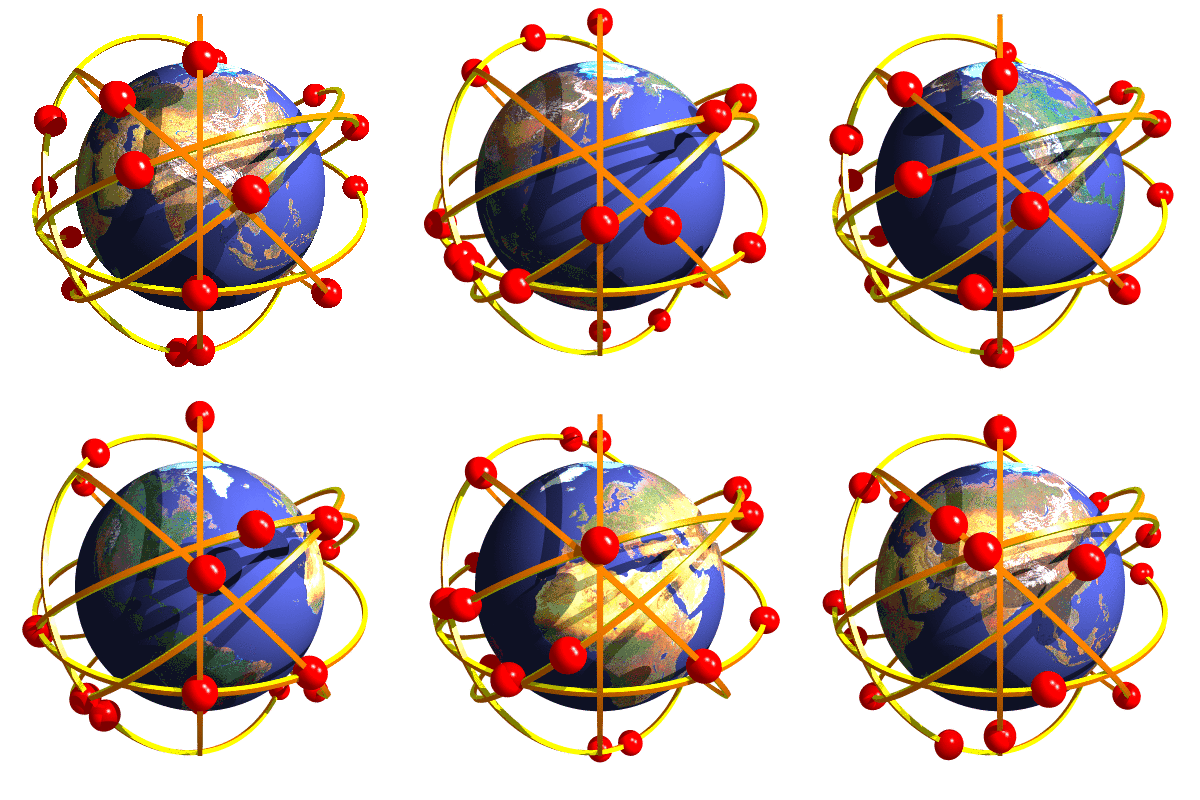
There are 24 satellites in 6 orbital planes at 20'195 km altitude.
Each satellite has 12 antennas and weights 1500 to 2000 kilograms.
Each makes two complete rotations in 24 hours. The orbits are arranged
so that at any time, anywhere on earth, there are at least 4 satellites
visible in the sky. The radio signals are sent at frequencies between
1.176 and 1.841 GHz. The GPS system was developed in 1973 by the US
department of defense.
Links
|

