$page_title = "Exhibit: latin squares";
$page_description = "Exhibit on a problem of latin squares in Math 21b, Linear Algebra and Applications";
${base} = "../../";
$robots = "all";
sub main_page {
print OUTPUT<<"EOF"
Latin squares
A nxn matrix is called a latin square if the numbers 1,...,n occur exactly once
in each row and exactly once in each column of the matrix.
A simple example is
A = | 1 2 |
| 2 1 |
An example of a 3x3 latin square, you have encountered in the first midterm.
Here is an example of a 5x5 latin square:
A = | 1 2 3 4 5 |
| 2 3 5 1 4 |
| 3 5 4 2 1 |
| 4 1 2 5 3 |
| 5 4 1 3 2 |
|
Suduku squares
A 9x9 matrix is a Suduku square,
if it is a latin square and if additionally in
each of the 9 3x3 submatrices all numbers 1..,9 occur exactly once too.
Here is an example:
A = | 3 4 2 9 7 8 1 5 6 |
| 6 9 5 2 4 1 3 7 8 |
| 1 7 8 6 3 5 2 4 9 |
| 7 6 3 4 9 2 5 8 1 |
| 8 1 9 3 5 7 4 6 2 |
| 2 5 4 8 1 6 7 9 3 |
| 9 3 7 1 6 4 8 2 5 |
| 4 8 1 5 2 9 6 3 7 |
| 5 2 6 7 8 3 9 1 4 |
|
Magic squares
A nxn matrix is called a Magic square if it contains all
integers 1,...,n2 exactly once and each row each column
and each diagonal column has the property that the sum is constant.
An example:
| 4 9 2 |
| 3 5 7 |
| 8 1 6 |
Note that this square appears in the center of the above Suduku matrix
which has been found by
Paul Muljadi.
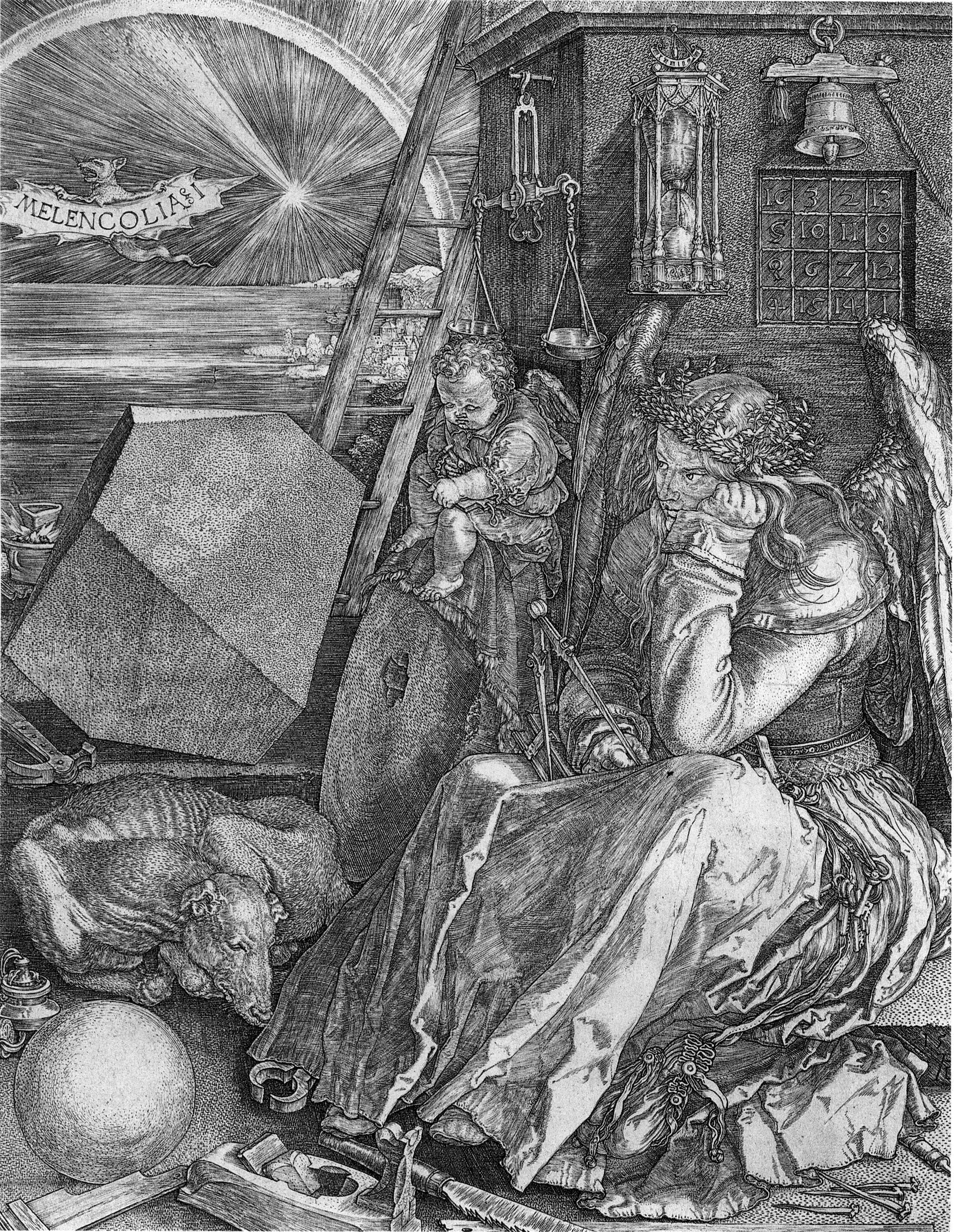
The magic square which appears in Durers Melancolia I is
A = | 16 3 2 13 |
| 5 10 11 8 |
| 9 6 7 12 |
| 4 15 14 1 |
|
Questions
Something to think about:
- Which of the three classes of matrices has the property that its transpose AT has the same property too?
- Can you find an eigenvalue and eigenvector in each of the above three classes of matrices?
- Can you see why every Suduku matrix has a nontrivial kernel and is therefore not invertible?
Links
EOF
}
1;