$page_title = "Exhibit: Pascal Matrices";
$page_description = "Exhibit page in Math 21b, Linear Algebra and Applications";
${base} = "../../";
$robots = "all";
sub main_page {
print OUTPUT<<"EOF"
Pascal Matrices
In the Final exam, we looked at
Pascal triangle matrices. So, here is the Pascal triangle, then the
Pascal triangle, in which the integers are seen modulo 2 (we look at
the remainder when dividing by 2, which means that we put 1 if the number
is odd and 0 if the number is even). It was generated with the following
line:
M=9; A=Table[ Binomial[n,k],{n,0,M-1},{k,0,M-1}]; Mod[A,2]
1  0  0  0  0  0  0  0  0
1  1  0  0  0  0  0  0  0
1  2  1  0  0  0  0  0  0
1  3  3  1  0  0  0  0  0
1  4  6  4  1  0  0  0  0
1  5 10 10  5  1  0  0  0
1  6 15 20 15  6  1  0  0
1  7 21 35 35 21  7  1  0
1  8 28 56 70 56 28  8  1
| |
1  0  0  0  0  0  0  0  0
1  1  0  0  0  0  0  0  0
1  0  1  0  0  0  0  0  0
1  1  1  1  0  0  0  0  0
1  0  0  0  1  0  0  0  0
1  1  0  0  1  1  0  0  0
1  0  1  0  1  0  1  0  0
1  1  1  1  1  1  1  1  0
1  0  0  0  0  0  0  0  1
|
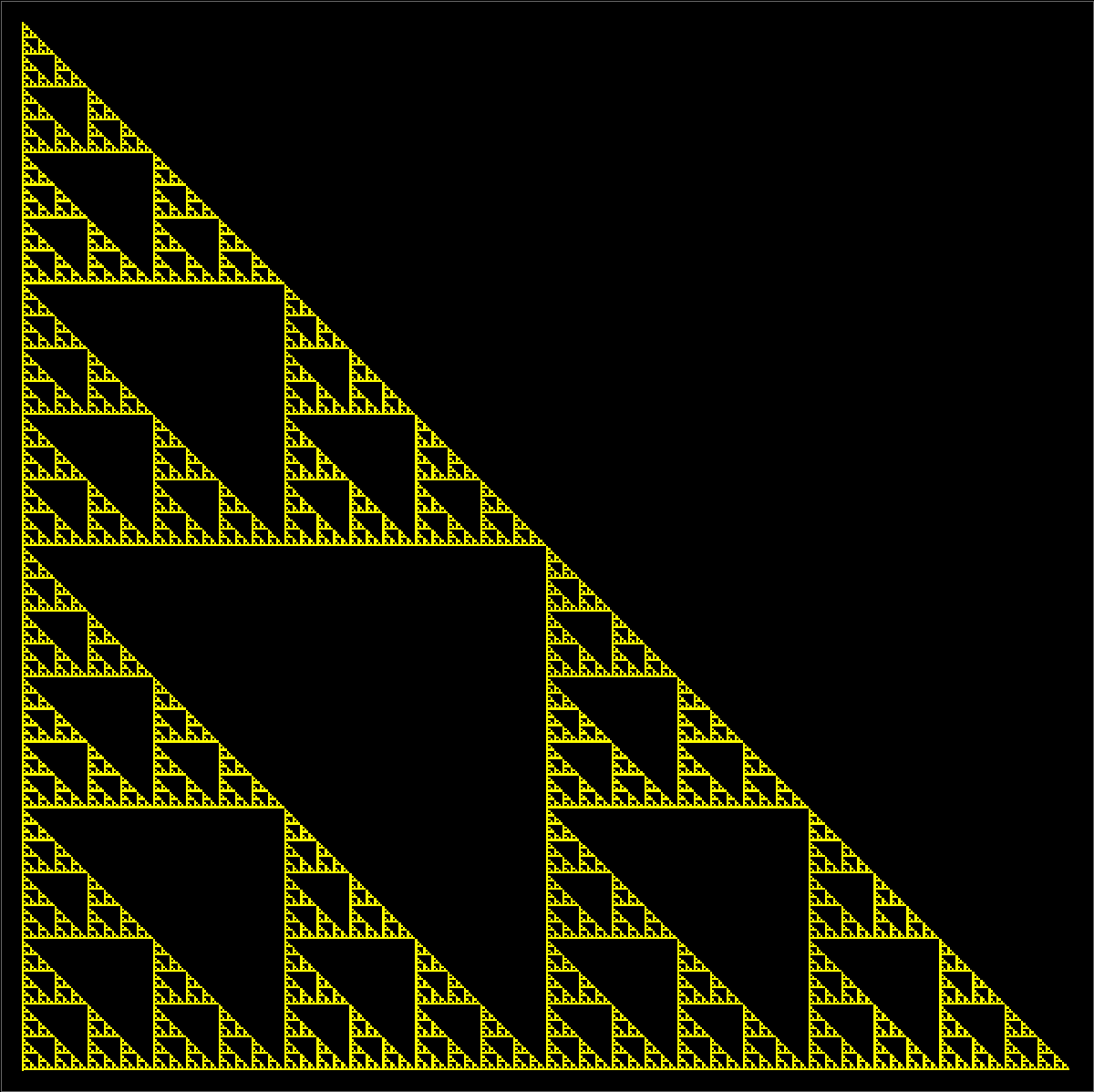
Here is a larger version for n=29 = 512. The picture of the matrix
converges to a fractal called the
Sierpinski triangle.
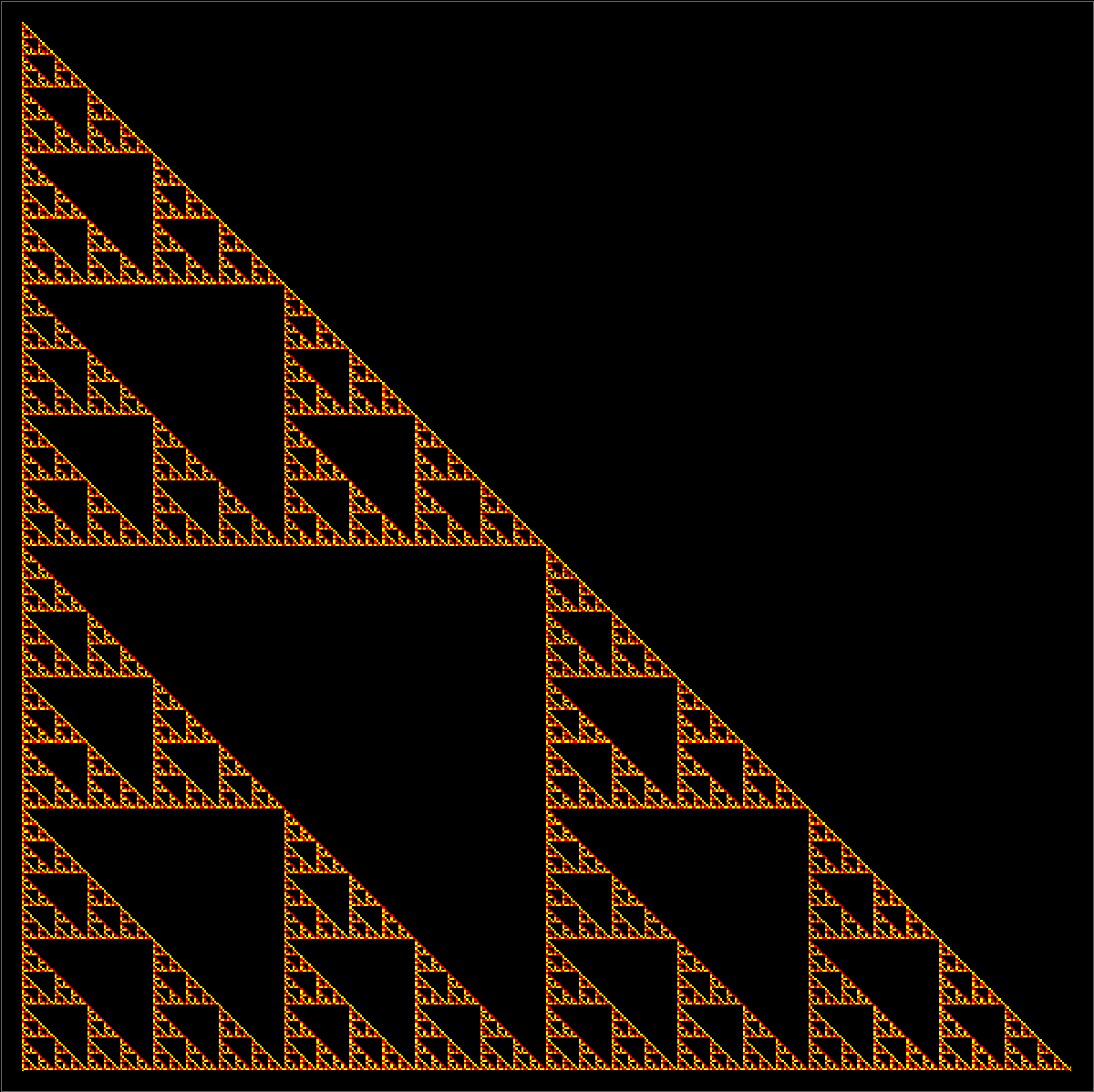 In the exam, we have computed the first column of the inverse of the Pascal matrix.
Here is a picture of the inverse for n=2048. The inverse takes values 0,1,-1 only.
EOF
}
1;
In the exam, we have computed the first column of the inverse of the Pascal matrix.
Here is a picture of the inverse for n=2048. The inverse takes values 0,1,-1 only.
EOF
}
1;