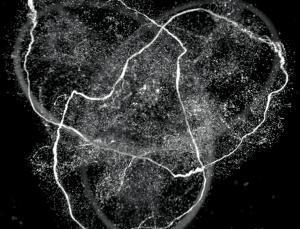
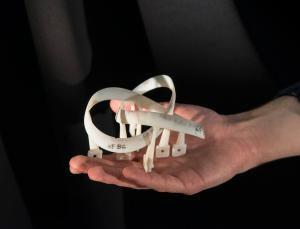
The movie does not show the for us interesting part,
how the fluid was prepared in order to produce the vortex
knot. The New Scientist article indicates that it was
a 3D printed strip of plastic shaped into
a trefoil knot and a Hopf link.
From the New Scientist:
Mathematicians have shown that just as knots in string can't be untied
no matter how much you prod and pull them, fluid knots should also
never unravel - even though the particles that make up the fluid will be
circulating around. But this non-unravelling property only applies if the
knot is made of a theoretical "ideal fluid", one that has no viscosity -
in other words, no resistance to flow. How a knot in a real fluid such
as smoke or water would evolve is unknown, as is whether these structures
exist in nature or in the plumes created by machines such as aircraft.
To investigate, Dustin Kleckner and William Irvine of the University
of Chicago, Illinois 3D-printed strips of plastic shaped into a trefoil
knot and a Hopf link. Crucially, the strips had a cross section shaped
like a wing, or hydrofoil.
Next, the researchers dragged the knots through water filled with
microscopic bubbles. Just as a wing passing through air creates a trailing
vortex, the acceleration of the hydrofoils created a knot-shaped vortex
that sucked in the bubbles. The result was a knot-shaped flow of moving
bubbles - the first fluid knot created in a lab - which the team imaged
with lasers.
Once formed, the knots move, rotate and eventually appear to dissipate,
though whether the vortices completely unknot, unlike in ideal fluids,
or somehow preserve the knottedness but in a more diffuse form remains
an open question.