Third industrial revolution
An
Economist article of
April 21, 2012 claims that after the first industrial revolution in
the 18th century in the textile industry, the second industrial revolution
with the assembly line leading to mass production, we are now in a third
industrial revolution where manufacturing becomes digital. From the article:
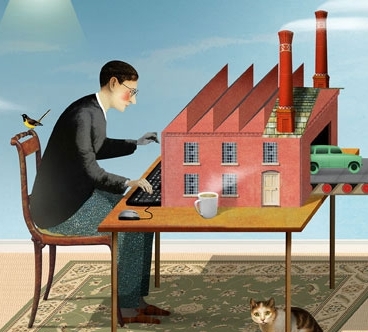
|
"A number of remarkable technologies are converging: clever software, novel
materials, more dexterous robots, new processes (notably three-dimensional
printing) and a whole range of web-based services. The factory of the past
was based on cranking out zillions of identical products: Ford famously
said that car-buyers could have any colour they liked, as long as it
was black. But the cost of producing much smaller batches of a wider
variety, with each product tailored precisely to each customer's whims,
is falling. The factory of the future will focus on mass customisation-and
may look more like those weavers' cottages than Ford's assembly line.
The old way of making things involved taking lots of parts and screwing
or welding them together. Now a product can be designed on a computer and
"printed" on a 3D printer, which creates a solid object by building up
successive layers of material. The digital design can be tweaked with
a few mouseclicks. The 3D printer can run unattended, and can make many
things which are too complex for a traditional factory to handle. In time,
these amazing machines may be able to make almost anything, anywhere-from
your garage to an African village.
The applications of 3D printing are especially mind-boggling. Already,
hearing aids and high-tech parts of military jets are being printed
in customised shapes. The geography of supply chains will change. An
engineer working in the middle of a desert who finds he lacks a certain
tool no longer has to have it delivered from the nearest city. He can
simply download the design and print it. The days when projects ground
to a halt for want of a piece of kit, or when customers complained that
they could no longer find spare parts for things they had bought, will
one day seem quaint.
Other changes are nearly as momentous. New materials are lighter,
stronger and more durable than the old ones. Carbon fibre is replacing
steel and aluminium in products ranging from aeroplanes to mountain
bikes. New techniques let engineers shape objects at a tiny scale.
Nanotechnology is giving products enhanced features, such as bandages
that help heal cuts, engines that run more efficiently and crockery that
cleans more easily. Genetically engineered viruses are being developed
to make items such as batteries. And with the internet allowing ever
more designers to collaborate on new products, the barriers to entry are
falling. Ford needed heaps of capital to build his colossal River Rouge
factory; his modern equivalent can start with little besides a laptop
and a hunger to invent."
|