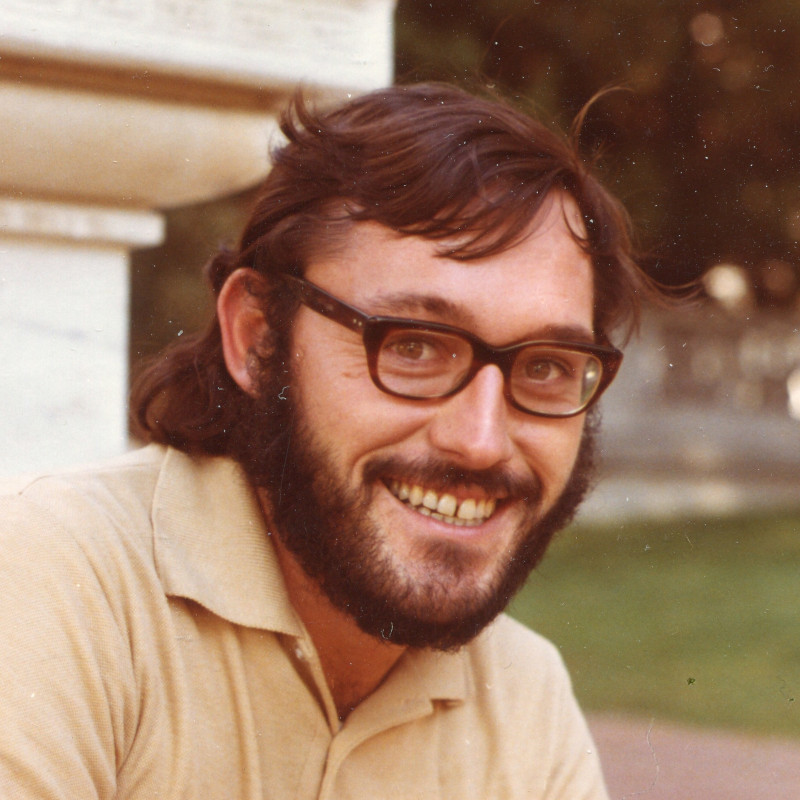
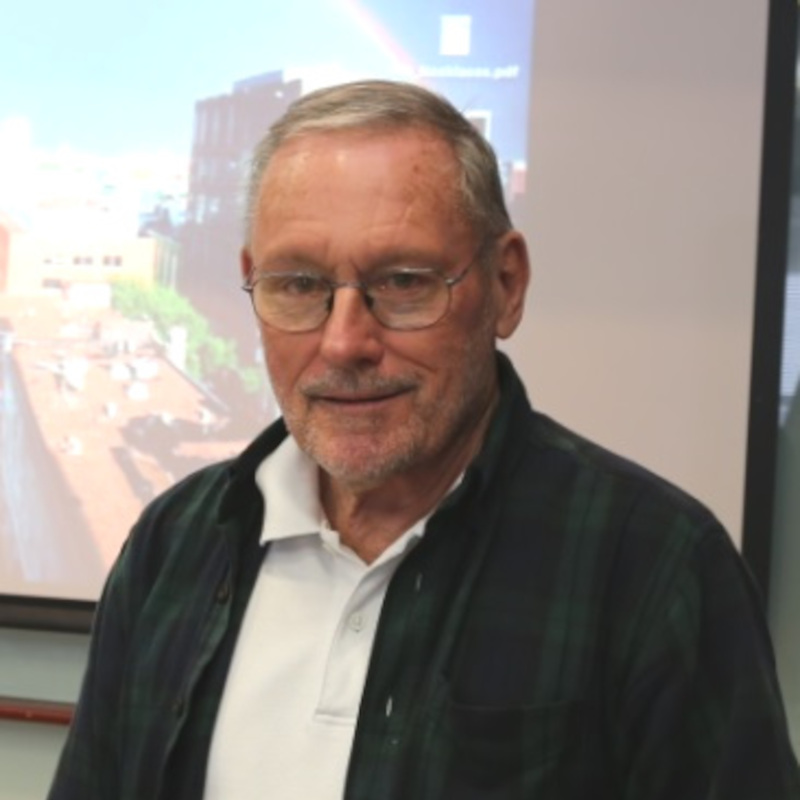
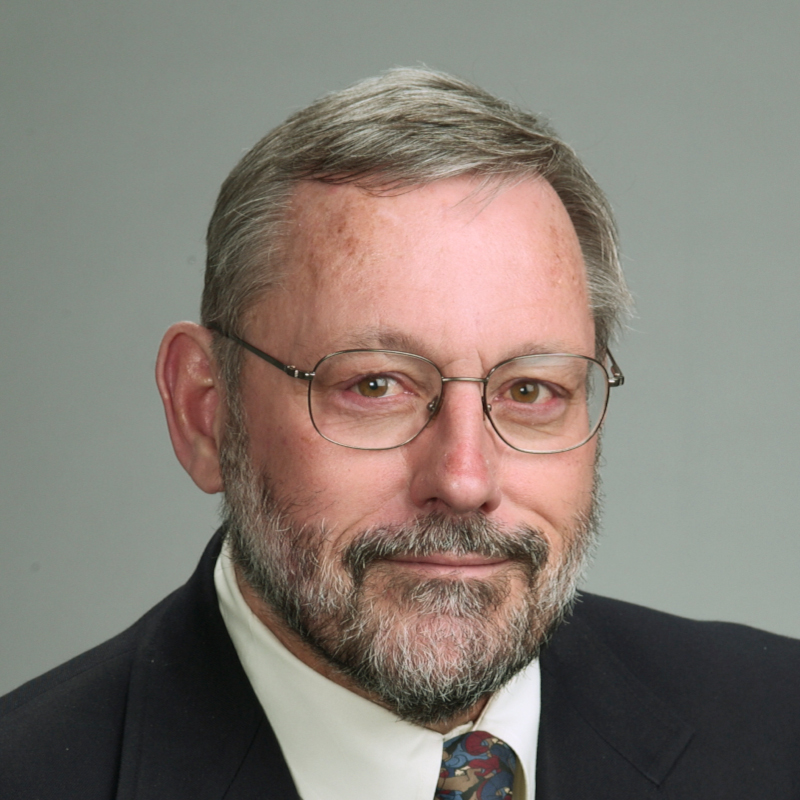
Bob Devaney (1948-2025)
O. Knill , December 19, 2025
Bob Devaney is a legend
in dynamical systems theory. One of the most iconic contributions is his definition of
Deveney Chaos of a topological dynamical system: topological transitivity and a dense
set of periodic points.
Davaney was a student of Stephen Smale
(who is now 95 years old) and Smale is a student of Raoul Bott who died 20 years ago.
[Robert Winters told me at the funeral of
Andy Engelward
last Wednesday about the recent passing of Devaney.
As Robert is a student of Devaney,
and Devaney is as student of Stephen Smale, Devaney is a grand kid of Raoul Bott.
As for building a bracket: Robert Winters once told me that Bott invited some of the other calculus teachers to this
place in on Middle Road in Chilmark on Martha's Vineyard. Robert so was teaching together with his
mathematical grand-grand father. Also a bit just to illustrate how small the world is,
I have met two other students of Devaney at
The Hillerod conference in 1993:
Pau Atela
and Nuria Fagella.]
Mathematically, Devaney was down to earth, working mostly on concrete problems like the three body problem,
linked twist mappings, or the complex dynamics of entire maps. His books sometimes also included computer code.
The Mandelbrot story exploded in the early 1980ies. In the computer labs, people would program things on the
early Apple computers or brag with the book "The fractal geometry of nature" of Mandelbrot. And already 2 years later, the
Duady-Hubbard proof
of the connectivity of the Mandelbrot set was presented by
Jochen Denzler (he called it "das Apfelmännchen") in a Moser pro-seminar which I attended. They were
intense research level seminars, where students presented.
[P.S> I myself presented there a stability theorem of Paul Rabinowitz in multidimensional complex dynamics
(my preparation notes [PDF]
and the notes of Rabinowtz [PDF], I used then.)
Apropos: I learned in November from Wilhelm Klingenberg
(who by the way had been an office room-mate of mine (in this office) when I was a starting
graduate student at ETH) that Dietmar Salomon, a symplectic mathematician, also recently passed away (also relatively young with 72 years,
ETHZ Memorial. Apropos
Symplectic people, also Edi Zehnder died a year earlier in November 84. I
assisted as a grad student several times in Zehnder's functional analysis courses.)
Salomon had been participating in that Moser seminar too.(He was then a FIM visitor and assisted Moser there). Dietmar himself presented about the
dynamics of geodesic flows. Something a bit embarrassing about me: I remember when Moser handed me the Rabinowitz paper (typed on a typewriter with
Moser's handwriting "Rabinowitz" on top, Rabinowitz had been Moser's PhD student), and which was written a few years before the Mandelbrot story,
I complained "Isn't this a bit old-fashioned?" Moser only laughed
and said "No, it is not". And he definitely was right. I think the time of more serious multidimensional complex dynamics
is still to come this century. Devaney's work was very much also in complex dynamics, especially the iteration of entire maps was "his thing".
I my self tried to understand during my thesis the entire map on C4 given by (z,w,u,v) -> (zw exp(z-u),w exp(z-u),uv exp(u-z),v exp(u-z))
(see page 312 in my thesis) as this map contains a one parameter family of 2-tori on which the map induces the standard map!) Sometimes in 1988, I claimed
that one can use the subharmonic technique of Herman (we have an analytic map, analytic cocycles and Lyapunov exponents are pluri subharmonic
as limits of harmonic functions) and to show that the Lyapunov exponent (and so entropy) of the Standard map is positive and gave my proof to Moser.
He overnight found the mistake: The invariant 2-tori in C4 are not boundaries of polydisks! Well, if that would have worked,
this would have been a short 1 page PhD written in a few weeks. I had to pick my brain for many more years in order to earn a thesis.]
One of the most beautiful definitions is "Devaney integrability" which means being transitive and having
a dense set of periodic points.
There are quite many definitions of "chaos" or "integrability" in dynamical systems.
My favorite definition of "chaos" is: a system is "spectrally chaotic" if there exists
an invariant measure for which the spectrum has some absolutely continuous spectrum. A system is
"spectrally integrable" if for all invariant measures, the spectrum has only pure point spectrum.
Generic dynamical systems are neither spectrally chaotic nor spectrally chaotic as their spectrum
is singular continuous. For Hamiltonian systems, my favorite definition of chaos is "positive metric
entropy" and integrability still that all invariant measures have pure point spectrum.
Devaney's work had been important to me from the beginning. When I wrote
my senior thesis
at the ETHZ under the guidance of Juergen Moser about the Stoermer problem, the
literature list there
listed work of Devaney 5 times. Other important references for me in that area had been
Martin Braun and Alex Dragt and Maciej Wojtkowski.
I myself saw Devaney only once in person, when he gave one his
1000 talks (source: vita).
The talk I was fortunate to see took place on February 1998 at the
university of Texas. It was great to see a dynamical systems legend in person.
And here is the
Obituary.
"Bob Devaney" appears currently in google searches not first. There was a college football coach (1915-1997) with the same name
who appears first. I guess that within a few decades this will change. In the long term, mathematicians are remembered longer
than sports celebrities.
Posted: December 20, 2025