Next: Discussion and open problems
Up: Cellular automata with almost
Previous: A one-dimensional example: rule
The Game of Life.
The most famous two dimensional automata and probably the best known
automaton at all is Conway's Game of Life.
Simulations with random initial conditions (giving
probability p for a living cell) and lattices of sizes up
to L=1100 were performed in
[30, 8]. In the time interval of order  ,
large fluctuations of the observables were measured,
in the time interval from
,
large fluctuations of the observables were measured,
in the time interval from  , a scaling region with
power law behavior reaching a steady state region starting from
, a scaling region with
power law behavior reaching a steady state region starting from  .
Whatever boundary conditions has been taken
in those experiments (probably periodic boundary conditions),
they play a crucial role for the the number of time steps
(
.
Whatever boundary conditions has been taken
in those experiments (probably periodic boundary conditions),
they play a crucial role for the the number of time steps
(  10000) performed in those experiments.
In [1] the Game of Life was claimed to show `self-organized
criticality', but this claim was dismissed in [2] as
an artefact of small lattice sizes.
It would be interesting to repeat these experiments with subshifts
with irrational
10000) performed in those experiments.
In [1] the Game of Life was claimed to show `self-organized
criticality', but this claim was dismissed in [2] as
an artefact of small lattice sizes.
It would be interesting to repeat these experiments with subshifts
with irrational  , which eliminates dependence on boundary
conditions, or with a sequence of rational 's to investigate
the importance of the lattice size.
, which eliminates dependence on boundary
conditions, or with a sequence of rational 's to investigate
the importance of the lattice size.
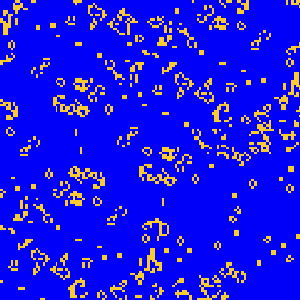
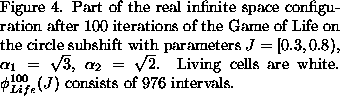
We made some runs with Life starting with
a circle-shift initial condition given by one interval or two asymmetric
intervals. See animated almost periodic life
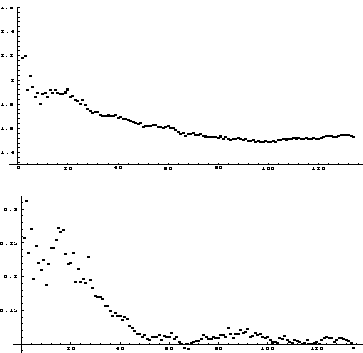
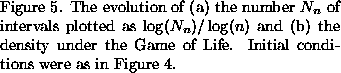
It seems that the number of intervals grows slower than quadratically if the
evolution does not become time periodic.
Lattice gas automata.
Lattice gas automata are cellular automata that model particles moving
on a lattice. They can be used to study fluid flows.
Perhaps the simplest lattice gas automaton is the
HPP-model of Hardy, Pazzis and Pomeau [14, 13].
It is a deterministic, two-dimensional cellular automaton.
Numerically it shows relaxation to equilibrium.
Another two-dimensional model of interest is the hexagonal model
of Frisch, Hasslacher and Pomeau [6, 15].
This, however, is a non-deterministic cellular automaton.
Three dimensional lattice gas automata have also been considered.
For a review of lattice gas automata, see [15].
An extensive annotated bibliography of literature on
lattice gas automata (deterministic and non-deterministic) is [9].
We mainly consider the HPP model.
In the HPP model particles move on  along the directions
of the coordinate axes.
They all move at the same speed: one step per unit of time.
The only interaction is when exactly two particles meet at a lattice point
in a head-on collision (if three or four particles meet they do
not interact).
After a head-on collision, particles depart in opposite directions
perpendicular to the axis along which they moved before the
collision.
There can be up to four paricles on a lattice site, but
at each lattice site there is at most one particle moving in
each of the four directions
along the directions
of the coordinate axes.
They all move at the same speed: one step per unit of time.
The only interaction is when exactly two particles meet at a lattice point
in a head-on collision (if three or four particles meet they do
not interact).
After a head-on collision, particles depart in opposite directions
perpendicular to the axis along which they moved before the
collision.
There can be up to four paricles on a lattice site, but
at each lattice site there is at most one particle moving in
each of the four directions  , where
  denote the standard orthonormal basis vectors in .
The HPP model can be implemented as a cellular automaton acting
on circle subshifts in the following way.
There are 16 possible configurations at each point of the lattice,
since one has to specify whether or not there is a particle
moving in each of the directions .
This can be done by a vector  ,
where
,
where  if there is particle moving in, respectively
the direction
if there is particle moving in, respectively
the direction  .
So the circle subshifts are now subshifts of the full shift over
16 symbols.
Since
.
So the circle subshifts are now subshifts of the full shift over
16 symbols.
Since  (the configuration at n after one
time step) only depends on
(the configuration at n after one
time step) only depends on  and
and  ,
one can write
,
one can write

where P is the permutation of  that implements
the interaction in that it exchanges
(1,0,1,0) and (0,1,0,1).
In words: to get the velocity distribution at the cell
n in the next time step we let evolve the particles of the four
nearest neighbors that have velocities towards n
and then we take care of possible head-on collisions.
that implements
the interaction in that it exchanges
(1,0,1,0) and (0,1,0,1).
In words: to get the velocity distribution at the cell
n in the next time step we let evolve the particles of the four
nearest neighbors that have velocities towards n
and then we take care of possible head-on collisions.
The model can obviously be extended to incorporate collisions
with obstacles so that we simulate a fluid in an almost periodic porous
medium.
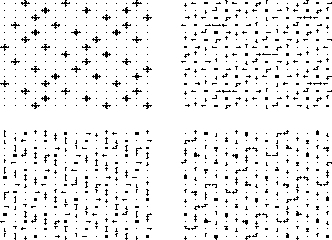
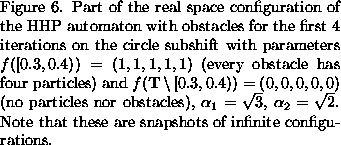
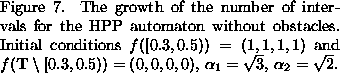
Figure 6 shows the first few steps of the evolution
of part of the real space configuration defined by a circle subshift.
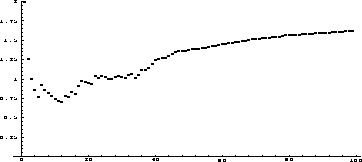
The number of intervals grows slower than quadratically (see Figure 7).
Automata with obstacles are of interest because lattice gas automata are
used specifically to model fluid flow in complex geometries.
For the implementation we take the alphabet  ,
where the fifth bit describes whether or not there is an obstacle
at that point. It is convenient to think an obstacle as a particle
with zero velocity and infinite mass.
The cellular automata rule is then changed so that
particles are reflected at the obstacles.
,
where the fifth bit describes whether or not there is an obstacle
at that point. It is convenient to think an obstacle as a particle
with zero velocity and infinite mass.
The cellular automata rule is then changed so that
particles are reflected at the obstacles.
The distribution of the obstacles in is
determined by a finite union of half open intervals  and the two irrational rotation
  .
For every
.
For every  the obstacles are in

A connected component of O is called a cluster.
Circle subshifts have been studied as a model of
dependent percolation in
[25, 26], for the
case that J consists of one interval.
It was found that (for given frequencies) there are three regimes
(depending on the length of the interval): no infinite cluster,
infinitely many infinite clusters (parallel `strips')
and a unique infinite cluster.
If there is no infinite cluster for the complement of  ,
all particles are
trapped in `chambers' and the time evolution becomes periodic.
,
all particles are
trapped in `chambers' and the time evolution becomes periodic.

Begin of the proof.
The motion of finitely many particles in a bounded chamber
is periodic since the map  is deterministic and because
there are only finitely many states. Moreover, there is a bound on the
possible periods depending on the size of the chamber.
There is a global bound on the size of chambers (argument in
Lemma 4.3 of [26]).
We have therefore only finitely many
different chambers and hence finitely many periods.
The smallest common multiple of all the periods for
all chambers is the period of the cellular automaton.
is deterministic and because
there are only finitely many states. Moreover, there is a bound on the
possible periods depending on the size of the chamber.
There is a global bound on the size of chambers (argument in
Lemma 4.3 of [26]).
We have therefore only finitely many
different chambers and hence finitely many periods.
The smallest common multiple of all the periods for
all chambers is the period of the cellular automaton.
End of the proof.
We have also implemented the hexagonal model (with and without
obstacles), a three dimensional HPP model and a HPP
model with mirrors (cf. [3]).
The programs are available at mathsource@wri.com.


Next: Discussion and open problems
Up: Cellular automata with almost
Previous: A one-dimensional example: rule
Oliver Knill
Fri Jun 26 16:29:39 CDT 1998