


|
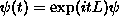 of
the quantum evolution can be determined efficiently.
Even for a bounded operator L, the computation of
of
the quantum evolution can be determined efficiently.
Even for a bounded operator L, the computation of  can become tremendous; in higher dimensions
it is a task for super computers (e.g. [23]).
can become tremendous; in higher dimensions
it is a task for super computers (e.g. [23]).
Many properties of the orbit  are determined by the spectral measures
 which are probability measures on the real line. Dynamical
properties of the system depend on the nature of the spectral measure because
the Fourier transform of is
which are probability measures on the real line. Dynamical
properties of the system depend on the nature of the spectral measure because
the Fourier transform of is
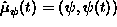 . For
example, a Hamiltonian L with absolutely continuous spectrum leads by
the Rieman-Lebesgue lemma
to the transient behavior
. For
example, a Hamiltonian L with absolutely continuous spectrum leads by
the Rieman-Lebesgue lemma
to the transient behavior  . On the other hand, if
an operator L has purely discrete spectrum, then
. On the other hand, if
an operator L has purely discrete spectrum, then  is almost periodic a fact which is responsible for recurrent behavior of the
dynamics.
is almost periodic a fact which is responsible for recurrent behavior of the
dynamics.
In this note, we use the fact that it is often irrelevant, whether we
evolve with the Hamiltonian L or if we use a deformed Hamiltonian f(L), where
f is an invertible smooth real function. The reason is that the spectral
measures of f(L) are only distorted versions of the spectral measures of L.
It is therefore natural, to look for a function f such that the discrete
time step  can be easily computed. Properties of the spectrum,
which are unchanged by a replacement
can be easily computed. Properties of the spectrum,
which are unchanged by a replacement  can now be determined faster
through numerical experiments because iterating a map is more simple than
integrating a differential equation.
can now be determined faster
through numerical experiments because iterating a map is more simple than
integrating a differential equation.
If 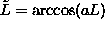 where L has been rescaled such that aL
has norm smaller or equal to 1, the
time evolution can be computed by iterating the map
where L has been rescaled such that aL
has norm smaller or equal to 1, the
time evolution can be computed by iterating the map
 on
on  .
This is the time one map for the unitary evolution
of
.
This is the time one map for the unitary evolution
of  . This allows an efficient determination of the Fourier coefficients
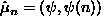 with
with  of measures on the circle, which
determine the spectral measures
of measures on the circle, which
determine the spectral measures  of L.
Some properties of the quantum evolution are not affected by the change
of L.
Some properties of the quantum evolution are not affected by the change
 because the spectral measures
  of
and the spectral measure
of
and the spectral measure  of L are related by
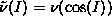 for every interval I.
One possibility to test for discrete spectrum of an operator is to
determine numerically the Wiener averages
 .
We illustrate this method for a tight binding model of an
electron in a constant or random magnetic field in the plane. For random
magnetic fields, where the existence of point spectrum is not known,
we made numerical experiments on a grid of size up to
.
We illustrate this method for a tight binding model of an
electron in a constant or random magnetic field in the plane. For random
magnetic fields, where the existence of point spectrum is not known,
we made numerical experiments on a grid of size up to  .
.
We also illustrate the theoretical usefulness of the discrete time evolution by
providing a relation between quantum mechanical return probabilities
of the generator for a random walk on a graph and the return probability
of the classical random walk on a graph:
continuity properties of spectral measures
with respect to the  -dimensional Hausdorff measures are related
to power-law decays of averaged return probabilities of the random walk.
-dimensional Hausdorff measures are related
to power-law decays of averaged return probabilities of the random walk.