


|
 needs a numerical integration like
 ,
where n is so large that
,
where n is so large that  is smaller than the
desired accuracy
is smaller than the
desired accuracy  .
Any such truncation produces high-frequency noise after a relatively
small number of time steps.
An other method used in quantum dynamics is to diagonalize
a finite dimensional approximation
.
Any such truncation produces high-frequency noise after a relatively
small number of time steps.
An other method used in quantum dynamics is to diagonalize
a finite dimensional approximation  of L and to
evolve its eigenfunctions (see for example [14]).
It is quantitatively not clear, how well a finite dimensional
Galerkin cut-off respects the actual dynamics. Moreover,
in dimension d, the number of grid points N has to be so small that
an eigensystem of a
of L and to
evolve its eigenfunctions (see for example [14]).
It is quantitatively not clear, how well a finite dimensional
Galerkin cut-off respects the actual dynamics. Moreover,
in dimension d, the number of grid points N has to be so small that
an eigensystem of a  matrix can be found.
While numerical approximations of are not unitary, the evolution
(2.1) is conjugated to a unitary evolution.
Other discrete unitary time evolutions have been considered in [4].
The problem to preserve unitarity is similar to
numerical integration problems for ODE's, where for example symplecticity
should be preserved during the discretisation of a Hamiltonian system.
If  has compact support, then
  has this property too.
This leads to a finite propagation speed as in a relativistic set-up.
This fact has computational advantages. For example, we know exactly,
after which time, boundary effects begin to influence the value of a wave at
some point.
has this property too.
This leads to a finite propagation speed as in a relativistic set-up.
This fact has computational advantages. For example, we know exactly,
after which time, boundary effects begin to influence the value of a wave at
some point.
The discrete evolution preserves the (not necessarily closed)
algebraic field in which L is defined.
For example, if L is an operator defined over the rationals  and if the coordinates of are rational, then
  is rational and
 can be determined exactly.
The evolution (2.1) can be defined on all bounded sequences
 and not
only on
and not
only on  . For example, the evolution leaves almost periodic
configurations invariant, elements
. For example, the evolution leaves almost periodic
configurations invariant, elements  , for which
the closure of all translated sequences
, for which
the closure of all translated sequences  is compact in the uniform topology
  ).
This is useful, because solutions of (2.1) define generalized
eigenfunctions
).
This is useful, because solutions of (2.1) define generalized
eigenfunctions  of an operator K defined on space-time.
The unitary operator V=- i U solves 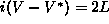 which is a discretisation of the
Schrödinger equation
which is a discretisation of the
Schrödinger equation  . Since
 , the evolutions U and V are essentially the same.
The discrete evolution
, the evolutions U and V are essentially the same.
The discrete evolution  is a second order approximation
to
is a second order approximation
to  in the sense that
  and
and  agree up to second order. This second order approximation is
more efficient than the second order but computationally more expensive
Cayley method
agree up to second order. This second order approximation is
more efficient than the second order but computationally more expensive
Cayley method
