 between the velocity direction
and the tangent at the point T(s).
between the velocity direction
and the tangent at the point T(s).
|
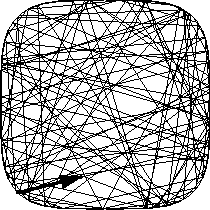
In contrast from the real billiard game, where relatively short orbits
are considered and other factors like the spin of the ball are relevant,
the more academic
Birkhoff billiard deals with trajectories of arbitrary length,
hitting the boundary according to the precise law of reflection.
An orbit is determined by the starting point T(s)
of the table and the angle between the velocity direction
and the tangent at the point T(s).
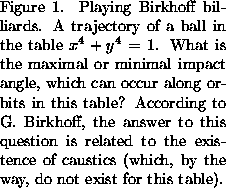
If we shoot a billiard ball and follow the individual angles of impact,
it is natural to ask what is the minimal or maximal angle which occurs
along an orbit.
Is it possible to shoot in such a way that a ball hits the boundary in
the future with angles arbitrarily close to 0 and at other times with
angles arbitrarily close to  ?
?
|
|
Birkhoff realized that such an orbit does not exist
if and only if there is a continuous invariant curve
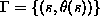 in the phase space of all pairs
  . Such an invariant curve
 in the phase space
is associated to a caustic
in the phase space
is associated to a caustic  in the interior of the table.
The curve has the property that
if the path of a ball has a tangency
at , then also the reflected path
has a tangency at .
in the interior of the table.
The curve has the property that
if the path of a ball has a tangency
at , then also the reflected path
has a tangency at .
An aim of our article is to look closer at the geometry of caustics
and to illustrate the story with some pictures. By relating the caustics of a
class of billiards with differential geometrical caustics, we will see that this
subject is of more general interest. Differential geometric caustics are
relevant in applied sciences including observational
astronomy and earthquake science: assume that a light source is switched on
in a nonhomogeneous or nonflat medium or assume that
an earthquake starts at its epicenter.
The set of points which are reached by the light or the sound wave after a
given time is called a wave front. For small times, such a wave front
is diffeomorphic to a sphere. If the medium is not homogeneous or not flat,
these spheres become more and more deformed as time increases and there
will be in general points where the front ceases to be an immersed surface,
for example points where different parts of the front selfintersect.
The set of all points, where the immersion fails, is called the caustic of the
light or acoustic source. As we will illustrate,
there can be relations between differential geometric caustics and caustics in
billiards.
Our story, which begins in the next section can be read first in the fast lane by following the text to the figures.
Next: Convex billiard tables Up: On nonconvex caustics of Previous: On nonconvex caustics of
Oliver Knill