Next: Appendix: Is there a
Up: On nonconvex caustics of
Previous: Are there examples of
A three-dimensional Birkhoff billiard is defined by
a differentiable convex surface R in  .
The return map to the boundary defines a map
.
The return map to the boundary defines a map  on a
four-dimensional manifold
on a
four-dimensional manifold  :
two successive impact points
:
two successive impact points  define the next pair
 . Caustics for such billiards do not exist
[3] [12].
One can consider however differential geometric caustics of three-dimensional
billiards which are defined through the wave front (see Figure 16).
We now illustrate this in the case of a surface of equal thickness.
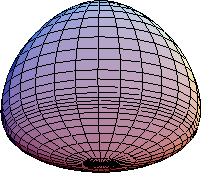
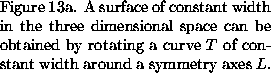
Take a curve T of constant width in the x-z plane in .
Assume that T is reflection symmetric with
respect to the z-axes L. If we rotate T around L,
we obtain a surface R of revolution which is at the same time a surface
of constant width (see [6]).
A billiard trajectory orthogonal to a point P of R intersects
the surface R a second time orthogonally. It corresponds to a
2-periodic orbit of the return map .
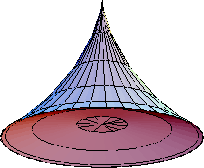
By symmetry, a two-dimensional differential geometrical
caustic of a three-dimensional billiard is obtained
by rotating the caustic
. Caustics for such billiards do not exist
[3] [12].
One can consider however differential geometric caustics of three-dimensional
billiards which are defined through the wave front (see Figure 16).
We now illustrate this in the case of a surface of equal thickness.
Take a curve T of constant width in the x-z plane in .
Assume that T is reflection symmetric with
respect to the z-axes L. If we rotate T around L,
we obtain a surface R of revolution which is at the same time a surface
of constant width (see [6]).
A billiard trajectory orthogonal to a point P of R intersects
the surface R a second time orthogonally. It corresponds to a
2-periodic orbit of the return map .
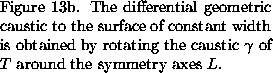
By symmetry, a two-dimensional differential geometrical
caustic of a three-dimensional billiard is obtained
by rotating the caustic  of T around L.
The symmetry of the surface of revolution leads to a billiard map
which has an angular momentum integral I.
One has to understand the dynamics of on
three-dimensional leaves I=const.
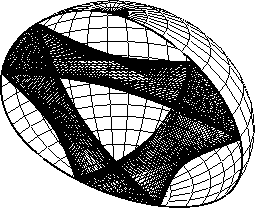
When the angular momentum is zero, an orbit
moves in a plane through the rotation axis L.
The three-dimensional zero angular momentum leaf is
foliated by two-dimensional invariant manifolds on which the dynamics is
the two-dimensional billiard map (see Figure 14).
Having a two-dimensional Birkhoff billiard as a subsystem of the three-
dimensional billiard implies the
existence of many periodic orbits, more than are known to exist in
general [2].
Also, by the variational theorem in ergodic theory, the
topological entropy of the three-dimensional billiard map is bounded below by
the topological entropy of the two-dimensional billiard.
It would be interesting to know
more about the dynamics of on a nonzero angular momentum leaf.
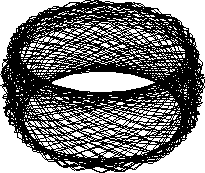
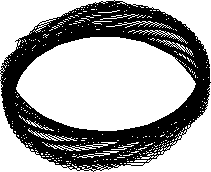
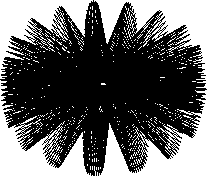
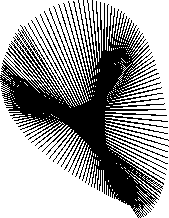
Figure 15 shows some typical numerically computed trajectories.
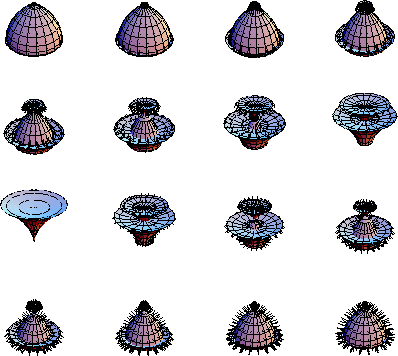
Figure 16. The standard Legendre collapse of a wave front moving
from a surface of revolution of constant width. Two-dimensional
sections of this collapse are shown in Figure 11a. The surface
turns inside out during this collapse as can be seen by the arrows
which point inside the surface at the beginning and outside at the end.
Differing from the famous movie, this "turning the sphere inside out"
is not smooth: the smoothness fails on points of the caustic.
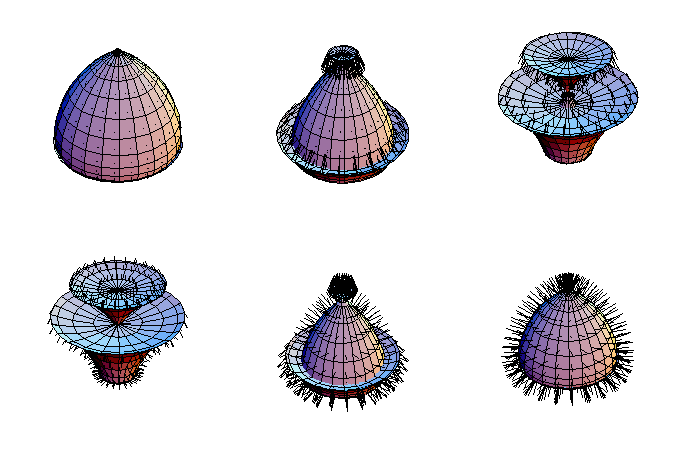 |
Movie (250 K Gif movie) of the Standard collapse.
|
Next: Appendix: Is there a
Up: On nonconvex caustics of
Previous: Are there examples of
Oliver Knill
Fri Jun 12 13:34:37 CDT 1998