Next: Invariant curves and topological
Up: Billiards in the unit
Previous: Numerical computation of orbits
According to Poincaré Birkhoff's theorem, there exists for each pair
(p,q) with p;SPMgt;1 and  and 0;SPMlt;q/p;SPMlt;1 a periodic orbit of
period p which winds around the table q times. These periodic
orbits are called Birkhoff periodic orbits. In general, there exist
many more orbits of period p. It is an open question whether the
set of periodic orbits can form a set of positive Lebesgue measure in
the phase space. There exist some results for small periods
[20, 19]. We cannot
decide this question for our case.
and 0;SPMlt;q/p;SPMlt;1 a periodic orbit of
period p which winds around the table q times. These periodic
orbits are called Birkhoff periodic orbits. In general, there exist
many more orbits of period p. It is an open question whether the
set of periodic orbits can form a set of positive Lebesgue measure in
the phase space. There exist some results for small periods
[20, 19]. We cannot
decide this question for our case.
Even if the set of periodic orbits forms a set of zero Lebesgue measure,
they still generally have a significant
influence on the global phase space picture. A stable
periodic orbit keeps a whole neighborhood nearby stable, which prevents
ergodicity. A first step in understanding the stability of the orbits
is finding out whether they are linear stable.
The stability of periodic orbits of small order can be decided
by hand. We will treat orbits
of period 2 and 4.

Proof.
Look at an orbit of period 2 hitting the table at points
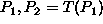 with
curvatures
with
curvatures  and
and  and let l
be the distance between the two points.
A computation of the trace
and let l
be the distance between the two points.
A computation of the trace  of the Jacobean of
  (see Proposition 4 of [22] or
Proposition 3 of [23]) shows that the orbit
is elliptic if and only if
(see Proposition 4 of [22] or
Proposition 3 of [23]) shows that the orbit
is elliptic if and only if
 or
or  .
.
Consider a 2-orbit of length  , that meets the billiard
table at points with radii of curvature
, that meets the billiard
table at points with radii of curvature  and
and  , with
 . If one of the inequalities
 or
or  is satisfied, then the
orbit is hyperbolic, while if either
is satisfied, then the
orbit is hyperbolic, while if either  or
or 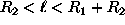 is satisfied, the orbit is elliptic.
For our 2-orbits,
is satisfied, the orbit is elliptic.
For our 2-orbits,  , so we get elliptic
orbits when
, so we get elliptic
orbits when  and hyperbolic orbits when
  .
.
We look first at the horizontal 2-orbit  . The vertical 2-orbit
is obviously identical to the horizontal one. The horizontal orbit has
length 2. The curvature at the endpoints is
. The vertical 2-orbit
is obviously identical to the horizontal one. The horizontal orbit has
length 2. The curvature at the endpoints is  , 1, and 0 for
 , respectively. This gives radii of
curvature of 0, 1, and for ,
respectively. For
, respectively. This gives radii of
curvature of 0, 1, and for ,
respectively. For  and the orbit is hyperbolic. And for
  , and
the orbit is elliptic. So the horizontal orbit is hyperbolic if p;SPMlt;2 and
elliptic if p;SPMgt;2.
The diagonal orbit has
, and
the orbit is elliptic. So the horizontal orbit is hyperbolic if p;SPMlt;2 and
elliptic if p;SPMgt;2.
The diagonal orbit has  . The curvature at the
endpoints is
. The curvature at the
endpoints is 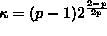 . The radius
of curvature is then
. The radius
of curvature is then  . The
orbit is elliptic if , or
. The
orbit is elliptic if , or

Multiplying both sides by  , we get
 , which means p;SPMlt;2. So the diagonal 2-orbit is elliptic
if p;SPMlt;2. Similarly, the
diagonal 2-orbit is hyperbolic if p;SPMgt;2.
, which means p;SPMlt;2. So the diagonal 2-orbit is elliptic
if p;SPMlt;2. Similarly, the
diagonal 2-orbit is hyperbolic if p;SPMgt;2.
End of the proof.

Proof.
We calculate the Hessian for  . Let
. Let  be the
central angle for the
be the
central angle for the  point of the orbit,
  be
the angle between the path of the particle leaving the
be
the angle between the path of the particle leaving the  point and the directed tangent to the p-curve at that point.
 gives the distance of the straight line
connecting the points given by and
gives the distance of the straight line
connecting the points given by and  , and
, and
 is the curvature at the point. The Hessian is then
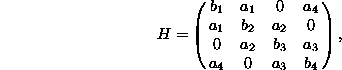
with

In our case we have by symmetry  and all of the
  .
The determinant
of the Hessian then simplifies to
.
The determinant
of the Hessian then simplifies to
 . Define
 .
The orbit is hyperbolic if D;SPMgt;2 and
and elliptic if D;SPMlt; 2 (see [22]). For the
symmetric 4-orbits we have
.
The orbit is hyperbolic if D;SPMgt;2 and
and elliptic if D;SPMlt; 2 (see [22]). For the
symmetric 4-orbits we have

First look at the -orbit. We get with  ,
and
,
and  , so that

We have already calculated  at these points, so we get


So we get that the -orbit is hyperbolic for p;SPMlt;2 and parabolic
for  . (Numerical experimentation suggests that the -orbit
is stable for p;SPMgt;2).
. (Numerical experimentation suggests that the -orbit
is stable for p;SPMgt;2).
For the orbit  , all four points have
  .
We then calculate
.
We then calculate

and

The  -orbit is elliptic if
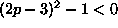 and
and  .
So the orbit is elliptic if 1;SPMlt;p;SPMlt;2 and
hyperbolic for p;SPMgt;2.
.
So the orbit is elliptic if 1;SPMlt;p;SPMlt;2 and
hyperbolic for p;SPMgt;2.
End of the proof.
Next: Invariant curves and topological
Up: Billiards in the unit
Previous: Numerical computation of orbits
Oliver Knill, Jul 10 1998