On taste in mathematics
Update October 14, 2022:
There was a discussion in
this blog about the question whether machines can have good mathematical taste.
It is maybe easier to say what is bad taste than good taste. Bad taste for example is just
following a brute force path. It is also maybe easier to define what is bad taste notation
and what is good taste. Here is an example:
On bad taste
I got the following question. Mathematical notation is very much a matter of taste
but this is related to clarity. Here is a mouthful of a mathematical statement
which looks like an interesting result:
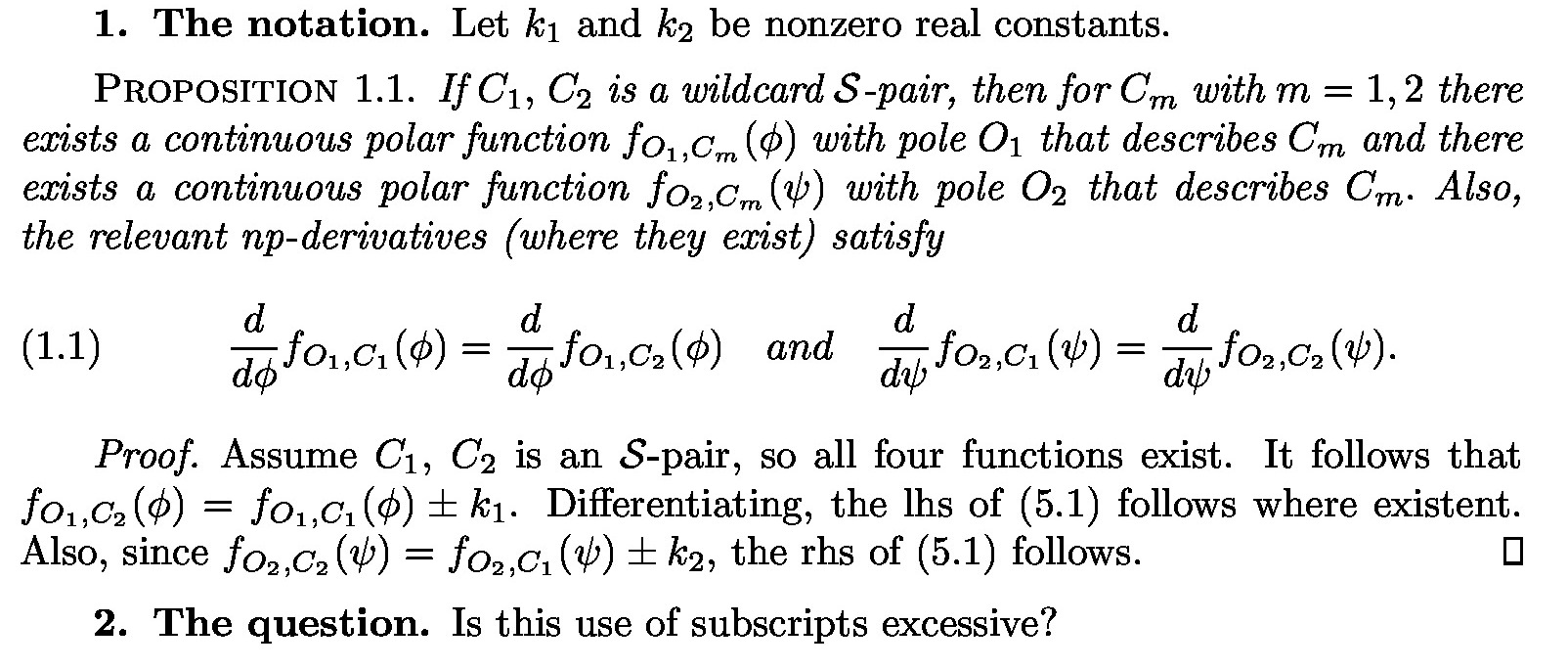 My Answer:
It is not wrong but not necessary in this case. If the situation is later done with more
objects C_m and not only with two, it could make sense to introduce subscripts. It seems however
that the statement says that if f(x,y,t) centered at (x,y) is a polar function
of an angle t that describes the ``first wildcard" and g(x,y,t) centered at (x,y)
is a polar function of t that describes the ``second wildcard", then the partial derivatives
satisfy f_t = g_t independent of the center (x,y). The proof seems to use that
f(t,x,y) = g(t,x,y)+ k(x,y) for a function k(x,y) which does not depend on t.
Proposition 1.1 follows from this assumption.
The proposition mathematically just expresses that if two functions of
several variables differ by a function which does not contain the variable t,
then their partial derivatives with respect to t are the same.
The statement does not only use excessive scripts, it also dresses up
something completely obvious as a proposition. There is nothing wrong, but
just bad taste.
Oliver Knill
Posted: September 22, 2022