|
A
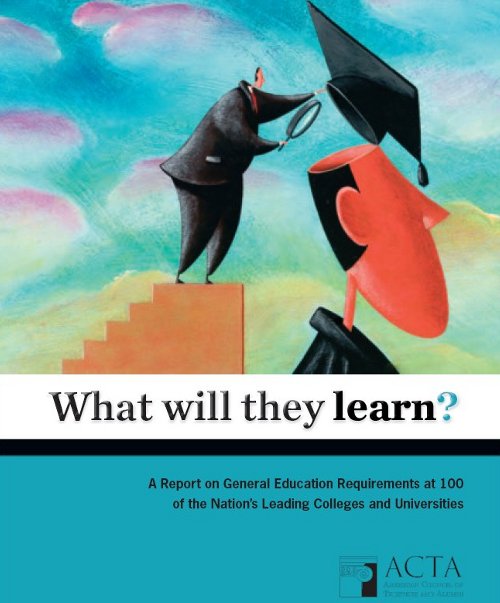
report [PDF] on the general education requirements at 100 of the
Nation's Leading Colleges and Universities by the American Council of
Trustees and Alumni (ACTA) had been discussed
by Stanley Fish
in the New York Times, mainly focusing on the writing abilities. Here
are some citations from this report which concern mathematics or Harvard.
From the introduction of the report:
"What we found is alarming. Even as our students need broad-based skills and
knowledge to succeed in the global marketplace, our colleges and universities are
failing to deliver. Topics like U.S. government or history, literature, mathematics,
and economics have become mere options on far too many campuses. Not
surprisingly, students are graduating with great gaps in their knowledge-and
employers are noticing. If not remedied, this will have significant consequences
for U.S. competitiveness and innovation.
Higher education used to uphold academic standards against outside pressure. Today, however, the pressure to dumb things down often comes from inside. As a consequence, we now have what former University of Chicago president Robert Maynard Hutchins called "education by the adding machine," where academics refuse to decide what is important, leaving students to fend for themselves. But education cannot be left to chance." |
|
A citation about Mathematics on page 21:
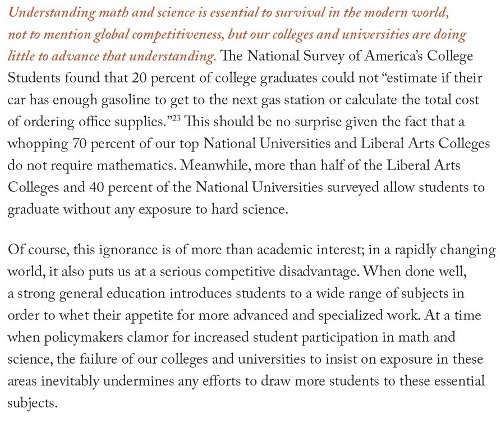
"Understanding math and science is essential to survival in the modern
world, not to mention global competitiveness, but our colleges and
universities are doing little to advance that understanding. The National
Survey of America's College Students found that 20 percent of college
graduates could not "estimate if their car has enough gasoline to get
to the next gas station or calculate the total cost of ordering office
supplies." This should be no surprise given the fact that a whopping
70 percent of our top National Universities and Liberal Arts Colleges
do not require mathematics. Meanwhile, more than half of the Liberal
Arts Colleges and 40 percent of the National Universities surveyed allow
students to graduate without any exposure to hard science.
Of course, this ignorance is of more than academic interest; in a rapidly changing world, it also puts us at a serious competitive disadvantage. When done well, a strong general education introduces students to a wide range of subjects in order to whet their appetite for more advanced and specialized work. At a time when policymakers clamor for increased student participation in math and science, the failure of our colleges and universities to insist on exposure in these areas inevitably undermines any efforts to draw more students to these essential subjects." |
|
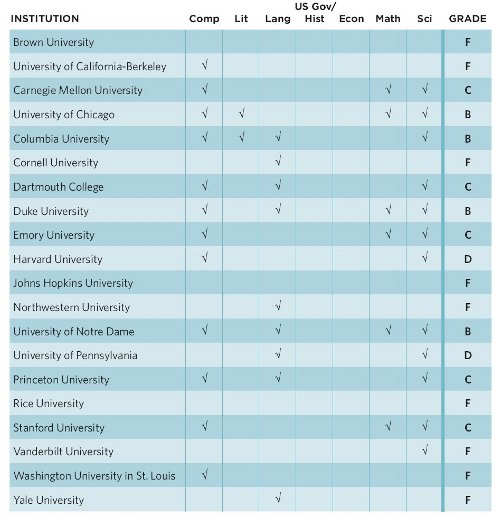
100 colleges and universities are ranked on a scale from A to F based on whether
students are required to take courses in seven key areas - composition,
literature, foreign language, U.S. government or history, economics,
mathematics and natural or physical science.
A citation about Harvard on Page 34:
"Harvard University: No credit given for Foreign Language because only one
year of a language is required. No credit given for U.S. Government or History
because the United States in the World requirement is made up of niche
courses. No credit given for Mathematics because courses with little college level
math content-such as "Fat Chance," a course billed in its description as
"not mathematically demanding"-may be used to fulfill the Empirical and
Mathematical Reasoning requirement."
Comment: The judgment on the Harvard situation might be too premature since the GenEd change just starts to be
implemented here and the judgment is based on course description. In the core curriculum
(the predecessor of GenEd), the corresponding course had been quite demanding. |