Here is the study and the citations of the
article:
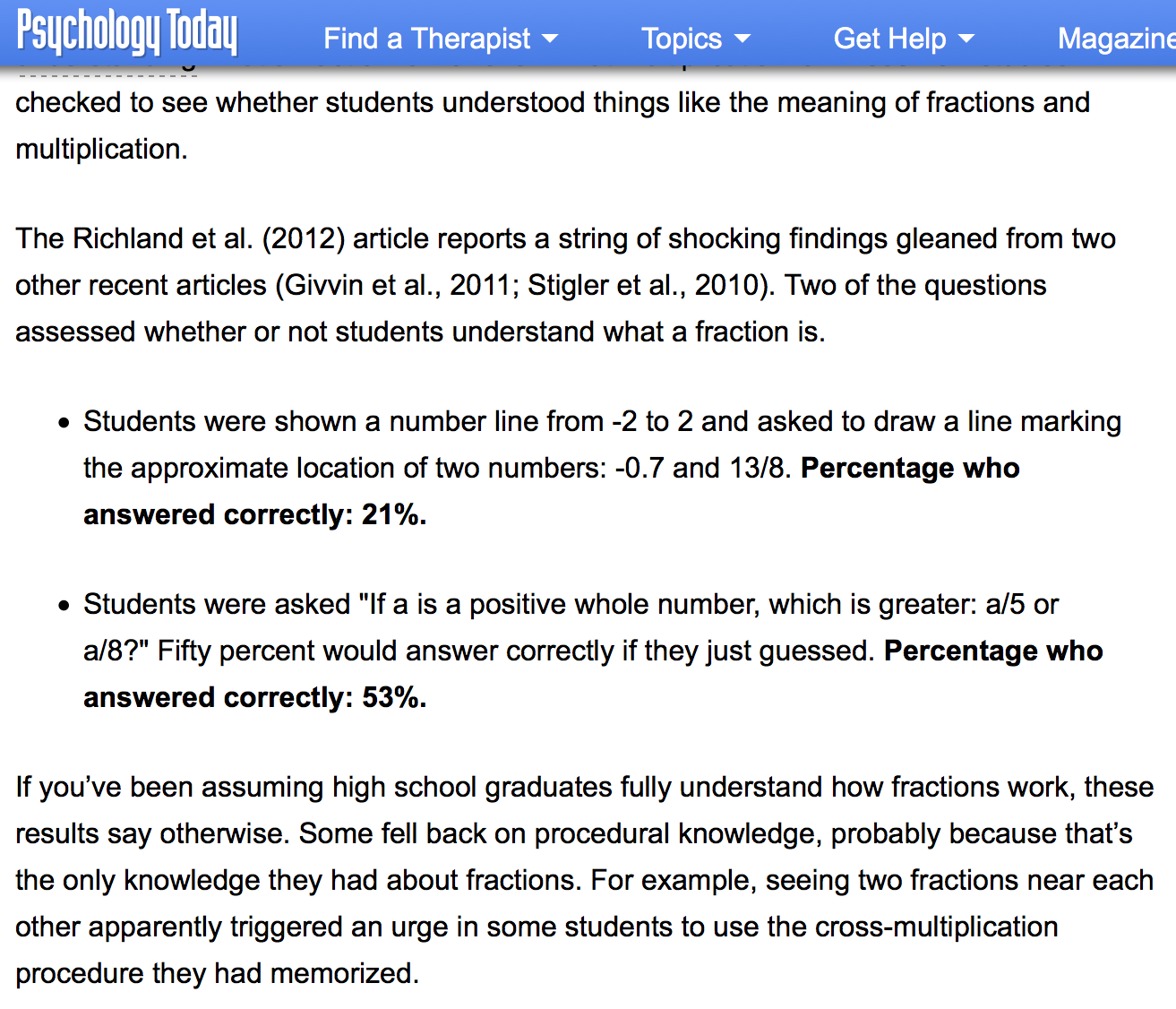
 The Richland et al. (2012) article reports a string of shocking
findings gleaned from two other recent articles (Givvin et al., 2011;
Stigler et al., 2010). Two of the questions assessed whether or not
students understand what a fraction is.

    Students were shown a number line from -2 to 2 and asked to draw a
    line marking the approximate location of two numbers: -0.7 and 13/8.
        Percentage who answered correctly: 21%.

    Students were asked "If a is a positive whole number, which is
    greater: a/5 or a/8?" Fifty percent would answer correctly if they
    just guessed. Percentage who answered correctly: 53%.

If you've been assuming high school graduates fully understand how
fractions work, these results say otherwise. Some fell back on procedural
knowledge, probably because that's the only knowledge they had about
fractions. For example, seeing two fractions near each other apparently
triggered an urge in some students to use the cross-multiplication
procedure they had memorized.

Hiebert, J. C., & Grouws, D. A. (2007). The effects of classroom
mathematics teaching on students learning.  In F. K. Lester, Jr. (Ed.),
Second handbook of research on mathematics teaching and learning
(Vol. 1, pp. 371-404). New York, NY: Information Age.  Givvin, K. B.,
Stigler, J. W., & Thompson, B. J. (2011). What community college
developmental mathematics students understand about mathematics, Part
II: The interviews. The MathAMATYC Educator, 2(3), 4-18.  Richland,
L. E., Stigler, J. W., & Holyoak, K. J. (2012). Teaching the conceptual
structure of mathematics. Educational Psychologist, 47(3), 189-203.
Stigler, J. W., Givvin, K. B., & Thompson, B. (2010). What community
college developmental mathematics students understand about mathematics.
The MathAMATYC Educator, 10, 4-16
Document history:
- December 20 2015, put first online, December 28 2015: added the escalator riddle