Feb 4 2026: About the Birch and Swinnerton-Dyer Conjecture
Oliver Knill, February 6, 2026
The Talk
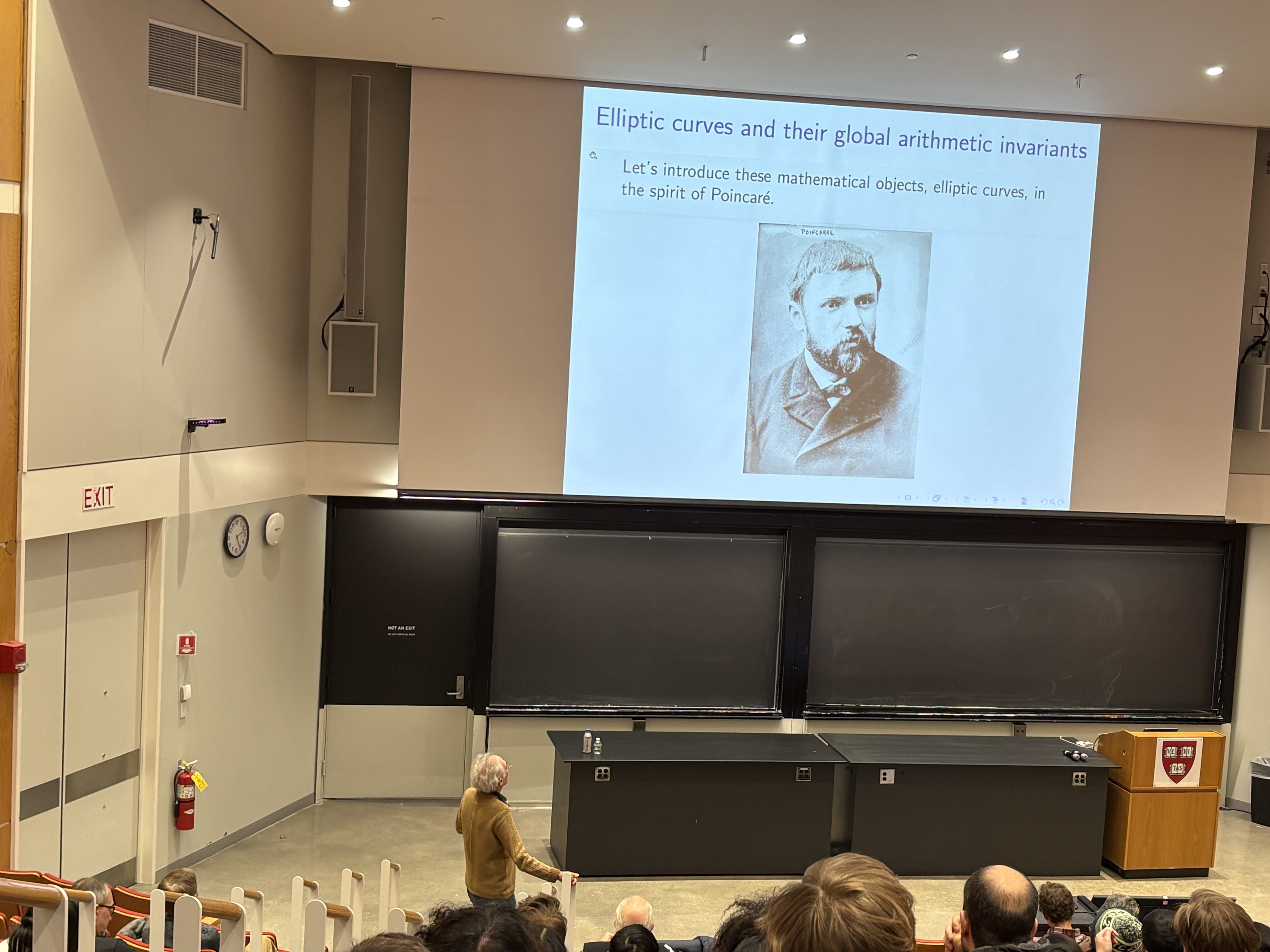
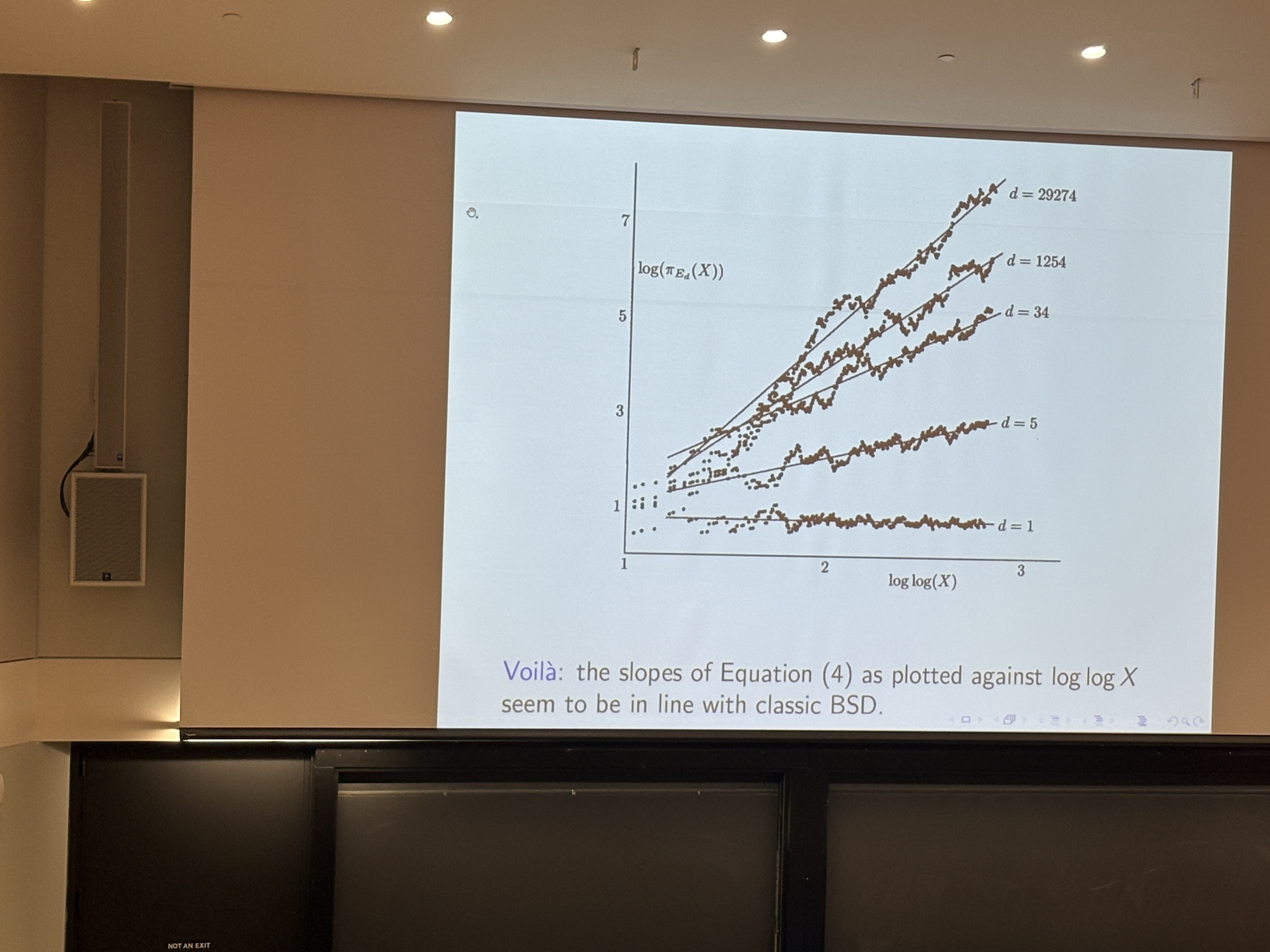
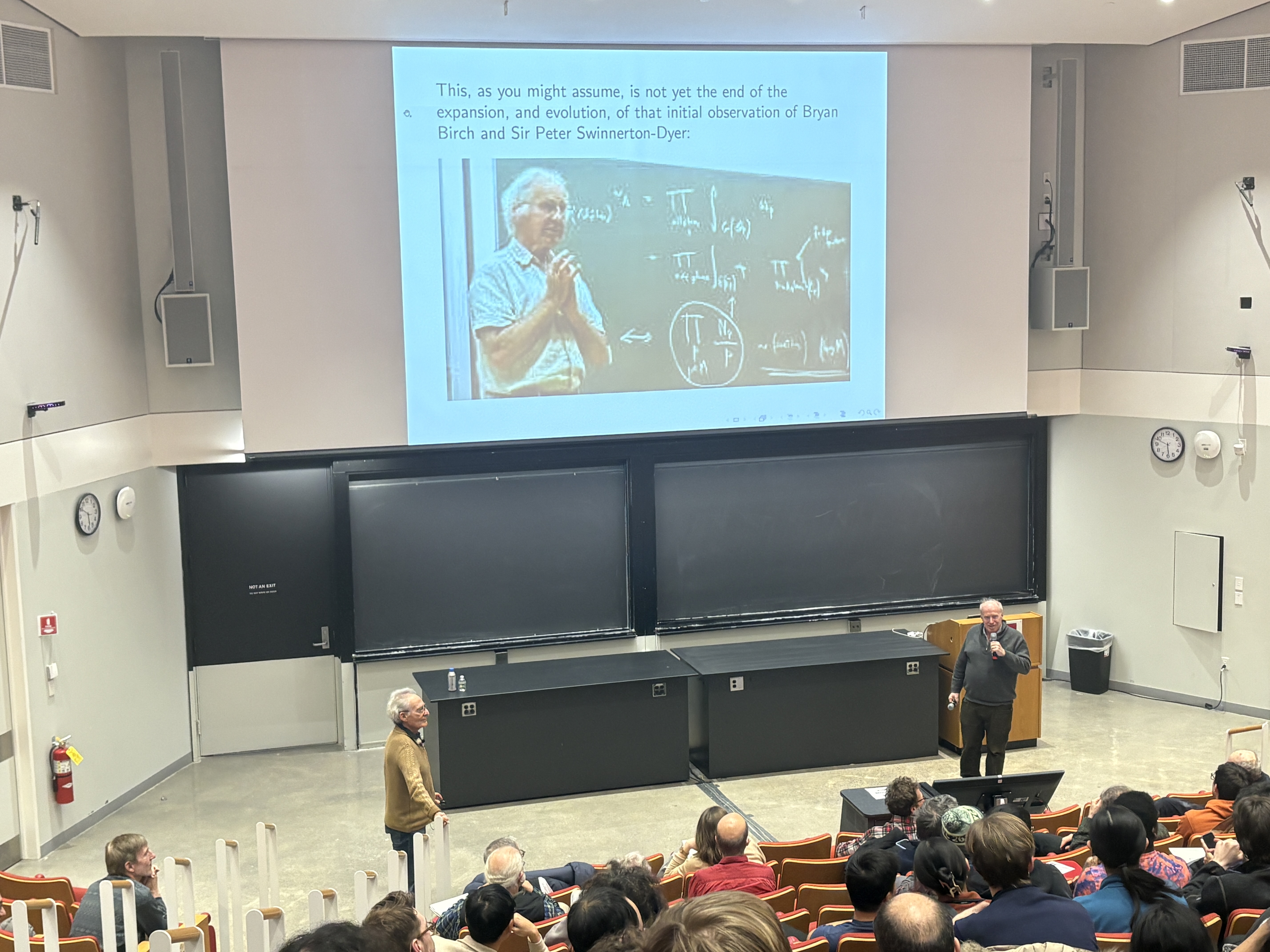
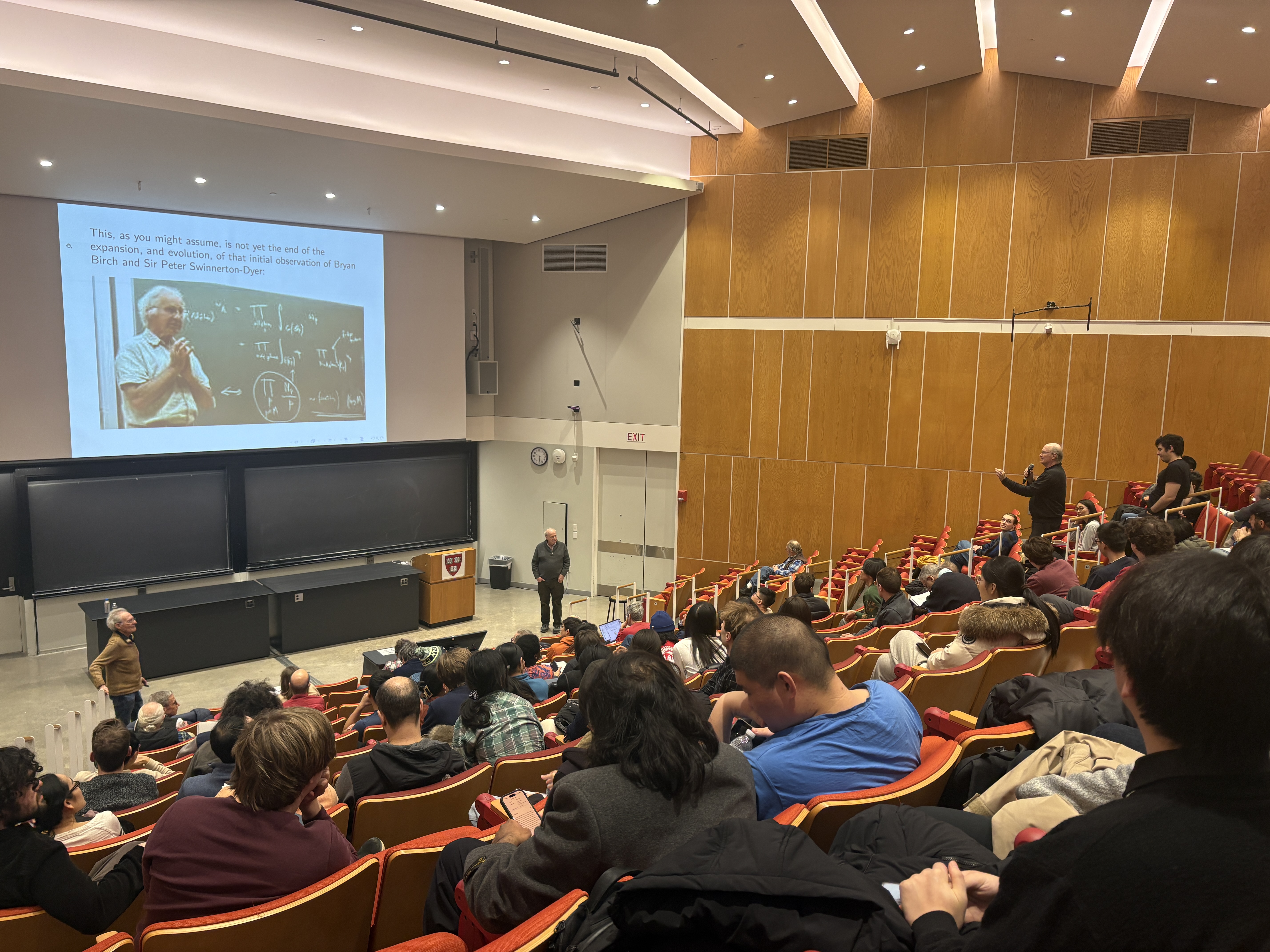
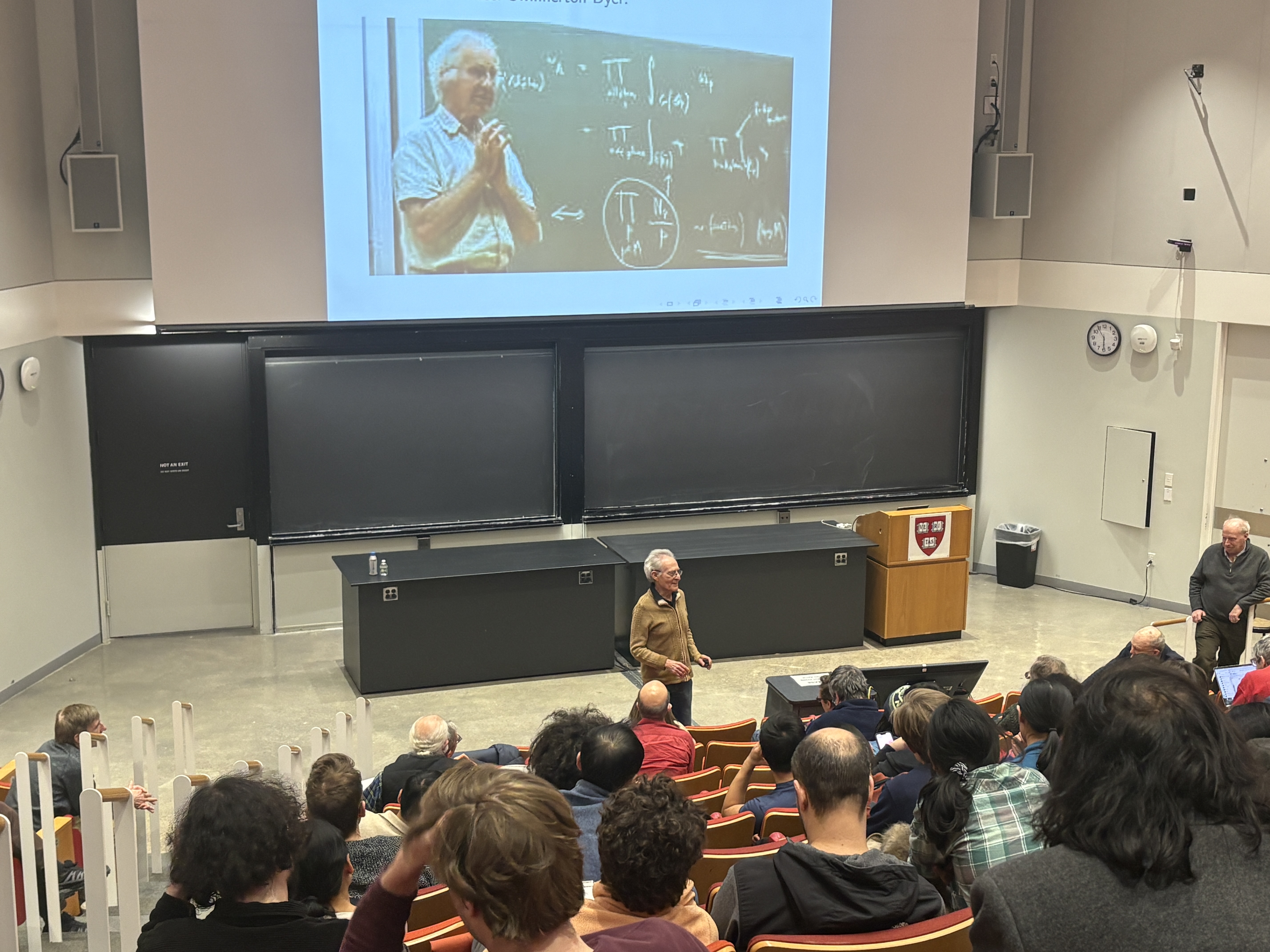
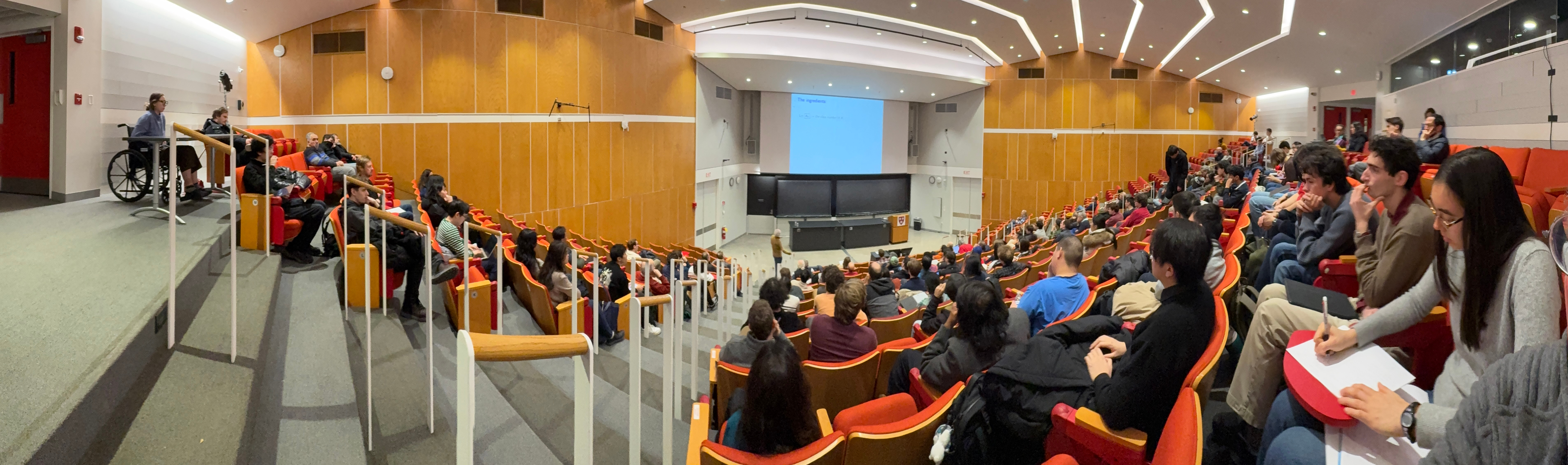
Here are some photos from the talk. The talk was very clear and organized. The disadvantage to
have such good slides however was the temptation to read too much from them. It was so
far the most demanding in that lecture series. It was the 5th talk: so far, the Poincare conjecture, the
P-NP,
the Mass gap problem and
the Hodge conjecture have been covered. The Navier Stokes and the Riemann hypothesis are still to come.
The talk was well attended. The BSD conjecture relates the order r of an elliptic curve E in an explicit
way with the multiplicity of the root s=1 of an entire zeta function zeta(s) defined by E. One
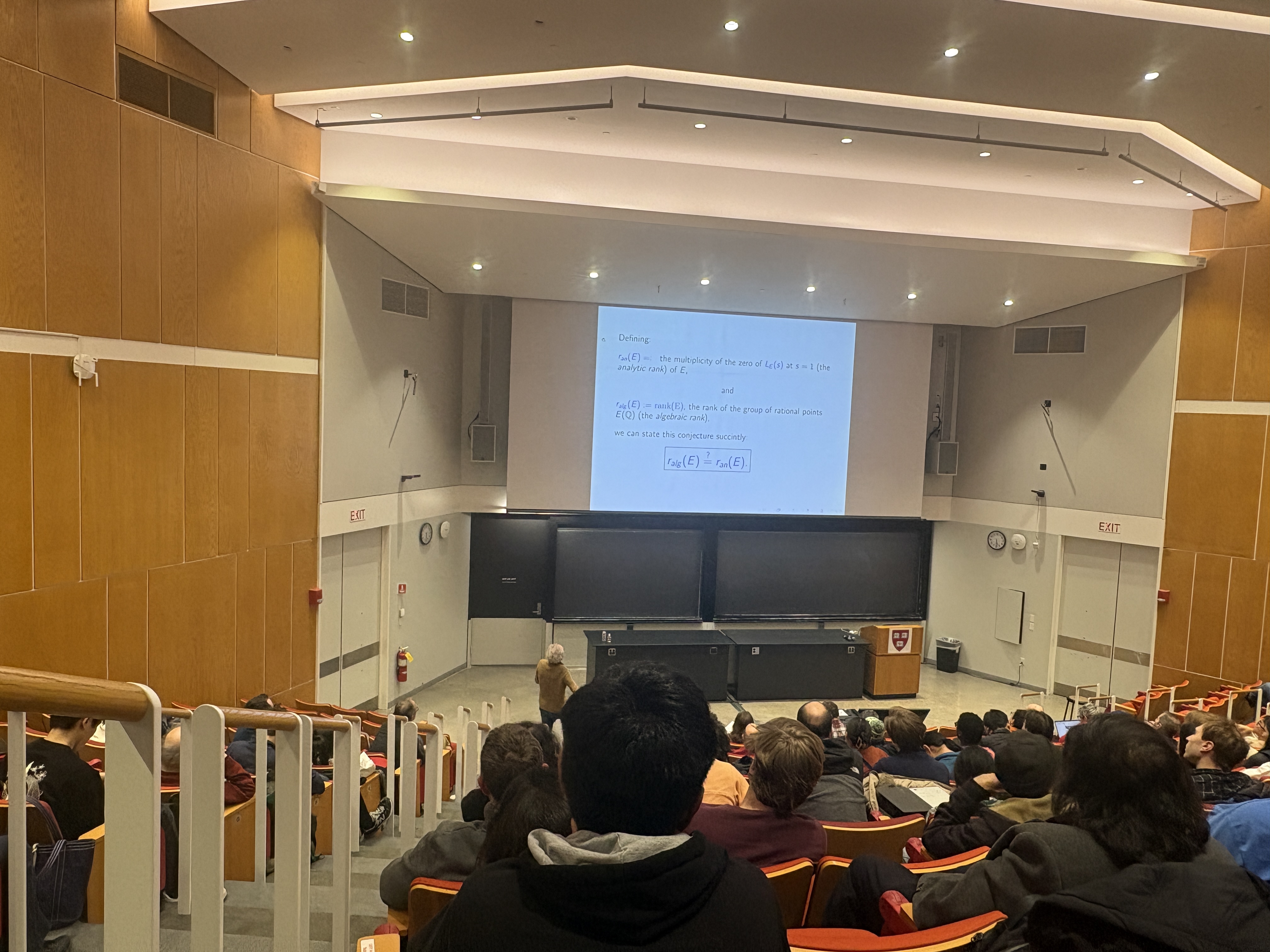
has even precise expressions relating the multiplicity of the root 1 of zeta(s) with the rank of E: The algebraic
and analytic rank seem to agree. When formulated as such it is similar to the Atiyah-Singer theorem telling that
an analytic and algebric index agree. It is this explicit nature of conjecture which makes it a "good problem".
The constant C depends on fancy objects like the
torsion order, Tamagawa numbers, regulartor, Shafarevich-Tate group. I myself like most theorems of the form A=B, where
A and B come from different parts of mathematics. In the BSD conjecture it is a collision of number theory,
algebra with analysis. An elliptic curve defines a group allowing to count stuff modulo primes and so is also
closely related to arithmetic and number theory. The zeta function is of analytic nature. It is a great problem
unlike the "WischWaschi" (German for nonsense) Mass gap problem, where the problem is not even spelled out.
(the mass-gap problem is similarly imprecise like annoyingly vague
Hilbert Problem 6 about the axiom system in
physics. What does that even mean? But I vented about this already here
arguing that Hilbert would have done much better taking a concrete problem like the odd perfect number problem as the 6th).
Also to repeat from this post, I would still guess that the
BSD conjecture is one of the first to tumble. There are so many different aspects to the problem that it would is
hard to believe that there is a counter example or that it is undecidable.
Slides (click to see them larger)
Oliver Knill, Posted February 6, 2026