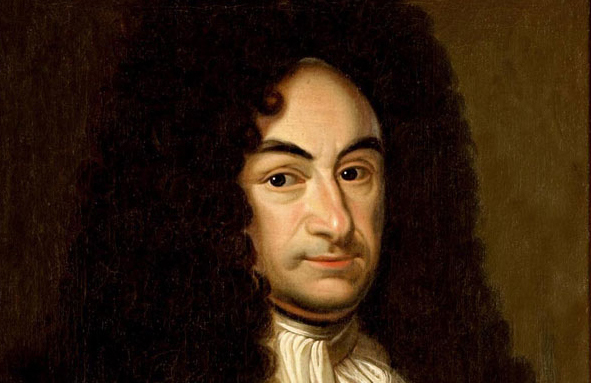
The Monadology by Gottfried Wilhelm LEIBNIZ
English translation by Robert Latta, 1898.

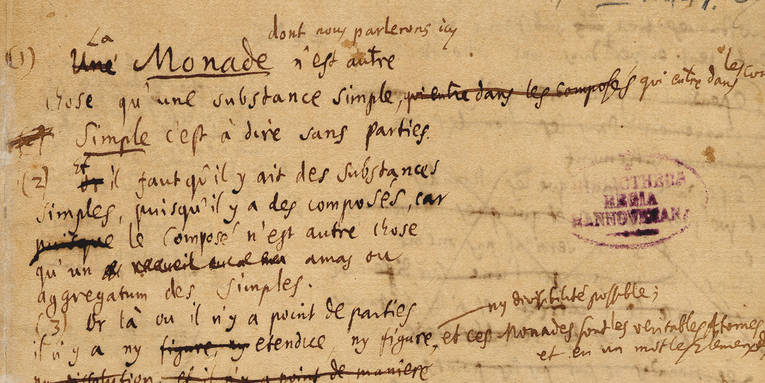
    1. The Monad, of which we shall here speak, is nothing but a simple
    substance, which enters into compounds. By `simple' is meant `without
    parts.' (Theod. 10.)

    2. And there must be simple substances, since there are compounds;
    for a compound is nothing but a collection or aggregatum of simple
    things.

    3. Now where there are no parts, there can be neither extension nor
    form [figure] nor divisibility. These Monads are the real atoms of
    nature and, in a word, the elements of things.

    4. No dissolution of these elements need be feared, and there is
    no conceivable way in which a simple substance can be destroyed by
    natural means. (Theod. 89.)

    5. For the same reason there is no conceivable way in which a simple
    substance can come into being by natural means, since it cannot be
    formed by the combination of parts [composition].

    6. Thus it may be said that a Monad can only come into being or
    come to an end all at once; that is to say, it can come into being
    only by creation and come to an end only by annihilation, while that
    which is compound comes into being or comes to an end by parts.

    7. Further, there is no way of explaining how a Monad can be altered
    in quality or internally changed by any other created thing; since it
    is impossible to change the place of anything in it or to conceive in
    it any internal motion which could be produced, directed, increased
    or diminished therein, although all this is possible in the case of
    compounds, in which there are changes among the parts. The Monads have
    no windows, through which anything could come in or go out. Accidents
    cannot separate themselves from substances nor go about outside of
    them, as the `sensible species' of the Scholastics used to do. Thus
    neither substance nor accident can come into a Monad from outside.

    8. Yet the Monads must have some qualities, otherwise they would not
    even be existing things. And if simple substances did not differ
    in quality, there would be absolutely no means of perceiving any
    change in things. For what is in the compound can come only from the
    simple elements it contains, and the Monads, if they had no qualities,
    would be indistinguishable from one another, since they do not differ
    in quantity. Consequently, space being a plenum, each part of space
    would always receive, in any motion, exactly the equivalent of what
    it already had, and no one state of things would be discernible from
    another.

    9. Indeed, each Monad must be different from every other. For in
    nature there are never two beings which are perfectly alike and in
    which it is not possible to find an internal difference, or at least
    a difference founded upon an intrinsic quality [denomination].

    10. I assume also as admitted that every created being, and
    consequently the created Monad, is subject to change, and further
    that this change is continuous in each.

    11. It follows from what has just been said, that the natural changes
    of the Monads come from an internal principle, since an external cause
    can have no influence upon their inner being. (Theod. 396, 400.)

    12. But, besides the principle of the change, there must be a
    particular series of changes [un detail de ce qui change], which
    constitutes, so to speak, the specific nature and variety of the
    simple substances.

    13. This particular series of changes should involve a multiplicity
    in the unit [unité] or in that which is simple. For, as
    every natural change takes place gradually, something changes and
    something remains unchanged; and consequently a simple substance
    must be affected and related in many ways, although it has no parts.

    14. The passing condition, which involves and represents a
    multiplicity in the unit [unité] or in the simple substance,
    is nothing but what is called Perception, which is to be distinguished
    from Apperception or Consciousness, as will afterwards appear. In
    this matter the Cartesian view is extremely defective, for it treats
    as non-existent those perceptions of which we are not consciously
    aware. This has also led them to believe that minds [esprits]
    alone are Monads, and that there are no souls of animals nor other
    Entelechies. Thus, like the crowd, they have failed to distinguish
    between a prolonged unconsciousness and absolute death, which has
    made them fall again into the Scholastic prejudice of souls entirely
    separate [from bodies], and has even confirmed ill-balanced minds
    in the opinion that souls are mortal.

    15. The activity of the internal principle which produces change or
    passage from one perception to another may be called Appetition. It
    is true that desire [l'appetit] cannot always fully attain to the
    whole perception at which it aims, but it always obtains some of it
    and attains to new perceptions.

    16. We have in ourselves experience of a multiplicity in simple
    substance, when we find that the least thought of which we are
    conscious involves variety in its object. Thus all those who admit
    that the soul is a simple substance should admit this multiplicity
    in the Monad; and M. Bayle ought not to have found any difficulty
    in this, as he has done in his Dictionary, article `Rorarius.'

    17. Moreover, it must be confessed that perception and that which
    depends upon it are inexplicable on mechanical grounds, that is
    to say, by means of figures and motions. And supposing there were
    a machine, so constructed as to think, feel, and have perception,
    it might be conceived as increased in size, while keeping the same
    proportions, so that one might go into it as into a mill. That
    being so, we should, on examining its interior, find only parts
    which work one upon another, and never anything by which to explain
    a perception. Thus it is in a simple substance, and not in a compound
    or in a machine, that perception must be sought for. Further, nothing
    but this (namely, perceptions and their changes) can be found in
    a simple substance. It is also in this alone that all the internal
    activities of simple substances can consist.  (Theod. Pref. [E. 474;
    G. vi. 37].)

    18. All simple substances or created Monads might be called
    Entelechies, for they have in them a certain perfection (
    ); they have a certain self-sufficiency () which
    makes them the sources of their internal activities and, so to speak,
    incorporeal automata. (Theod. 87.)

    19. If we are to give the name of Soul to everything which has
    perceptions and desires [appetits] in the general sense which I have
    explained, then all simple substances or created Monads might be
    called souls; but as feeling [le sentiment] is something more than a
    bare perception, I think it right that the general name of Monads or
    Entelechies should suffice for simple substances which have perception
    only, and that the name of Souls should be given only to those in
    which perception is more distinct, and is accompanied by memory.

    20. For we experience in ourselves a condition in which we remember
    nothing and have no distinguishable perception; as when we fall into
    a swoon or when we are overcome with a profound dreamless sleep. In
    this state the soul does not perceptibly differ from a bare Monad;
    but as this state is not lasting, and the soul comes out of it,
    the soul is something more than a bare Monad. (Theod. 64.)

    21. And it does not follow that in this state the simple substance
    is without any perception. That, indeed, cannot be, for the reasons
    already given; for it cannot perish, and it cannot continue to exist
    without being affected in some way, and this affection is nothing
    but its perception. But when there is a great multitude of little
    perceptions, in which there is nothing distinct, one is stunned;
    as when one turns continuously round in the same way several times
    in succession, whence comes a giddiness which may make us swoon,
    and which keeps us from distinguishing anything. Death can for a
    time put animals into this condition.

    22. And as every present state of a simple substance is naturally a
    consequence of its preceding state, in such a way that its present
    is big with its future. (Theod. 350.)

    23. And as, on waking from stupor, we are conscious of our
    perceptions, we must have had perceptions immediately before we awoke,
    although we were not at all conscious of them; for one perception
    can in a natural way come only from another perception, as a motion
    can in a natural way come only from a motion. (Theod. 401-403.)

    24. It thus appears that if we had in our perceptions nothing marked
    and, so to speak, striking and highly-flavoured, we should always
    be in a state of stupor. And this is the state in which the bare
    Monads are.

    25. We see also that nature has given heightened perceptions to
    animals, from the care she has taken to provide them with organs,
    which collect numerous rays of light, or numerous undulations
    of the air, in order, by uniting them, to make them have greater
    effect. Something similar to this takes place in smell, in taste
    and in touch, and perhaps in a number of other senses, which are
    unknown to us. And I will explain presently how that which takes
    place in the soul represents what happens in the bodily organs.

    26. Memory provides the soul with a kind of consecutiveness, which
    resembles [imite] reason, but which is to be distinguished from
    it. Thus we see that when animals have a perception of something which
    strikes them and of which they have formerly had a similar perception,
    they are led, by means of representation in their memory, to expect
    what was combined with the thing in this previous perception, and
    they come to have feelings similar to those they had on the former
    occasion. For instance, when a stick is shown to dogs, they remember
    the pain it has caused them, and howl and run away. (Theod. Discours
    de la Conformite, &c., ss. 65.)

    27. And the strength of the mental image which impresses and moves
    them comes either from the magnitude or the number of the preceding
    perceptions. For often a strong impression produces all at once
    the same effect as a long-formed habit, or as many and oft-repeated
    ordinary perceptions.

    28. In so far as the concatenation of their perceptions is due
    to the principle of memory alone, men act like the lower animals,
    resembling the empirical physicians, whose methods are those of mere
    practice without theory. Indeed, in three-fourths of our actions we
    are nothing but empirics. For instance, when we expect that there
    will be daylight to-morrow, we do so empirically, because it has
    always so happened until now. It is only the astronomer who thinks
    it on rational grounds.

    29. But it is the knowledge of necessary and eternal truths that
    distinguishes us from the mere animals and gives us Reason and the
    sciences, raising us to the knowledge of ourselves and of God. And
    it is this in us that is called the rational soul or mind [esprit].

    30. It is also through the knowledge of necessary truths, and through
    their abstract expression, that we rise to acts of reflexion, which
    make us think of what is called I, and observe that this or that
    is within us: and thus, thinking of ourselves, we think of being,
    of substance, of the simple and the compound, of the immaterial,
    and of God Himself, conceiving that what is limited in us is in
    Him without limits.  And these acts of reflexion furnish the chief
    objects of our reasonings.  (Theod. Pref. [E. 469; G. vi. 27].)

    31. Our reasonings are grounded upon two great principles, that of
    contradiction, in virtue of which we judge false that which involves
    a contradiction, and true that which is opposed or contradictory to
    the false; (Theod. 44, 169.)

    32. And that of sufficient reason, in virtue of which we hold that
    there can be no fact real or existing, no statement true, unless
    there be a sufficient reason, why it should be so and not otherwise,
    although these reasons usually cannot be known by us. (Theod. 44,
    196.)

    33. There are also two kinds of truths, those of reasoning and those
    of fact. Truths of reasoning are necessary and their opposite is
    impossible: truths of fact are contingent and their opposite is
    possible. When a truth is necessary, its reason can be found by
    analysis, resolving it into more simple ideas and truths, until we
    come to those which are primary. (Theod. 170, 174, 189, 280-282,
    367. Abrege, Object. 3.)

    34. It is thus that in Mathematics speculative Theorems and
    practical Canons are reduced by analysis to Definitions, Axioms and
    Postulates.

    35. In short, there are simple ideas, of which no definition can
    be given; there are also axioms and postulates, in a word, primary
    principles, which cannot be proved, and indeed have no need of proof;
    and these are identical propositions, whose opposite involves an
    express contradiction. (Theod. 36, 37, 44, 45, 49, 52, 121-122, 337,
    340-344.)

    36. But there must also be a sufficient reason for contingent truths
    or truths of fact, that is to say, for the sequence or connexion of
    the things which are dispersed throughout the universe of created
    beings, in which the analyzing into particular reasons might go on
    into endless detail, because of the immense variety of things in
    nature and the infinite division of bodies. There is an infinity of
    present and past forms and motions which go to make up the efficient
    cause of my present writing; and there is an infinity of minute
    tendencies and dispositions of my soul, which go to make its final
    cause.

    37. And as all this detail again involves other prior or more detailed
    contingent things, each of which still needs a similar analysis to
    yield its reason, we are no further forward: and the sufficient or
    final reason must be outside of the sequence or series of particular
    contingent things, however infinite this series may be.

    38. Thus the final reason of things must be in a necessary substance,
    in which the variety of particular changes exists only eminently,
    as in its source; and this substance we call God. (Theod. 7.)

    39. Now as this substance is a sufficient reason of all this variety
    of particulars, which are also connected together throughout; there
    is only one God, and this God is sufficient.

    40. We may also hold that this supreme substance, which is unique,
    universal and necessary, nothing outside of it being independent
    of it,- this substance, which is a pure sequence of possible being,
    must be illimitable and must contain as much reality as is possible.

    41. Whence it follows that God is absolutely perfect; for perfection
    is nothing but amount of positive reality, in the strict sense,
    leaving out of account the limits or bounds in things which are
    limited. And where there are no bounds, that is to say in God,
    perfection is absolutely infinite. (Theod. 22, Pref. [E. 469 a;
    G. vi. 27].)

    42. It follows also that created beings derive their perfections
    from the influence of God, but that their imperfections come from
    their own nature, which is incapable of being without limits. For it
    is in this that they differ from God. An instance of this original
    imperfection of created beings may be seen in the natural inertia
    of bodies. (Theod. 20, 27-30, 153, 167, 377 sqq.)

    43. It is farther true that in God there is not only the source of
    existences but also that of essences, in so far as they are real,
    that is to say, the source of what is real in the possible. For the
    understanding of God is the region of eternal truths or of the ideas
    on which they depend, and without Him there would be nothing real
    in the possibilities of things, and not only would there be nothing
    in existence, but nothing would even be possible. (Theod. 20.)

    44. For if there is a reality in essences or possibilities, or
    rather in eternal truths, this reality must needs be founded in
    something existing and actual, and consequently in the existence of
    the necessary Being, in whom essence involves existence, or in whom
    to be possible is to be actual. (Theod. 184-189, 335.)

    45. Thus God alone (or the necessary Being) has this prerogative
    that He must necessarily exist, if He is possible. And as nothing can
    interfere with the possibility of that which involves no limits, no
    negation and consequently no contradiction, this [His possibility] is
    sufficient of itself to make known the existence of God a priori. We
    have thus proved it, through the reality of eternal truths. But a
    little while ago we proved it also a posteriori, since there exist
    contingent beings, which can have their final or sufficient reason
    only in the necessary Being, which has the reason of its existence
    in itself.

    46. We must not, however, imagine, as some do, that eternal truths,
    being dependent on God, are arbitrary and depend on His will, as
    Descartes, and afterwards M. Poiret, appear to have held. That is
    true only of contingent truths, of which the principle is fitness
    [convenance] or choice of the best, whereas necessary truths depend
    solely on His understanding and are its inner object. (Theod. 180-184,
    185, 335, 351, 380.)

    47. Thus God alone is the primary unity or original simple substance,
    of which all created or derivative Monads are products and have their
    birth, so to speak, through continual fulgurations of the Divinity
    from moment to moment, limited by the receptivity of the created
    being, of whose essence it is to have limits. (Theod. 382-391, 398,
    395.)

    48. In God there is Power, which is the source of all, also Knowledge,
    whose content is the variety of the ideas, and finally Will, which
    makes changes or products according to the principle of the best.
    (Theod. 7, 149, 150.) These characteristics correspond to what
    in the created Monads forms the ground or basis, to the faculty
    of Perception and to the faculty of Appetition. But in God these
    attributes are absolutely infinite or perfect; and in the created
    Monads or the Entelechies (or perfectihabiae, as Hermolaus Barbarus
    translated the word) there are only imitations of these attributes,
    according to the degree of perfection of the Monad. (Theod. 87.)

    49. A created thing is said to act outwardly in so far as it has
    perfection, and to suffer [or be passive, patir] in relation to
    another, in so far as it is imperfect. Thus activity [action] is
    attributed to a Monad, in so far as it has distinct perceptions,
    and passivity [passion] in so far as its perceptions are
    confused. (Theod. 32, 66, 386.)

    50. And one created thing is more perfect than another, in this,
    that there is found in the more perfect that which serves to explain
    a priori what takes place in the less perfect, and it is on this
    account that the former is said to act upon the latter.

    51. But in simple substances the influence of one Monad upon another
    is only ideal, and it can have its effect only through the mediation
    of God, in so far as in the ideas of God any Monad rightly claims
    that God, in regulating the others from the beginning of things,
    should have regard to it. For since one created Monad cannot have
    any physical influence upon the inner being of another, it is only by
    this means that the one can be dependent upon the other. (Theod. 9,
    54, 65, 66, 201.  Abrege, Object. 3.)

    52. Accordingly, among created things, activities and passivities
    are mutual. For God, comparing two simple substances, finds in each
    reasons which oblige Him to adapt the other to it, and consequently
    what is active in certain respects is passive from another point of
    view; active in so far as what we distinctly know in it serves to
    explain [rendre raison de] what takes place in another, and passive
    in so far as the explanation [raison] of what takes place in it is to
    be found in that which is distinctly known in another. (Theod. 66.)

    53. Now, as in the Ideas of God there is an infinite number of
    possible universes, and as only one of them can be actual, there
    must be a sufficient reason for the choice of God, which leads Him
    to decide upon one rather than another. (Theod. 8, 10, 44, 173,
    196 sqq., 225, 414-416.)

    54. And this reason can be found only in the fitness [convenance], or
    in the degrees of perfection, that these worlds possess, since each
    possible thing has the right to aspire to existence in proportion
    to the amount of perfection it contains in germ. (Theod. 74, 167,
    350, 201, 130, 352, 345 sqq., 354.)

    55. Thus the actual existence of the best that wisdom makes known
    to God is due to this, that His goodness makes Him choose it, and
    His power makes Him produce it. (Theod. 8, 78, 80, 84, 119, 204,
    206, 208. Abrege, Object. 1 and 8.)

    56. Now this connexion or adaptation of all created things to each and
    of each to all, means that each simple substance has relations which
    express all the others, and, consequently, that it is a perpetual
    living mirror of the universe. (Theod. 130, 360.)

    57. And as the same town, looked at from various sides, appears
    quite different and becomes as it were numerous in aspects
    [perspectivement]; even so, as a result of the infinite number
    of simple substances, it is as if there were so many different
    universes, which, nevertheless are nothing but aspects [perspectives]
    of a single universe, according to the special point of view of each
    Monad. (Theod.  147.)

    58. And by this means there is obtained as great variety as possible,
    along with the greatest possible order; that is to say, it is the way
    to get as much perfection as possible. (Theod. 120, 124, 241 sqq.,
    214, 243, 275.)

    59. Besides, no hypothesis but this (which I venture to call
    proved) fittingly exalts the greatness of God; and this Monsieur
    Bayle recognized when, in his Dictionary (article Rorarius), he
    raised objections to it, in which indeed he was inclined to think
    that I was attributing too much to God- more than it is possible to
    attribute. But he was unable to give any reason which could show the
    impossibility of this universal harmony, according to which every
    substance exactly expresses all others through the relations it has
    with them.

    60. Further, in what I have just said there may be seen the reasons
    a priori why things could not be otherwise than they are. For God in
    regulating the whole has had regard to each part, and in particular
    to each Monad, whose nature being to represent, nothing can confine
    it to the representing of only one part of things; though it is
    true that this representation is merely confused as regards the
    variety of particular things [le detail] in the whole universe,
    and can be distinct only as regards a small part of things, namely,
    those which are either nearest or greatest in relation to each of the
    Monads; otherwise each Monad would be a deity. It is not as regards
    their object, but as regards the different ways in which they have
    knowledge of their object, that the Monads are limited. In a confused
    way they all strive after [vont a] the infinite, the whole; but they
    are limited and differentiated through the degrees of their distinct
    perceptions.

    61. And compounds are in this respect analogous with [symbolisent
    avec] simple substances. For all is a plenum (and thus all matter
    is connected together) and in the plenum every motion has an effect
    upon distant bodies in proportion to their distance, so that each
    body not only is affected by those which are in contact with it and
    in some way feels the effect of everything that happens to them,
    but also is mediately affected by bodies adjoining those with which
    it itself is in immediate contact. Wherefore it follows that this
    inter-communication of things extends to any distance, however
    great. And consequently every body feels the effect of all that
    takes place in the universe, so that he who sees all might read
    in each what is happening everywhere, and even what has happened
    or shall happen, observing in the present that which is far off
    as well in time as in place: µ  [sympnoia panta], as
    Hippocrates said. But a soul can read in itself only that which is
    there represented distinctly; it cannot all at once unroll everything
    that is enfolded in it, for its complexity is infinite.

    62. Thus, although each created Monad represents the whole universe,
    it represents more distinctly the body which specially pertains to
    it, and of which it is the entelechy; and as this body expresses the
    whole universe through the connexion of all matter in the plenum,
    the soul also represents the whole universe in representing this body,
    which belongs to it in a special way. (Theod. 400.)

    63. The body belonging to a Monad (which is its entelechy or its
    soul) constitutes along with the entelechy what may be called a
    living being, and along with the soul what is called an animal. Now
    this body of living being or of an animal is always organic; for,
    as every Monad is, in its own way, a mirror of the universe, and
    as the universe is ruled according to a perfect order, there must
    also be order in that which represents it, i.e. in the perceptions
    of the soul, and consequently there must be order in the body,
    through which the universe is represented in the soul. (Theod. 403.)

    64. Thus the organic body of each living being is a kind of
    divine machine or natural automaton, which infinitely surpasses
    all artificial automata. For a machine made by the skill of man is
    not a machine in each of its parts. For instance, the tooth of a
    brass wheel has parts or fragments which for us are not artificial
    products, and which do not have the special characteristics of the
    machine, for they give no indication of the use for which the wheel
    was intended. But the machines of nature, namely, living bodies,
    are still machines in their smallest parts ad infinitum. It is this
    that constitutes the difference between nature and art, that is to
    say, between the divine art and ours. (Theod.  134, 146, 194, 403.)

    65. And the Author of nature has been able to employ this divine and
    infinitely wonderful power of art, because each portion of matter
    is not only infinitely divisible, as the ancients observed, but
    is also actually subdivided without end, each part into further
    parts, of which each has some motion of its own; otherwise it
    would be impossible for each portion of matter to express the whole
    universe. (Theod. Prelim., Disc. de la Conform. 70, and 195.)

    66. Whence it appears that in the smallest particle of matter there
    is a world of creatures, living beings, animals, entelechies, souls.

    67. Each portion of matter may be conceived as like a garden full
    of plants and like a pond full of fishes. But each branch of every
    plant, each member of every animal, each drop of its liquid parts
    is also some such garden or pond.

    68. And though the earth and the air which are between the plants
    of the garden, or the water which is between the fish of the pond,
    be neither plant nor fish; yet they also contain plants and fishes,
    but mostly so minute as to be imperceptible to us.

    69. Thus there is nothing fallow, nothing sterile, nothing dead in
    the universe, no chaos, no confusion save in appearance, somewhat
    as it might appear to be in a pond at a distance, in which one
    would see a confused movement and, as it were, a swarming of
    fish in the pond, without separately distinguishing the fish
    themselves. (Theod. Pref. [E.  475 b; 477 b; G. vi. 40, 44].)

    70. Hence it appears that each living body has a dominant entelechy,
    which in an animal is the soul; but the members of this living body
    are full of other living beings, plants, animals, each of which has
    also its dominant entelechy or soul.

    71. But it must not be imagined, as has been done by some who have
    misunderstood my thought, that each soul has a quantity or portion
    of matter belonging exclusively to itself or attached to it for
    ever, and that it consequently owns other inferior living beings,
    which are devoted for ever to its service. For all bodies are in
    a perpetual flux like rivers, and parts are entering into them and
    passing out of them continually.

    72. Thus the soul changes its body only by degrees, little by little,
    so that it is never all at once deprived of all its organs; and
    there is often metamorphosis in animals, but never metempsychosis
    or transmigration of souls; nor are there souls entirely separate
    [from bodies] nor unembodied spirits [genies sans corps]. God alone
    is completely without body. Theod. 90, 124.)

    73. It also follows from this that there never is absolute birth
    [generation] nor complete death, in the strict sense, consisting
    in the separation of the soul from the body. What we call births
    [generations] are developments and growths, while what we call deaths
    are envelopments and diminutions.

    74. Philosophers have been much perplexed about the origin of forms,
    entelechies, or souls; but nowadays it has become known, through
    careful studies of plants, insects, and animals, that the organic
    bodies of nature are never products of chaos or putrefaction,
    but always come from seeds, in which there was undoubtedly some
    preformation; and it is held that not only the organic body was
    already there before conception, but also a soul in this body, and,
    in short, the animal itself; and that by means of conception this
    animal has merely been prepared for the great transformation involved
    in its becoming an animal of another kind.  Something like this is
    indeed seen apart from birth [generation], as when worms become flies
    and caterpillars become butterflies. (Theod. 86, 89. Pref. [E. 475 b;
    G. vi. 40 sqq.]; 90, 187, 188, 403, 86, 397.)

    75. The animals, of which some are raised by means of conception
    to the rank of larger animals, may be called spermatic, but those
    among them which are not so raised but remain in their own kind
    (that is, the majority) are born, multiply, and are destroyed like
    the large animals, and it is only a few chosen ones [élus]
    that pass to a greater theatre.

    76. But this is only half of the truth, and accordingly I hold that
    if an animal never comes into being by natural means [naturellement],
    no more does it come to an end by natural means; and that not only
    will there be no birth [generation], but also no complete destruction
    or death in the strict sense. And these reasonings, made a posteriori
    and drawn from experience are in perfect agreement with my principles
    deduced a priori, as above. (Theod. 90.)

    77. Thus it may be said that not only the soul (mirror of an
    indestructible universe) is indestructible, but also the animal
    itself, though its mechanism [machine] may often perish in part and
    take off or put on an organic slough [des depouilles organiques].

    78. These principles have given me a way of explaining naturally
    the union or rather the mutual agreement [conformité]
    of the soul and the organic body. The soul follows its own laws,
    and the body likewise follows its own laws; and they agree with
    each other in virtue of the pre-established harmony between all
    substances, since they are all representations of one and the same
    universe. (Pref. [E. 475 a; G. vi.  39]; Theod. 340, 352, 353, 358.)

    79. Souls act according to the laws of final causes through
    appetitions, ends, and means. Bodies act according to the laws of
    efficient causes or motions. And the two realms, that of efficient
    causes and that of final causes, are in harmony with one another.

    80. Descartes recognized that souls cannot impart any force
    to bodies, because there is always the same quantity of force
    in matter.  Nevertheless he was of opinion that the soul could
    change the direction of bodies. But that is because in his time it
    was not known that there is a law of nature which affirms also the
    conservation of the same total direction in matter. Had Descartes
    noticed this he would have come upon my system of pre-established
    harmony. (Pref. [E. 477 a; G. vi. 44]; Theod. 22, 59, 60, 61, 63,
    66, 345, 346 sqq., 354, 355.)

    81. According to this system bodies act as if (to suppose the
    impossible) there were no souls, and souls act as if there were no
    bodies, and both act as if each influenced the other.

    82. As regards minds [esprits] or rational souls, though I find that
    what I have just been saying is true of all living beings and animals
    (namely that animals and souls come into being when the world begins
    and no more come to an end that the world does), yet there is this
    peculiarity in rational animals, that their spermatic animalcules,
    so long as they are only spermatic, have merely ordinary or sensuous
    [sensitive] souls; but when those which are chosen [élus],
    so to speak, attain to human nature through an actual conception,
    their sensuous souls are raised to the rank of reason and to the
    prerogative of minds [esprits]. (Theod. 91, 397.)

    83. Among other differences which exist between ordinary souls and
    minds [esprits], some of which differences I have already noted,
    there is also this: that souls in general are living mirrors or
    images of the universe of created things, but that minds are also
    images of the Deity or Author of nature Himself, capable of knowing
    the system of the universe, and to some extent of imitating it through
    architectonic ensamples [echantillons], each mind being like a small
    divinity in its own sphere. (Theod. 147.)

    84. It is this that enables spirits [or minds- esprits] to enter into
    a kind of fellowship with God, and brings it about that in relation
    to them He is not only what an inventor is to his machine (which is
    the relation of God to other created things), but also what a prince
    is to his subjects, and, indeed, what a father is to his children.

    85. Whence it is easy to conclude that the totality [assemblage]
    of all spirits [esprits] must compose the City of God, that is to
    say, the most perfect State that is possible, under the most perfect
    of Monarchs.  (Theod. 146; Abrege, Object. 2.)

    86. This City of God, this truly universal monarchy, is a moral
    world in the natural world, and is the most exalted and most divine
    among the works of God; and it is in it that the glory of God really
    consists, for He would have no glory were not His greatness and
    His goodness known and admired by spirits [esprits]. It is also in
    relation to this divine City that God specially has goodness, while
    His wisdom and His power are manifested everywhere. (Theod. 146;
    Abrege, Object.  2.)

    87. As we have shown above that there is a perfect harmony between the
    two realms in nature, one of efficient, and the other of final causes,
    we should here notice also another harmony between the physical realm
    of nature and the moral realm of grace, that is to say, between God,
    considered as Architect of the mechanism [machine] of the universe
    and God considered as Monarch of the divine City of spirits [esprits].
    (Theod. 62, 74, 118, 248, 112, 130, 247.)

    88. A result of this harmony is that things lead to grace by the
    very ways of nature, and that this globe, for instance, must be
    destroyed and renewed by natural means at the very time when the
    government of spirits requires it, for the punishment of some and
    the reward of others. (Theod. 18 sqq., 110, 244, 245, 340.)

    89. It may also be said that God as Architect satisfies in all
    respects God as Lawgiver, and thus that sins must bear their penalty
    with them, through the order of nature, and even in virtue of the
    mechanical structure of things; and similarly that noble actions
    will attain their rewards by ways which, on the bodily side, are
    mechanical, although this cannot and ought not always to happen
    immediately.

    90. Finally, under this perfect government no good action would
    be unrewarded and no bad one unpunished, and all should issue
    in the well-being of the good, that is to say, of those who are
    not malcontents in this great state, but who trust in Providence,
    after having done their duty, and who love and imitate, as is meet,
    the Author of all good, finding pleasure in the contemplation of
    His perfections, as is the way of genuine `pure love', which takes
    pleasure in the happiness of the beloved. This it is which leads wise
    and virtuous people to devote their energies to everything which
    appears in harmony with the presumptive or antecedent will of God,
    and yet makes them content with what God actually brings to pass
    by His secret, consequent and positive [decisive] will, recognizing
    that if we could sufficiently understand the order of the universe,
    we should find that it exceeds all the desires of the wisest men,
    and that it is impossible to make it better than it is, not only as
    a whole and in general but also for ourselves in particular, if we
    are attached, as we ought to be, to the Author of all, not only as
    to the architect and efficient cause of our being, but as to our
    master and to the final cause, which ought to be the whole aim of
    our will, and which can alone make our happiness. (Theod. 134, 278.
    Pref. [E. 469; G. vi. 27, 28].)
|