Home
Course Info
Schedule
Problem Sets
FAQ
Resources
Q&A Tool
Math Department
|
|
Basic Information
Math 20
Introduction to Linear Algebra and Multivariable Calculus
Spring 2005, MWF 9-10 a.m.
Science Center 309
Instructor
Dr. Derek Bruff
Preceptor in Mathematics
Science Center 231
617-496-0459
bruff [at] fas.harvard.edu
Office Hours: Mondays 2:30-4 pm, Thursdays 4-5:30 pm
Course Assistants
Helis Zulijani
zulijani [at] fas.harvard.edu
Problem Sessions: Wednesdays, 7-8:30 pm in Science Center 507
Nancy Chen
chen18 [at] fas.harvard.edu
Problem Sessions: Tuesdays, 5-6:30 pm in Science Center 216
Course Description
Math 20 is designed to introduce the concepts and techniques of linear algebra and
multivariable calculus most useful to those studying the social sciences, particularly
economics.
During most of the semester we will focus on ideas from linear algebra -
particularly linear equations, matrices, eigenvalues, and orthogonality -
and their applications. Applications we will consider include assignment problems,
game theory, economic input-output models, Markov chains, and discrete dynamical
systems.
We will integrate the mathematics we study with
these applications, studying them as we come to the associated linear algebra topics.
In the latter portion of the semester, we will consider the problem of finding the maximum or
minimum value of functions depending on several variables. We will first consider linear
functions of several variables, optimizing such functions using linear programming techniques.
We will then consider nonlinear functions of several variables, optimizing such functions
using multivariable calculus techniques.
Students in Math 20 are assumed to be familiar with differential calculus of
a single variable (a topic covered by Math 1a, for instance) since these ideas will be
built upon during our study of multivariable calculus.
Course Goals
-
Students should have an understanding of the fundamental concepts and
techniques of linear algebra and multivariable calculus most useful in
the social sciences.
-
Students should have an understanding of the tools mathematicians use
to solve problems and skill in using those tools to solve problems in
the social sciences.
-
Students should be able to communicate mathematical ideas clearly and
effectively both verbally and in writing.
Textbooks
|
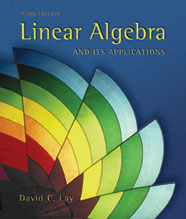
Linear Algebra and Its Applications, 3rd Edition, by
David C. Lay
The David Lay linear algebra book (shown to the right) will be our primary textbook for the course.
We will cover most of chapters 1, 2, 5, and 6.
|
|
|
Calculus with Applications, 8th Edition, by
Margaret Lial, Raymond Greenwell, and Nathan Ritchey
Chapter 9 of the Lial, Greenwell, and Ritchey text will serve as a our textbook
for the multivariable calculus portion of the course. This chapter will be
made available for purchase by students in Math 20.
|
|
Course Procedures
-
Class
Math 20 meets MWF at 9 a.m. in Science Center 309. Attendance will not be taken.
However, it is in your best interest to attend and participate in class
regularly. The class format will consist of an interactive lecture
style with occasional small group activities.
-
Course Assistants and Problem Sessions
Helis Zulijani and Nancy Chen, our course assistants, will grade homework and hold a weekly 90-minute problem session.
You are strongly encouraged to attend these
problem sessions as they are an integral part of the course and
will be devoted primarily to working problems and amplifying the
material presented in class.
-
Reading Assignments
You will generally be required to read the material in the textbook before we discuss
it in class, as opposed to reading it after the class. Before class you will answer
a few free response questions online via the
Q&A Tool.
One question will always give you the
opportunity to describe the particular parts of the reading you found most
difficult. I will read your answers before class and base our class discussions
in part on your answers.
In order to reward your effort in doing pre-class reading assignments, the assignments will be graded on effort (0 points for a blank or nearly blank answer, 1 point for
something reasonable, and 2 points for a good, honest effort as judged by me) and that
grade figured into your course grade.
-
Getting Help
If you have questions about any aspect of the course, feel free to come
by my office and ask me for help. My office hours are given above.
You can also email me to ask a question or to set up a time to meet if
you cannot make my office hours in a given week.
The course assistants are also sources of help. The weekly problem
sessions held by the CAs are designed to allow you opportunities to ask
questions about the course and its material.
Additionally, the Mathematics Department operates the
Mathematics
Question Center in Loker Commons from 8 to 10 p.m. on Sunday through
Thursday evenings. The MQC is staffed by course assistants from the
calculus courses and by graduate students. You are encouraged to use
this resource as you do your homework and when questions arise.
Finally, many students find it helpful to study for their courses in
small groups. If you find yourself struggling with course material,
consider finding one or more fellow students with which to study.
-
Calculators
Only standard scientific, non-graphing calculators are allowed on the
midterms and final. You are welcome to use graphing calculators on any
other work, unless otherwise noted.
Graded Work
-
Homework
You will be given weekly problem sets consisting of textbook exercises.
Problem sets will typically be due each Friday at the start of class
and graded by the course assistant.
If for some reason
you do not attend class on the day that a problem set is due,
you are responsible for turning your problem
set in to one of our CAs' mailboxes by 9 am that day. The mailboxes are across from the
elevators on the third floor of the Science Center.
You are allowed to turn in one late
problem set during the semester. If you use this one "late pass,"
then you may turn in your problem set up to 72 hours after the original due
date at no penalty. Once you have used your "late pass," no further late
problem sets will be accepted.
Homework problems are themselves an extension of the course material. This is not like
high school in which there are a limited number of "types" of problems in mathematics
and your teacher is responsible for showing you how to do each type. Some problems will
require you to apply the concepts of the class and the textbook to solve problems not
explicitly covered in class.
It is essential not only that you get the right answers on your
homework but also that you understand how those answers were obtained.
Take advantage of the resources listed above under "Getting Help"
when you encounter difficult homework problems. You are encouraged to
work on your homework with
other students, although copying another student's work is not permitted.
If you do work with others on a homework assignment, list your collaborators'
names on your assignment.
-
Midterms
We will have two midterms this semester. Midterm One will be given in class on
Monday, March 16th, and will cover through §2.6. Midterm Two will be given
in class on Monday, April 25th, and will cover through §6.6.
Plan your schedule around the midterms, as missed midterms may not be
made up. If you are absent from a midterm, you will receive a 0 for
that test. Exceptions will only be made in extreme circumstances and
only with prior notification.
-
Application Project
The linear algebra and multivariable calculus ideas we will study this
semester have applications in a variety of fields. Learning about the
ways in which mathematical ideas are applied to problems from other
disciplines is one of the goals of this course. To that end, you will
be required to complete an application project during the semester.
The application project should demonstrate your understanding of a
particular problem from the social sciences or other discipline, the
mathematical concepts and techniques that can be used to solve the
problem, and the ways in which mathematical modes of thought are
brought to bear on the problem.
The project should be an extension of mathematical ideas or
applications seen in this course.
The project will take the
form of a properly formatted paper of an appropriate length as well as a
poster presentation during Reading Period. Due dates for the components
of the project are as follows.
- Monday, April 11th -- Abstract Due
- Friday, April 22nd -- Rough Draft Due
- Friday, May 6th -- Final Paper Due
- Friday, May 13th -- Project Poster Due
During Reading Period on Friday, May 13th, we will meet in SC 309 and 309a
from 2 to 3:30 pm for a project poster session. During this session, you will
have the opportunity to find out about your classmates' projects. You will also
vote on the projects you find most interesting. Students with winning projects
will receive bonus points to their application project grade.
More information about the application project are available on this
handout.
-
Final Exam
The final exam for this course will be given Friday, May 27th, from
9:15 am to 12:15 pm. The final exam will be cumulative.
-
Grading
Your course grade will be determined by whichever of the following two plans
results in a higher grade. Plan One rewards students who work consistently
well during the semester. Plan Two rewards students who learn the material
well by the end of the semester.
|
Plan One
| Reading Assignments |
5% |
| Homework |
15% |
| Midterm 1 |
20% |
| Midterm 2 |
20% |
| Application Project |
15% |
| Final Exam |
25% |
|
|
Plan Two
| Reading Assignments |
5% |
| Homework |
15% |
| Midterm 1 |
12.5% |
| Midterm 2 |
12.5% |
| Application Project |
15% |
| Final Exam |
40% |
|
Your numerical score will be converted to a letter grade according to
the following scale. This scale may be adjusted downward (that is,
favorably to you, the student) at the end of the semester at my discretion.
| Score |
Grade |
Score |
Grade |
| 93-100 |
A |
73-76 |
C |
| 90-92 |
A- |
70-72 |
C- |
| 87-89 |
B+ |
67-69 |
D+ |
| 83-86 |
B |
63-66 |
D |
| 80-82 |
B- |
60-62 |
D- |
| 77-79 |
C |
0-59 |
E |
|
