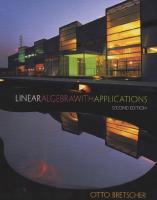
Math21b:
An introduction to linear algebra, including linear transformations,
determinants, eigenvectors, eigenvalues, inner products and linear spaces.
We will further study linear differential equations and applications. We will
emphasise a firm understanding of the basic principles.
[See below for a more detailed list of topics.] Math21b:
An introduction to linear algebra, including linear transformations,
determinants, eigenvectors, eigenvalues, inner products and linear spaces.
We will further study linear differential equations and applications. We will
emphasise a firm understanding of the basic principles.
[See below for a more detailed list of topics.]
This course is taught entirely in sections (taught by teaching fellows [TF]), with an
additional weekly problem session (conducted by a Course Assistant [CA]). Sectioning
must be done via computer by noon on Thursday, Jan 31. You will be notified of your
assigned section on Friday, Feb 1. Classes will begin on Monday, Feb 4.
Course Head:
Course website:
http://www.courses.harvard.edu/~math21b
Here you'll find homework solutions, exam review problems and solutions, and course
supplements.
Exams:
There will be two midterm exams and a Final Exam.
We expect to schedule the midterms as follows, any changes will be announced
here and in class:
- Exam #1: Wed, Mar 6, 7:00-8:45pm in Sci Ctr Hall D
- Exam #2: Mon, Apr 15, 7:00-8:45pm in Sci Ctr Hall C
|
[If you think you are unable to take the exams at either of these for
any forseeable reason (eg a religeous conflict) you must inform the course
head by the end of the first week of classes.]
Grades:
Grades: Your overall course grade will be determined according to the following
weights:
- Midterm exams: 20% each
- Homework: 20%
- Final Exam: 40%
|
Text:
Linear Algebra with Applications, by Otto Bretscher (2nd edition).
Available at the Coop and elsewhere.
Homework:
Homework will be assigned each class and due at the start of the next class.
The assignments will also be posted on the Math 21b course web site. Graded
homework will generally be returned the class after it was due and homework
solutions will be posted on the Math 21b course web site about a week later.
Late homework will only be accepted within 1 week of the date it was due and
will receive a maximum of 70% credit. Your three worst homeworks will not
be counted towards your overall homework grade.
Homework problems are an integral part of this course. It is impossible to understand
the material and do well on the exams without working through the homework problems in a
thoughtful manner. Mathematics is not a spectator sport. Don’t just crank
through computations and write down answers - think about the problems posed, your
strategy, the meaning of the computations you perform, and the answers you get. Nothing
prevents you from trying a few more problems in a given section if you feel it may do you
some good.
We encourage you to form study groups with other students in the class so you can
discuss the work with each other. Your Course Assistant will, upon request, distribute a
list of names and phone numbers of those in class in order to facilitate this. Although we
encourage you to talk to your classmates, work must be written up independently.
Many of the problems for homework will look different from problems you discussed in
class and in the text. This is not an accident. We want you to think about the
material and learn to apply it in unfamiliar settings and interpret it in different ways.
Only if you understand the material (as opposed to merely knowing it) will you be able to
go beyond the information you are given.
Many math students seem to subscribe to the "Ten Minute Rule": If you cannot
solve it in ten minutes, you cannot solve it at all. Nothing could be further from the
truth, of course. You will probably learn most from those problems which keep you busy
more than ten minutes, whether you can ultimately solve them or not.
Math Question Center:
In addition to class,
problem sessions, and office hours, the Mathematics Department operates a Question Center
in Loker on Sunday, Monday, Tuesday, Wednesday, and Thursday evenings from 8pm to 10pm.
The Question Center will be staffed by Course Assistants from Math 1a, 1b, 21a, and 21b
and by graduate students and others. You are encouraged to use this resource as you do
your homework and when questions arise. It is intended to supplement the office hours held
by your Section Leader.
Use of technology:
In some of the homework problems you will be asked not to use
any technology (calculators or software packages). If no restriction is made, you may use
the form of technology of your choice, e.g. TI-85 or TI-89 calculator, Matlab, Maple, Mathematica.
You may want to arrange to have access to some form of technology.
Calculators will not be allowed in the exams.
Syllabus:
We will cover approximately one section of the text per class (MWF
schedule). Your Section Leader will highlight the key concepts introduced in each section,
but there may not be enough time to cover all the topics. You will need to study the text
to fill in the details. Reading the text is an integral part of the course.
On the exams, you will be responsible for all the material discussed in the text and in
class. Below is the approximate day-by-day syllabus for the MWF sections of
the course, although it is quite likely that we will decide to reorder the
material after chapter 5. Also adjustments may be made if time is limited.
|
1: Systems of linear equations
1.1: Introduction to linear systems
1.2: Matrices and Gauss-Jordan Elimination
1.3: On the solutions of linear systems
2: Linear transformations
2.1: Introduction to linear transformations and their inverses
2.2: Linear transformations in geometry
2.3: The inverse of a linear transformation
2.4: Compositions of linear transformations; matrix products
3: Subspaces of Rn and their dimension
3.1: Image and kernel of a linear transformation
3.2: Subspaces of Rn; Bases and linear independence
3.3: The dimension of a subspace of Rn
3.4: Coordinates
Review and first midterm.
5: Orthogonality and least squares
5.1: Orthonormal bases and orthogonal projections
5.2: Gram-Schmidt process and QR factorization
5.3: Orthogonal transformations and orthogonal matrices
5.4: Least squares and data fitting
10: Function spaces (supplementary notes to be provided here.)
10.1: Function spaces (see 4.1 and 4.2)
10.2: Ordinary linear differential equations (see 9.3)
10.3: Fourier series (see 5.5)
10.4: Partial differential equations I - The Heat Equation
10.5: Partial differential equations II - Laplace's Equation, the Wave Equation
6: Determinants
6.1: Introduction to determinants
6.2: Properties of the determinant
6.3: Geometrical interpretations of the determinant, Cramer's rule
Review and second midterm.
7: Eigenvalues and eigenvectors
7.1: Dynamical systems and eigenvectors: An introductory example
7.2: Finding the eigenvalues of a matrix
7.3: Finding the eigenvectors of a matrix
7.4: Diagonalisation
7.5: Complex eigenvalues
7.6: Stability
8: Symmetric matrices and quadratic forms
8.1: Symmetric matrices
9: Linear systems of differential equations
9.1: An introduction to continuous dynamical systems
9.2: The complex case: Euler's formula
9.4: Non-linear systems (supplementary notes to be provided here.)
|
|