Boundary conditions
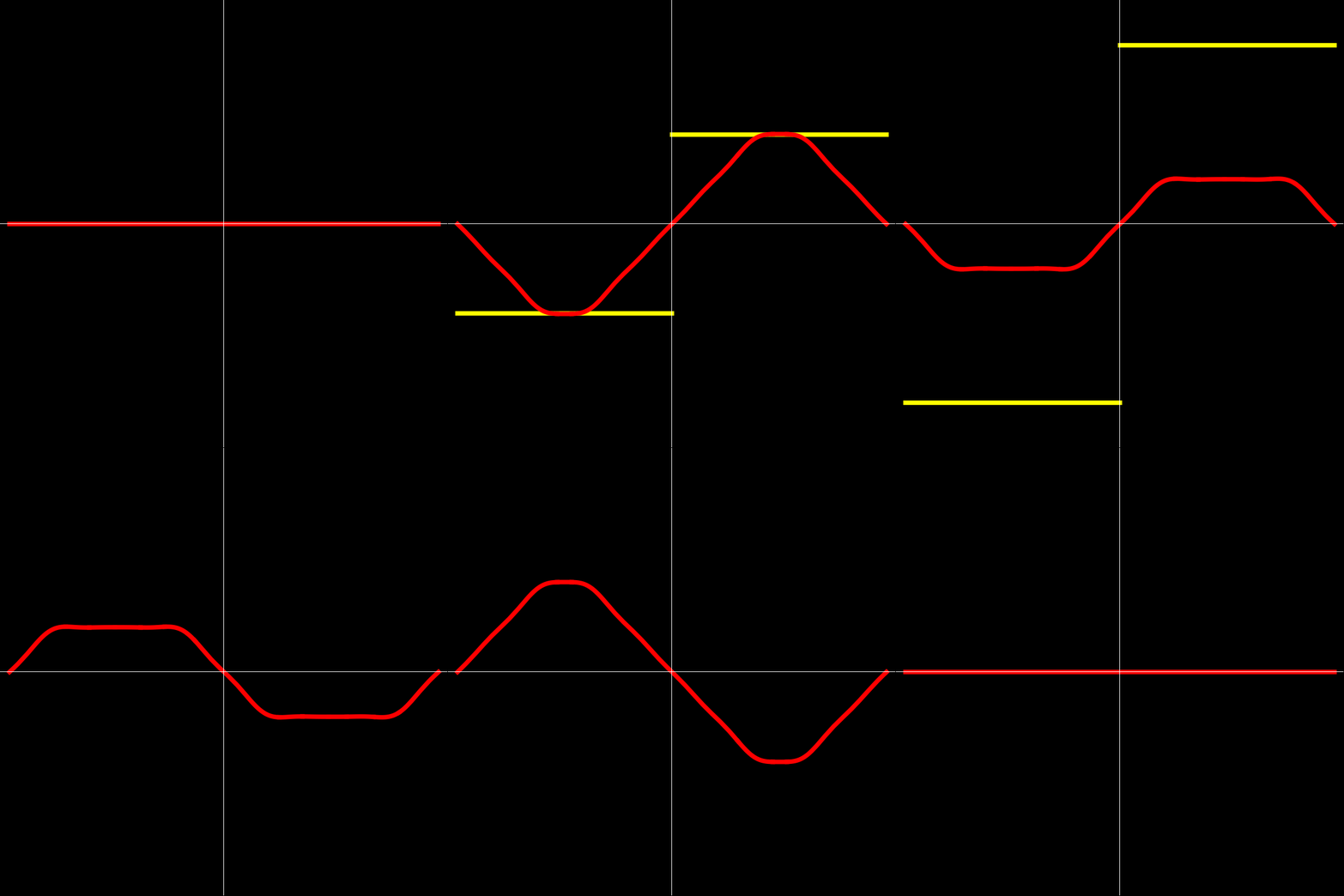
We have treated partial differential equations in a bit simplified form in that we assumed that the initial conditions u(x,0) or initial velocities ut(x,0) were given as a sin series. This implicitly produces some boundary conditions at x=0 and x=Pi. Lets take the example utt = uxx with initial condition u(x,0)=0 and ut(x,0) = sign(x), the function which is 1 for positive x and -1 for negative x. Now we have the explicit solutionu(x,t) = sum bn sin(nx) sin(nt)/n
This is the solution which has the boundary condition at 0. But there is an other solution u(x,t) = sign(x) t which also satisfies the wave equation and has an odd solution. The following animation shows both solutions. It was produced with
f[x_,t_]:= Sum[(2(1-(-1)^n)/(n Pi)) Sin[n x] Sin[n t]/n,{n,1,10}]
S = Table[ Plot[{Sign[x] t, f[x, t]}, {x, -Pi, Pi}, PlotRange -> {-Pi, Pi},
    {t, 0, 2 Pi, 2 Pi/100}];
The solution which escapes up is a string which is not attached and can
move up for ever. We have bypassed all these boundary condition questions
by asking that we make a sin(nx) expansion.