Introduction to Functions and Calculus I
Home > syllabus
Course Head
-
Thomas W. Judson, Ph.D.
Preceptor in Mathematics - Office: 429 Science Center
- TEL: (617) 495-5735
- EMAIL: judson@math.harvard.edu
- Office Hours: Monday at 8:00-9:00 (at the MQC), Friday at 9:00-10:00, or by appointment.
Assistant Course Head
-
Angela Vierling-Claassen, Ph.D.
Preceptor in Mathematics - Office: 435 Science Center
- TEL: (617) 495-4744
- EMAIL: angelavc@math.harvard.edu
- Office Hours: To be announced.
About Math X
The goal of Math X is to provide you with a deep understanding of topics from precalculus and calculus as well as a strong sense of how useful mathematics can be and how you can apply mathematics in your work and studies. Our aim is to provide you with a solid set of mathematical skills and a high degree of mathematical confidence when you finish the course so that you will be well-equipped for future studies in mathematics, biology, chemistry, economics, or other disciplines. To help you achieve these goals, we will use multiple approaches to problem solving, and we will stress understanding the ideas behind the mathematical formulas and techniques that you will learn.The Math Xab sequence covers all of the material learned in Math 1a. In terms of prerequisites for the other courses at Harvard, Math Xab is equivalent to Math 1a. We also cover geometric series (with biological, medical, and economic applications) and introduce you to differential equations.
In Math X, we will integrate topics from calculus and precalculus. We will begin the course by discussing the ideas of calculus immediately, integrating the necessary background material into the course as we need it. This will give us the entire year to reinforce the most important ideas and skills of calculus and its prerequisites by working with them in numerous contexts. We will have enough time to work on eliminating any mathematical weak spots that you feel you might have and help you to become familiar with and draw upon your strengths. Please work hard, but remember to take time to enjoy yourself this year.
Course Goals
- To gain an appreciation of the conceptual structure of functions and calculus.
- To acquire a foundation of mathematical concepts needed in the natural and social sciences and to see how mathematics is influential in other disciplines.
- To gain an appreciation of the role of mathematics in the modern world.
- To gain some measure of the mathematical way of approaching and viewing the modern world.
- To develop skills in numerical and symbolic computation, mathematical reasoning, and mathematical modeling.
- To gain skills in learning and communicating mathematics.
Learning Objectives
Upon successfully completing Math X, you should have acquired a solid foundation of the following topics and be able to move directly into second semester calculus.- Functions and Their Graphs---Linear, polynomial and rational, exponential, logarithmic, trigonometric, and inverse functions. Operations on functions. Continuity and limits of functions. The Intermediate and Extreme Value Theorems.
- Differentiation---as a rate of change, as a linear approximation to a function, optimization, techniques of differentiation, related rates. The Mean Value Theorem.
- Integration---The definite integral, Riemann sums, the Fundamental Theorem of Calculus. An introduction to the techniques of anti-differentiation, numerical approximation, applications of integration.
- Geometric series and an introduction to differential equations.
Textbook and Calculators
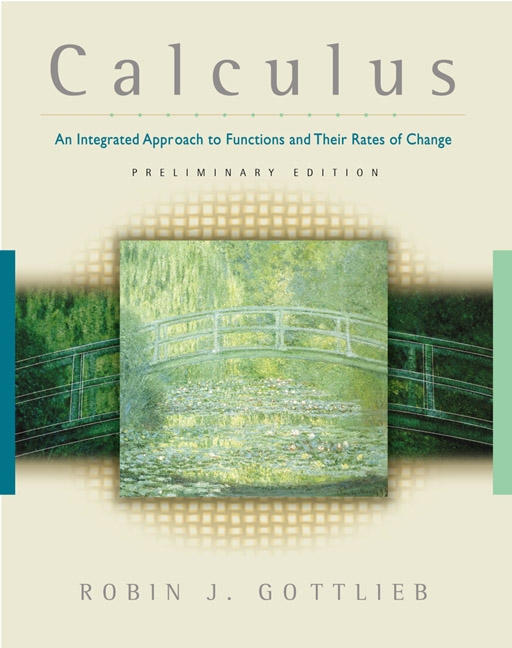
Robin J. Gottlieb. Calculus: An Integrated Approach to Functions and Their Rates of Change, preliminary edition. Addison Wesley, Boston, 2002.A graphing calculator will be a tremendous asset in this course. We encourage you to bring your calculator to class with you everyday. If you are purchasing a calculator, we recommend a Texas Instruments TI-83 or TI-84 calculator. You will be permitted to use your calculator on all tests and exams, except for the gateway examinations and one portion of the final exam.
With the advent of graphing calculators and mathematical software programs, it is now possible to do an amazing number of things almost instantaneously that would otherwise take hours or days to do by hand. Calculators can help you with your math skills and instincts by reducing the time you spend doing burdensome computations, however you should not rely on computers and calculators to such an extent that they keep you from developing your own skills. Technology should be used as an aid, but without a good understanding of the underlying mathematical concepts, the calculator will quite happily mislead you without your even knowing it. In general, technology is a good thing, but as with everything, sometimes too much of a good thing can lead to problems.
Grading and Exams
Your course grade will be determined as follows:| Component | Date | Percentage |
|---|---|---|
| Labs | - | 15% |
| Homework | - | 15% |
| Midterm I | Thursday, October 28, 2004 at 7:30-9:30 PM.
Science Center Lecture Hall D. |
20% |
| Midterm II | Thursday, December 9, 2004 at 7:30-9:30 PM.
Science Center Lecture Hall D. |
20% |
| Final Exam | TBA | 30% |
Semester numerical scores will be converted into letter grades
according to the following method.
| Range of numerical values | Corresponding Letter |
|---|---|
| 90-100 | A |
| 80-89 | B |
| 65-79 | C |
| 50-64 | D |
| 0-49 | E |
When we calculate your final grade at the end of the course, we will calculate a score on a 0-100 point scale using the scores that you have obtained during the course, and using the grade breakdown given above. Your course grade will then be obtained using this table. In the event of a fractional score, we will always round up to the nearest integer. We may modify these letter grades with a "+" or a "-" if we believe that your performance in the course warrants this. Make-up exams will be administered only if a documented serious illness or personal tragedy prevents a person from taking an exam at the scheduled time.
There will be three gateway exams in Math Xa. The idea of a
gateway exam is to provide you with a powerful incentive to learn how
to do the fundamental calculations and operations in a particular
subject area. The exams will be given on the following dates, and you
will have a large number of opportunities to make-up gateway exams
with no penalty whatsoever.
| Gateway Exam | Date | Deadline for Passing | Topic |
|---|---|---|---|
| Gateway I | Thursday, October 7, 2004 | Thursday, November 4, 2004 | Basic Algebra Skills |
| Gateway II | Tuesday, November 9, 2004 | Thursday, December 2, 2004 | Limits and Derivatives: Definitions and Concepts |
| Gateway III | Thursday, December 2, 2004 | Friday, January 14, 2005 | Differentiation Skills |
These exams will be straight-forward tests of fundamental skills. You may take the gateway tests as many times as you wish. Before each exam, you will be provided with an extensive collection of practice problems (complete with answers) that will be very similar to the problems that appear on the actual gateway tests. In our experience, students who make an earnest effort to work out all of the practice problems usually have little trouble passing the gateway exams.
For every gateway test that you have not passed by the gateway deadline your grade for the whole course will be reduced by one letter. For example, if you do not pass any of the gateway exams by 5 PM on Friday, December 17, then your "A" will turn into a "D." Extensions will be granted only to those individuals who have been making a sustained effort to pass the gateways by the deadlines.
Homework
There is no question that the best way to learn math is by doing math, and homework exercises are an essential part of any math course. If you just go to a math class and watch the teacher work problems, but do not actually try doing any problems on your own, then there is very little chance you will really learn the subject. It is also very unlikely that you will do well on exams without working through homework problems ahead of time. While doing homework, do not just write down answers. Think about the problems posed, your strategies, the meaning of your computations, and the answers you get. The main point is not to come up with specific answers to the specific problems you are working on, but to develop an understanding of what you are doing so that you can apply your reasoning to a wide range of similar situations. It is very unlikely that later on in life you will see exactly the same math problems you are working on now, so learn the material in such a way that you are prepared to use your general knowledge of mathematics in the future, not just how to apply particular formulas for very specific problems.
You are encouraged to form study groups with other students in the class so that you can discuss your work with each other; however, all work submitted must be written up individually. Make sure that even if you do work in groups, that you come away with the ability to explain everything you end up writing up in your homework.
There will generally be three problem sets due each week. Assignments will be graded by your course assistant and will typically be returned to you at the following class meeting. We will then post solutions to the homework on the course website. Check the solutions so that you can learn from your work. In order for us to post solutions as soon as possible, and in light of the fact that getting behind in a math class is one of the most uncomfortable things you can do to yourself, homework must be turned in on time. Since we will drop your 3 lowest homework grades, please do not try to harass your course assistant into accepting a late homework assignment.
There will be times when problems for homework will look different from what is discussed in class. For some classes we might ask you to read through a section ahead of time so that when you then see it covered in class, you will be able to follow along much more easily (as opposed to seeing it for the very first time in class). As an incentive to do this pre-reading, we might ask you to do one or two very straightforward questions from that section for homework, even though the material has not been covered yet in class.
Classes, Labs, Problem Sessions
Math X is taught in a small class so that you will have a better opportunity to ask questions and interact with your teacher. Make sure you take advantage of this arrangement. Any questions you ask in class will likely be ones that other students will want answered as well, so get over any hesitation you might have and ask questions as the material is presented. You will not be penalized for doing this, no matter how trivial or simple you think your questions might seem. Remember, the class is being held for you to learn the material, not just to give you a time to copy notes off of a blackboard, so be sure to get help when you need it and stay involved in your class.
You will also be attending problem sessions and labs led by the Course Assistant. The problem sessions and labs are an important part of the course. Problems sessions will be devoted mainly to working problems and reviewing material. Even if you find you are not having difficulty doing the homework problems, you should still make a habit of attending these sessions. Labs are required of everyone.
Fall 2004
| Home |
| Assignments |
| Examinations |
| Handouts |
| Laboratory |
| Previous Exams |
| Sections |
| Syllabus |