
|
|
Math Xb -
Introduction to Functions and Calculus II
Home
| Course Info
| Schedule
| Gateways
| Examinations
| Videos
| Sections & Labs
| Links
| Math Dept
|
Dr. Derek Bruff
Preceptor in Mathematics
Science Center 435
617-495-4744
bruff@math.harvard.edu
Dr. Thomas Judson
Preceptor in Mathematics
Science Center 429
617-495-5735
judson@math.harvard.edu
The goal of Math X is to provide you with a deep understanding of topics from precalculus and calculus as well as a strong sense of how useful mathematics can be and how you can apply mathematics in your work and studies. Our aim is to provide you with a solid set of mathematical skills and a high degree of mathematical confidence when you finish the course so that you will be well equipped for future studies in mathematics, biology, chemistry, economics, or other disciplines. To help you achieve these goals, we use multiple approaches to problem solving, and we stress understanding the ideas behind the mathematical formulas and techniques that you learn.
The Math Xab sequence covers all of the material learned in Math 1a. In terms of prerequisites for the other courses at Harvard, Math Xab is equivalent to Math 1a. We also cover geometric series (with biological, medical, and economic applications) and introduce you to differential equations.
In Math X, we will integrate topics from calculus and precalculus. We will begin the course by discussing the ideas of calculus immediately, integrating the necessary background material into the course as we need it. This will give us the entire year to reinforce the most important ideas and skills of calculus and its prerequisites by working with them in numerous contexts. We will have enough time to work on eliminating any mathematical weak spots that you feel you might have and help you to become familiar with and draw upon your strengths. Please work hard, but remember to take time to enjoy yourself this year.
You should gain an understanding of the important concepts and techniques associated with functions and calculus.
You should gain an appreciation of the role of mathematics in the natural and social sciences and in the modern world.
You should gain skills in mathematical reasoning, in mathematical modeling, in numeric and symbolic computation, and in learning and communicating mathematics.
Upon successfully completing Math X, you should acquire solid foundation in the following topics and be able to move directly into Math 1b.
| Functions and Their Graphs | Linear, polynomial and rational, exponential, logarithmic, trigonometric, and inverse functions. Operations on functions. Continuity and limits of functions. The Intermediate and Extreme Value Theorems. |
| Differential Calculus | The definition of the derivative. The derivative as a rate of change, as a linear approximation to a function. Optimization. Techniques of differentiation. Related rates. The Mean Value Theorem. |
| Integral Calculus | The definite integral, Riemann sums, and the Fundamental Theorem of Calculus. An introduction to techniques of anti-differentiation. Some applications of integration. |
In addition, you should gain some experience working with geometric series and differential equations. These are important topics in Math 1b, and seeing them in Math X will give you an advantage in Math 1b.
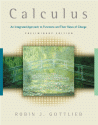
Robin J. Gottlieb. Calculus: An Integrated Approach to Functions and Their Rates of Change, Preliminary Edition. Addison Wesley, Boston, 2002.
In Math X, we will cover most sections in Chapters 1 through 25, 27, and 31. The textbook is available at the Harvard Coop.
Math X is taught in small sections so that you will have a better opportunity to ask questions and interact with your instructor. Make sure you take advantage of this arrangement. Any questions you ask in class will likely be ones that other students will want answered as well, so ignore any hesitation you might have and ask questions as the material is presented. You will not be penalized for doing this, no matter how trivial or simple you think your questions might seem. Remember, the class is being held for you to learn the material, not just to give you a time to copy notes off of a blackboard, so be sure to get help when you need it and stay involved in your class.
Lab meetings are held by the course assistants on Tuesdays and Thursdays during the semester. At the beginning of the term, you should choose one of the lab meetings to attend -- preferably the one offered by your section CA, if possible -- and attend that lab meeting throughout the semester. Three types of activities occur during lab meetings: graded lab assignments, problem sessions, and gateway exam. Lab meeting attendance is required for graded lab assignments and gateway exams and optional, but highly recommended, for problem sessions. Information on graded labs and gateway exams can be found below under Graded Work.
Problem sessions are those lab meetings during which no graded lab assignments are given. They are devoted primarily to working problems and reviewing material. Even if you find that you are not having difficulty doing the homework problems, you should still make a habit of attending these sessions.
You will find having a graphing calculator helpful in this course. We encourage you to bring your calculator to class with you every day. If you are purchasing a calculator, we recommend a Texas Instruments TI-83 PLUS calculator. You will be permitted to use your calculator on all assignments and exams, except for the gateway examinations and possibly one portion of the final exam.
With the availability of graphing calculators and mathematical software programs, it is now possible to do an amazing number of things almost instantaneously that would otherwise take hours or days to do by hand. Calculators can help you hone your mathematical skills and intuition by reducing time spend on computations and providing detailed graphs of functions. However, you should not rely on technology to such an extent that it keeps you from developing your own skills. It is easy to be misled by a calculator's results if you lack a good understanding of the associated mathematical concepts.
If you have questions about any aspect of the course, feel free to ask your section instructors, either by email or in person during their office hours. Additionally, students in every section of Math X are welcome to ask questions of the course head, either by email or in person during his office hours.
The course assistants are also sources of help. The twice-weekly lab meetings are led by the CAs. While some of the lab meetings consist of graded lab assignments, about half of the lab meetings are problem sessions designed to let you ask questions about the course material. You can also ask questions of your CAs via email or when they are on duty in the Math Question Center.
The Math Question Center is held in Loker Commons from 8 to 10 p.m. on Sunday through Thursday evenings during the term. The MQC is staffed by calculus course assistants, and it is a great place to work on homework with other Math X students and get help from the CAs. For more on the MQC, consult the MQC website.
You are also encouraged to form study groups with other students in the course to work on homework assignments. Working in study groups is one of the most effective strategies you can use to succeed in this or any other mathematics course. All homework assignments must be written up individually. If you do work with a study group, make sure that you are able to explain everything you write up in your homework assignment.
In general, if you miss a class or lab, you are still responsible for turning in homework and lab assignments to your course assistant on time. Exceptions will be granted only with the course head's approval.
If you miss a class or lab due to a Harvard-sponsored athletic or extracurricular event, you are responsible for turning in early any homework or lab assignments due during your absence. Exceptions will be granted only with the course head's prior approval.
If you cannot complete or turn in a homework or lab assignment due to illness, let the course head know. The course head may allow you to drop that assignment provided you present him with appropriate documenation of your illness from University Health Services, your physician, or your Assistant Freshman Dean or Senior Tutor.
The best way to learn mathematics is to do mathematics, which means that homework problems are an essential part of any mathematics course. Attending class and watching your instructor work problems are important, but without attempting the problems on your own, there is little chance that you will learn the material.
It is important not only that you get the right answers on your homework but also that you understand how those answers are obtained. While working on homework assignments, pay attention to the strategies you use to solve the problems and the meaning of your computations. Use the homework assignments to study the material in such a way that you can apply the concepts and techniques to a variety of problems -- even problems that do not look like problems you have seen before.
Homework will be assigned to be due most class meetings. Assignments will be graded by your course assistant and will typically be returned to you at the following class meeting. Solutions will then be posted on the course website. Make sure to read the solutions in order to learn more from your work.
Since solutions will be posted as soon as possible after homework assignments are due, and since getting behind in your homework is a bad idea, late homework assignments will not be accepted. However, we will drop your lowest three homework grades at the end of the course.
Labs are graded assignments distributed during some of the twice-weekly lab meetings held by the CAS. The labs are designed to build your skills in mathematical computation, reasoning, and modeling and to build your conceptual understanding of the course material. Lab meeting attendance is required on days in which graded labs are distributed. Labs are typically due in class on the following day. Graded labs are meant to take between 60 and 90 minutes, including the time spent during the lab meeting. Late labs will not be accepted, but your lowest lab grade will be dropped at the end of the course.
Two midterm examinations will be given during Math Xb, each covering roughly one-third of the course material. The midterms will be administered on the evenings listed in the table below. All Math Xb students will take each midterm together at the same time. Make-up exams will be administered only if a documented serious illness or personal tragedy prevents a person from taking an exam at the scheduled time. A review session will be offered prior to each midterm.
| Review Session 1 | Wednesday, March 10th, 5 to 7 p.m. | Science Center Hall E |
| Midterm 1 | Tuesday, March 16th, 7 to 9 p.m. | Science Center Hall D |
| Review Session 2 | Monday, April 12th, 7 to 9 p.m. | Science Center Hall A |
| Midterm 2 | Thursday, April 15th, 7 to 9 p.m. | Science Center Hall D |
A cumulative final exam will be given at the end of the term for Math Xb, as scheduled by the FAS Office of the Registrar. The Xb final is tentatively scheduled for Friday, May 21st, at 2:15 p.m.
Gateway exams are meant to test your understanding of certain fundamental pre-calculus and calculus techniques and concepts. Each exam consists of eight multiple-choice questions covering the topics listed in the table below. To pass a gateway exam, you must answer at least 7 of the 8 questions correctly. Before each exam, you will be provided with a collection of practice problems (complete with answers) that will be similar to the problems on the gateway exam.
Each gateway exam is first administered at the lab meeting listed on the table below. If you fail the gateway exam at this time, you must contact the course head or assistant course head to schedule a retake. You may retake a gateway exam as many times as you need to until you pass. For each gateway exam that you have not passed by 5 p.m. on May 7, 2004, your final grade for the whole course will be reduced by one letter. For example, if you have a B in the course but fail to pass two of the gateway exams, your course grade will be reduced to a D. However, students who make an earnest effort to pass the gateway exams almost always pass them eventually.
Note that calculators are not allowed on the gateway exams.
| Gateway 1 | Exponential and Logarithmic Functions | Tuesday, February 24th |
| Gateway 2 | Trigonometry | Thursday, March 11th |
| Gateway 3 | Differentiation | Thursday, April 22nd |
Your course grade will be determined as follows.
| Homework | 15% |
| Labs | 15% |
| Midterm 1 | 20% |
| Midterm 2 | 20% |
| Final Exam | 30% |
Your numerical score will be converted to a letter grade according to the following scale.
| Score | Grade |
| 90-100 | A |
| 80-89 | B |
| 65-79 | C |
| 50-64 | D |
| 0-49 | E |
Page maintained by Derek Bruff
(bruff@fas.harvard.edu).
Last updated on April 7, 2004.
Instructor's Toolkit