The birth year of Archimedes
This exhibit was written by Oliver Knill, Feb 1-Feb 3One reader of the new scientist article makes an interesting comment. Isn't Archimedes birthday 2299 years ago because the year 0 is missing in the counting in the AC/BC system? While the year 0 does not exist in that system, one can still justify that Archimedes birth was 2300 years ago. Our goal is to present a point of view which provides harmony between the different date notations.
We are aware that the official interpretation can be different. One authority in calendar matters is the book of Dershowitz-Reingold, "Calendrical Calculations" which deals in Section 1.3 with negative Years. An other source is "Jean Meeus, Astronomical Algorithms". [I'm thankful to Frank Josellis (the author of the unix calendar program "kal") for these references.] The Julian calendar is denoted Dershowitz-Reingold with C.E. (common era) resp. B.C.E (before common era) and uses the formula
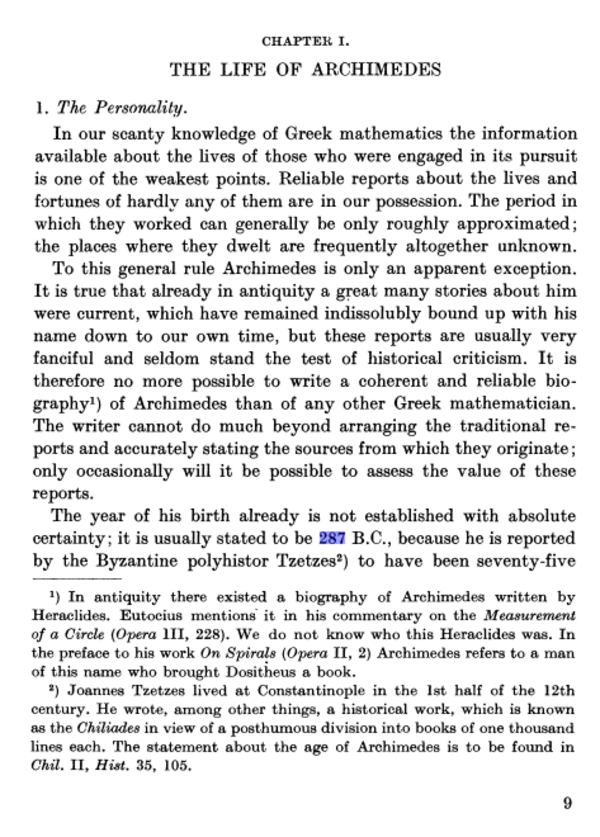
year -n [Gregorian] = year (n+1) B.C.E. [Julian]Dershowitz and Reingold write: "This convention is often a source of confusion, even among professional historians." Here are some pages from Dershowitz-Reingold [PDF], and some pages of Meeus [PDF]. The following argumentation is compatible with that formula. The discrepancy only comes when extending the formula from years to dates containing months and days which comes up rare since historical dates in that area are rarely known with that precision and because for astronomical data, the astronomical numbering is used. Archimedes birth year is reported to be 287 BC. In an extended year notation used by astronomers, this is the year -0286. That is not disputed. It is in the following interpretation that there can be disagreement:
| Hypothesis: Archimedes was born in the year 287BC was interpreted by early historians reporting the matter that his birth day falls in the time interval from 287BC to 288BC which is the time interval -287 to -0286 in the Gregorian calendar. |
On page 15 in Dershowitz-Reingold we see a different interpretation, since they translate also precise dates between the two. But note that for these tables, one side of the table does not reflect historical data, they are just translations done by the authors. Our main argument supporting the hypothesis is that the number 0 was considered a number only after the anno domini system was introduced (like for easter tables) and that the negative time axes must therefore have been considered a positive time axes turned backwards at a time when Tzetzes was writing (as the Anno Domini dating system is today).
Assume that the interpretation in the hypothesis holds and assume Archimedes would have been born on February 1, 287 (the month and day are of course completely made up), then the time interval between his birth and February 1, 2013 would be exactly 2300 years long. With this interpretation, the lack of the "zero year" can be compensated by "looking backwards in time" and the 2300 years are still fine. For example, if the birthday of Archimedes would be February 1, 287 BC, then today, on February 1, AC 2013, we would celebrate his 2300th birthday. The same conclusion can be drawn with the astronomical year numbering, where the birth date of Archimedes would fall into the interval [-0287,-0286]. With this notation, the year 287 BC ranges from -0287 to -0286. Since this is the same time interval, we get to 2300 years again. Here is an overview over the two dating systems and the situation:
                          no zero year but
                          zero time interval
                             |
                             |
             BC              v        AC

  288   287    ...     2   1   1   2   ...     2013 2014      anno domini dating
<--+-----+-----------------+---+----------------+----+---->
-0287  -0286   ...    -1   0   1   2   ...     2013 2014      astronomical year
    |                                            |            numbering
    |                                            |
  Feb 1 (example)                              Feb 1
  birth day     <--- exactly 2300 years  --->  today
This point of view has the following advantages:
- There is consistency between the anno domini dating and the astronomical year numbering. Of course the above formula in Dershowitz/Reingold is unchanged (we consider this a trivial fact and undisputed). It is only the interpretation of exact dates which changes.
- There is no missing year. Especially for historians closer to year 0, it would have been unacceptable to be aware of a missing year. How would one date events which fall into that time span? Would February 1 of year 0 (astronomical year numbering) really have been considered February 1 of year 1 BC and next year February 1 AC?
- Thinking in the same way as a mind of the middle ages, where negative numbers were avoided and even 0 was unknown or treated as "emerging technology", the following picture of the time axes could also well have been in the minds of scribes:
                              timespan of the
                              year 3 AC
                             <------>

                 1     2     3      4     5    6
AC               +------------------------------>

BC               +------------------------------>
                 1     2     3      4     5     6

                             <------>
                               timespan of the
                               year 3 BC
Since unlike for certain astronomical events,
we do not know the dates that accurately even for Archimedes, the discrepancy
is not so relevant and the question of placing dates is more or less academic.
Especially in the case of Archimedes, where one has to take the birth year anyway with
a give or take of one year.
And we might never know precisely, which interpretation historians have used thousand
years ago. Of course, it would be nice to have sources which make this more clear. But the above interpretation seems at least as likely as the interpretation that the point 4 BC is the starting point of the year 3BC. The later looks improbable for a mind which works only with positive numbers. The negative time axes looks only natural for us since we are familiar with the entire ring of integers embedded in nice line representing the real axis.
We have never seen this question addressed. It might be difficult to figure out with certainty what was in the mind the first historians reporting about events BC.
Numbering can look crazy but often make sense if interpreted. We call the time span from 1900 to 1999 the 20th century or the 19 hundreds. And both make sense. The name 19 hundreds refers to the number like 1949 and the 20th century reflects the fact that the first century includes the years until 99. Also here there is no discrepancy. But also here, the 19th century BC is the time interval from 2000 BC to 1900 BC which are the 19 hundreds BC. The interval from AC 1 to AC 99 is the first century AC and the interval from 1 BC to 99 BC is the first century BC. Also here, there is no missing interval. We just have not decided where to put the year from 1 BC to AC 1.
                    20th century AC
                    19hundreds
                <------------>

               1900         2000         2101
AC              +------------+------------+

BC              +------------+------------+
               1900         2000         2100

                <------------>
                    20th century BC
                    19 hundreds BC
So the challenge is the following:
| Find sources which indicate what historians and writers around 1200 were thinking when they wrote about historical events BC. Which time intervals did they consider. For example, if somebody would write about the year 1 BC, would they mean the time between the astronomical year 0 and -1 or would they mean the time between -1 and -2? |
It is clear that if they would write about the year 1 AC, they would mean the time between the astronomical year 1 and 2. Taking into account what BC abbreviates and that negative numbers were strange at that time, the former looks more likely. It has the advantage that it does not have the missing year problem and that it is compatible with everything else we know since anyway, we do not know historical dates that accurately.
If no sources can be found, then the interpretation given here should at least be considered equally likely.
The good news is that in the event that Archimedes should be only be 2299 years old in 2013, we would have an other opportunity to celebrate in 2014!
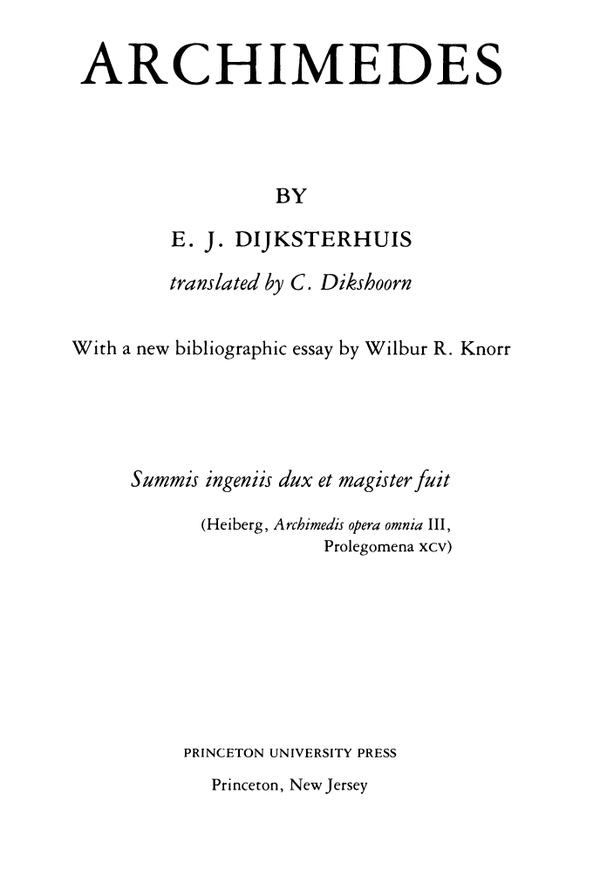
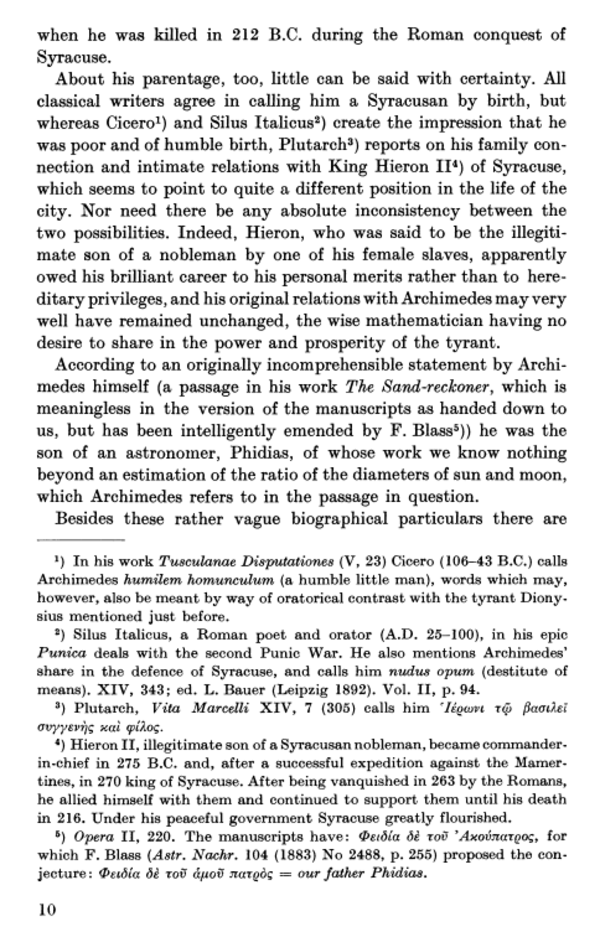
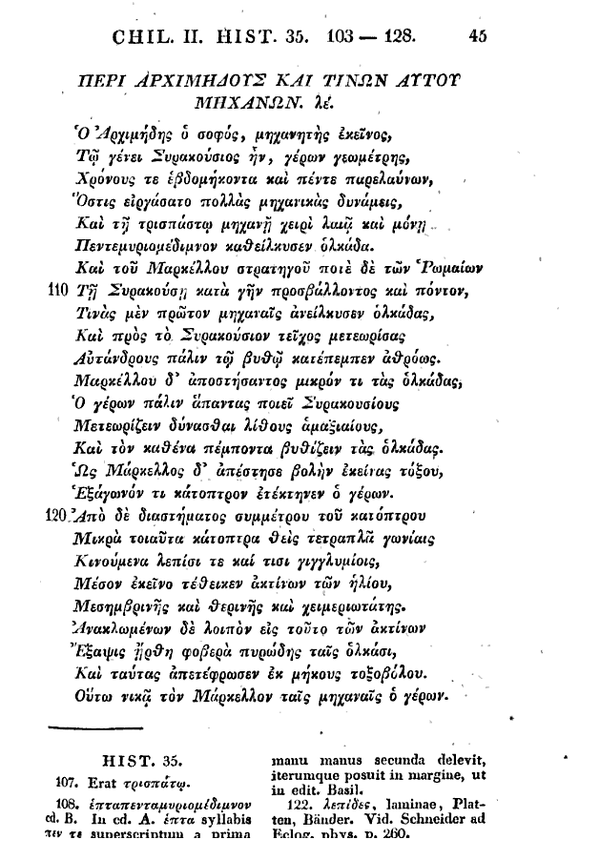
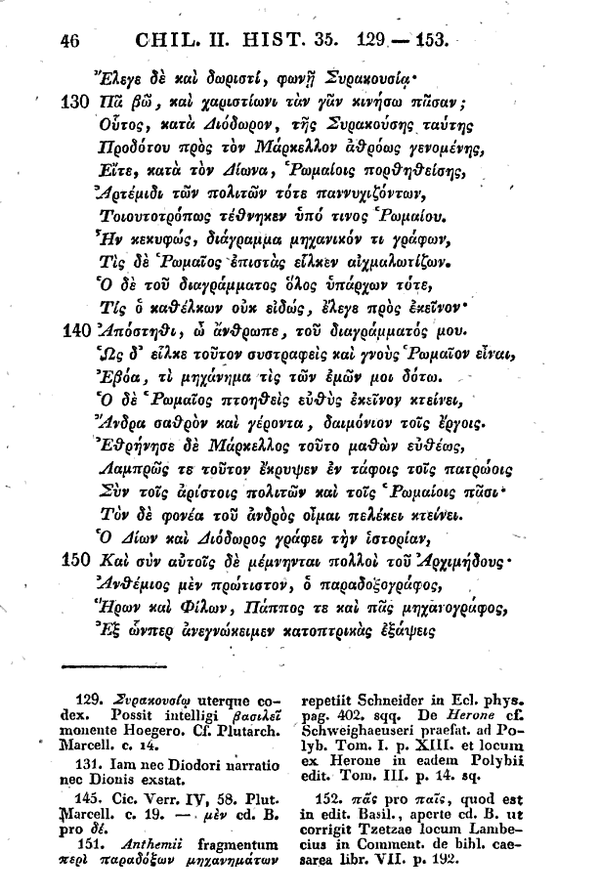
Anyway, when writing the article, our source was the book "Archimedes", by E.J. Dijksterhuis, Princeton University Press, (first printed 1956), 1987. Here are the relevant pages: