|
Update of August 11, 2018: The book of Fritz Staudacher appears in an extended forth edition (2018).
Staudacher. Fritz: Jost Bürgi, Kepler und der Kaiser.
Uhrmacher, Astronom, Mathematiker, Instrumentenbauer,
Erz-Metallurgist (1552-1632). 4., überarbeitete und
erweiterte Auflage, mit einem Beitrag des
Artificium-Entdeckers Menso Folkerts,
320 Seiten, 279 Abbildungen.
Verlag NZZ Libro, Zürich 2018. ISBN 978-3-03810-345-5.
It will be available
in the 4th edition soon.
Update of December 17, 2017:
My own book review of the book of Fritz Staudacher about Buergi.
Here is a cleaned out Google translation:
Not only is this the best information source about Buergi, it is also the best biography I've seen about this
mathematician. The book is well researched (there are many original sources and not just secondary literature), it
is clearly and well written and also beautifully printed. Jost Buergi is a very interesting Renaissance
personality, an universal talent that is even today vastly underestimated. For example, it has only been realized
recently that the logarithms of Buergi were not only found long before Napier, but that they were also introduced
in a more modern and clearer manner than those of Napier. Also, the enormous influence of Buergi on Kepler is
made clear in the book. Without the logarithms of Buergi, the latter would hardly have found the
Kepler laws. While other cases of unusual geniuses have been documented extensively (examples are Archimedes, who was also an
engineer and inventor, George Green, who was a miller, Albert Einstein who was a patent employee,
Srinivasa Ramanujan, who was an autodidact, Fritz Zwicky, a rocket man), so is the case Buergi much less well
known. This book will help to give the necessary attention to one of the best and most creative
mathematicians of the renaissance. On the structure of the book: the first chapter describes the origin of
Buergi (Lichtensteig in Toggenburg). The author built in a lot of historical background here.
The second chapter shows the professional career (locksmith, silversmith, watchmaker apprentice, etc.)
It is exciting that there is a great deal of uncertainty: did Jost learn the watchmaking profession in
Winterthur, or with the Habrecht family in Schaffhausen? Also, one does not know exactly, where Buergi spent his
apprentice years: Nuernberg is the almost certain guess. Chapter 3 describes clocks built by Buergi, including
observation clocks having an accuracy not surpassed at gthat time: Buergi was seven decades ahead of
Huygens pendulum clock, of course, accurate astronomical data were extremely important. Kepler would not
have found the elliptical shape without a precise timekeeping device. The book rightly refers to the
Antikythera, a calendar mechanism that could have been built by Archimedes. In Chapter 4, instruments
built by Buergi are introduced like (astrolabes, proportional compass, caliber rod, triangulation
instruments or sextants.) Kepler has determined the Mars orbital ellipse with a Buergi sextant.
Chapter 5 is dedicated to count Wilhelm IV of Hessel-Kassel. The kurfurstliche castle was the workplace
of Buergi for 25 years. Tycho Brahe called it the count the most important astronomer in Europe.
Buergi was responsible for the instruments. The fact that the accuracy of the Kasseler star measurements
is twice as good as that of Tycho Brahe, is the merit of Buergi.
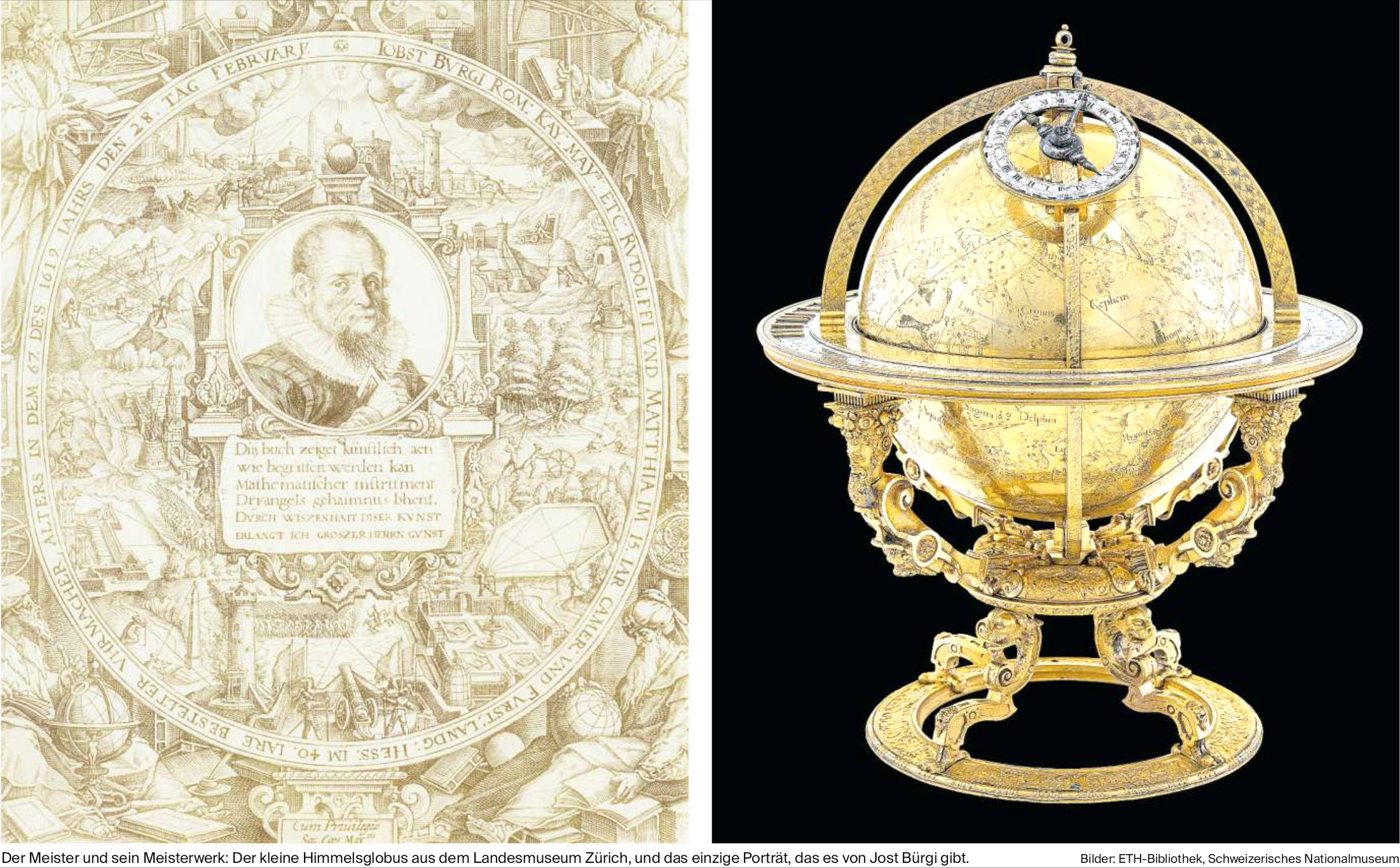
Chapter 6 is about the celectial globes. Finally, Chapter 7 is devoted to mathematics.
Buergi turns out to be more talented than the court mathematician Rothmann, who called the only
Swiss-German-speaking Buergi read "the Illiteratus" (the unread) or "Horlogiopaeus" (the watchmaker).
For the moment, Buergi has a friend in Reimers Baer, who also comes from simple circumstances, but
can translate the Kopernikus for Buergi. The book notes that "along with Viete, Clavius and
Stevin, Buergi is one of the pioneers of decimals and spelling" and
"For Johannes Kepler it is not a question that it is Jost Buergi who invented the decimal fraction."
Another central statement, which I have confirmed with my own humble research on writing an encyclopedia
article on Buergi, is on page 179 of the book: "Buergi's logarithm pegs are not only developed
earlier in time than Napier's, but from today's perspective also a qualitatively more modern one mathematical
concept. "The whole chapter is exciting, showing that Buergi himself is not far from his own calculating
machine and with an "art path algorithm" that anticipated matrix multiplication.
Chapter 8 addresses the question of why Buergi remains so much obscured still today.
Negative experiences played a role, and Kepler's secrecy clause is also essential. Buergi who was
"beyond university and Latin" had to work hard to invent any invention, not just unprejudiced and
unpunished copied. Fatal was that it was prohibited to Kepler due to objections by Brahe heirs,
to mention only Brahe and his assistants.
The logarithmic publication was also carried away in the turmoil of the Thirty Years' War.
An interesting paradox is mentioned at the end of the chapter: "It's a paradox: Kepler sees badly, Brahe
does not like to calculate, Buergi does not understand Latin, and yet revolutionizes this European
triumvirate of a German mathematician, a Danish Astronomen and a Swiss clock maker in the
Chech-Bohemian Prag in Austrian-Habsburg Aegide the knowledge of the world,
because of extraordinary individual competences in their complementary areas of expertice."
Chapter 9 illustrates the contributions of Buergi to the astronomy of Keplers,
Chapterl 10, the return from Prague to Kassel, where also the family circumstances of Buergi are explained.
chapter 12 is an epiloge to this extraordinary bibliography. A quote from the end of the book:
"Jost Buergi is is the reason why the modern age ticks".
|