Next: Cellular automata on circle
Up: Cellular automata with almost
Previous: Introduction
Let A be a finite set and consider the space
 with the product topology.
The set A is called the alphabet,
with the product topology.
The set A is called the alphabet,  the configuration space,
and points in are called configurations.
Let
the configuration space,
and points in are called configurations.
Let  act on by translation:
 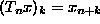 .
A cellular automaton
.
A cellular automaton  is a continuous map on
  such that
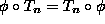 for all
  .
By the Curtis-Hedlund-Lyndon theorem (see e.g. [16]),
there is for every cellular automaton a finite set
.
By the Curtis-Hedlund-Lyndon theorem (see e.g. [16]),
there is for every cellular automaton a finite set  such that
  only depends on
  .
.
A set  is called invariant if
  for all .
A compact invariant subset of is called a subshift.
The orbit of
for all .
A compact invariant subset of is called a subshift.
The orbit of  is the set
 and the orbit closure
  of x is the closure of
  in .
So orbit closures are subshifts.
A subshift X is called minimal if
in .
So orbit closures are subshifts.
A subshift X is called minimal if  for all
  .
A probability measure
.
A probability measure  on (the Borel
  -algebra of)
or a subshift is called invariant if
-algebra of)
or a subshift is called invariant if 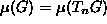 for all
measurable G and all .
A subshift is called uniquely ergodic if there exists only one invariant
probability measure on it; it is called strictly ergodic if it is uniquely
ergodic and minimal.
for all
measurable G and all .
A subshift is called uniquely ergodic if there exists only one invariant
probability measure on it; it is called strictly ergodic if it is uniquely
ergodic and minimal.
A cellular automaton maps subshifts to subshifts.
Thus the image  is what is called a topological factor of
X.
This implies that certain properties of subshifts are invariant
under cellular automata.
Examples are: topological transitivity (i.e., there is a dense orbit),
minimality (i.e., every orbit is dense), unique ergodicity (see
Proposition 3.11 in [4]),
being of finite type, and primality (there is no nontrivial factor).
is what is called a topological factor of
X.
This implies that certain properties of subshifts are invariant
under cellular automata.
Examples are: topological transitivity (i.e., there is a dense orbit),
minimality (i.e., every orbit is dense), unique ergodicity (see
Proposition 3.11 in [4]),
being of finite type, and primality (there is no nontrivial factor).
Remarks.
1) Prime subshifts exist [7].
If we apply a cellular automaton to a prime subshift, then
every subshift in the orbit of the cellular automaton is
topologically conjugated to the subshift
one started with unless one reaches a fixed point consisting of
a constant sequence.
2) If X is uniquely ergodic with invariant measure m and
has discrete spectrum  (i.e., the eigenfunctions
are dense in
(i.e., the eigenfunctions
are dense in  , where m is the invariant measure),
then
, where m is the invariant measure),
then  also has discrete spectrum
  and is a subgroup of .
The reason is that the measure theoretical factor
and is a subgroup of .
The reason is that the measure theoretical factor
 of
of  is isomorphic
to
is isomorphic
to 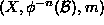 and that
the conditional expectation
and that
the conditional expectation  of an eigenfunction
  is again an eigenfunction.
3) A cellular automaton does not increase the topological
entropy of a subshift.
This observation, however, is of limited practical
importance since for d=1 subshifts generically (w.r.t.\
the Hausdorff metric)
have topological entropy zero [31],
whereas in higher dimensions the topological entropy
is `as a rule' infinite (cf. [27]).
The directional topological entropy in the direction  is defined
as the topological entropy of
is defined
as the topological entropy of  (cf. [27]).
Directional topological entropy does not increase either.
(cf. [27]).
Directional topological entropy does not increase either.
4) The fact that cellular automata leave classes of subshifts invariant
was our motivation to look at them. Call a minimal subshift X
palindromic, if an element (and hence all )
contains arbitrary long palindromes.
Cellular automata that commute
with the involution  map the set of palindromic subshifts into itself.
Discrete Schrödinger operators with
palindromic subshifts as potential have a generic set in their hull
for which the spectrum is purely singular continuous [19].
Therefore, applying cellular automata to palindromic subshifts
gives new classes of operators with singular continuous spectrum.
map the set of palindromic subshifts into itself.
Discrete Schrödinger operators with
palindromic subshifts as potential have a generic set in their hull
for which the spectrum is purely singular continuous [19].
Therefore, applying cellular automata to palindromic subshifts
gives new classes of operators with singular continuous spectrum.


Next: Cellular automata on circle
Up: Cellular automata with almost
Previous: Introduction
Oliver Knill
Fri Jun 26 16:29:39 CDT 1998