Next: A one-dimensional example: rule
Up: Cellular automata with almost
Previous: Cellular automata on subshifts
Denote by  the ring generated by half-open intervals
  ,
with the convention
,
with the convention  .
Every
.
Every  is a finite union of half-open intervals.
Given
is a finite union of half-open intervals.
Given
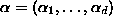 and
and  , let
, let
 ,
where the dot denotes the Euclidean inner product.
Assume that the
,
where the dot denotes the Euclidean inner product.
Assume that the  are rationally independent.
Then the orbit closure of x
is strictly ergodic, and independent of
are rationally independent.
Then the orbit closure of x
is strictly ergodic, and independent of  (see e.g. [18]).
We call it a circle subshift.
(see e.g. [18]).
We call it a circle subshift.
Circle subshifts of 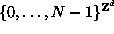 are defined analogously as the orbit closure of

where f is a function taking values in 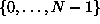 on
half-open intervals that partition
on
half-open intervals that partition  .
In other words,
.
In other words, 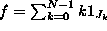 , where each
  is a finite union of half-open intervals [a,b),
  , and
, and  for
for  .
.

Begin of the proof.
Let  be a circle shift and
  a cellular automaton.
We show how to find a finite collection of half-open intervals
a cellular automaton.
We show how to find a finite collection of half-open intervals
 such that
  .
.
Choose a and let 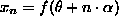 .
Let
.
Let  be a finite set such that
  only depends on
  .
Since commutes with translations,
.
Since commutes with translations, 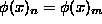 whenever x has the same pattern in F+n and in F+m.
There are finitely many different patterns
whenever x has the same pattern in F+n and in F+m.
There are finitely many different patterns  that can occur
in a translate of F.
For each there is a
that can occur
in a translate of F.
For each there is a  such that the pattern
occurs in F+n if and only if
such that the pattern
occurs in F+n if and only if  .
Each
.
Each  is a finite union of half-open intervals because
is a ring closed under intersection and union.
Indeed one has
is a finite union of half-open intervals because
is a ring closed under intersection and union.
Indeed one has
 if occurs in n+F.
Hence
if occurs in n+F.
Hence 
End of the proof.
Remarks.
1. This proof is constructive.
We have implemented it as an algorithm in
Mathematica ]
and all experiments we report here have been done with Mathematica.
The program is available
here in MathSource .
|
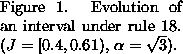
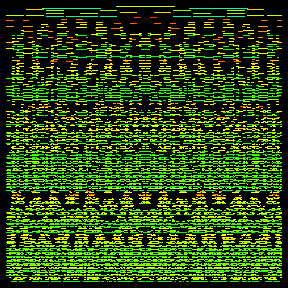
The iteration starts with one interval (at the top). After the first step,
there are two intervals. The intervals are colored according to the density
(the sum of the lengths of the intervals). There are 200 steps.
|
2. The subshift is periodic if and only if
 .
A cellular automaton on a periodic subshift is the same as the
cellular automaton with periodic boundary conditions with the same period.
.
A cellular automaton on a periodic subshift is the same as the
cellular automaton with periodic boundary conditions with the same period.
3. A configuration  is called a blinker, if it is a periodic point of and
has compact (and therefore finite) support
is called a blinker, if it is a periodic point of and
has compact (and therefore finite) support  .
If a cellular automaton has a blinker then we can construct
aperiodic circle subshifts that are periodic orbits of .
Let
.
If a cellular automaton has a blinker then we can construct
aperiodic circle subshifts that are periodic orbits of .
Let  be a cube such that the configuration outside G does
not effect the blinker in one iteration of .
We can assume
be a cube such that the configuration outside G does
not effect the blinker in one iteration of .
We can assume  .
Choose . There exists an
.
Choose . There exists an  such that
the intervals
such that
the intervals  are disjoint for all
  .
Now take
.
Now take  .
Then the circle subshift defined by J consists of quasi-periodically
spaced copies of the blinker, far enough apart so that the blinkers do
not interact.
.
Then the circle subshift defined by J consists of quasi-periodically
spaced copies of the blinker, far enough apart so that the blinkers do
not interact.
4. A configuration  is called a glider if
it is a blinker for the cellular automaton
is called a glider if
it is a blinker for the cellular automaton  for
some
for
some  and
and  .
The vector
.
The vector  is the velocity of the glider.
Since is a cellular automaton, it follows from the
previous remark that there are circle subshifts for
that consist of quasi-periodically spaced gliders.
is the velocity of the glider.
Since is a cellular automaton, it follows from the
previous remark that there are circle subshifts for
that consist of quasi-periodically spaced gliders.
5. If a cellular automaton of dimension  contains a glider, then the topological entropy of is infinite.
The reason is that one can then embed in it a (full) topological shift with
an arbitrary large alphabet.
The Game of Life therefore has infinite
topological entropy and one has to use higher dimensional entropies
[27] in order to get interesting quantities.
contains a glider, then the topological entropy of is infinite.
The reason is that one can then embed in it a (full) topological shift with
an arbitrary large alphabet.
The Game of Life therefore has infinite
topological entropy and one has to use higher dimensional entropies
[27] in order to get interesting quantities.
For the remainder of this section consider the case of d=1.

Begin of the proof.
The measurable map  conjugates
  with
the shift on .
The map
with
the shift on .
The map  is injective:
  implies
 for in a dense set and so
J=J+(x-y) with
for in a dense set and so
J=J+(x-y) with  .
.
By unique ergodicity,  so that
the map is measure preserving.
so that
the map is measure preserving.
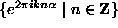
The isomorphism between the two
systems  and the shift on
assures that the shift on has also the spectrum
and the shift on
assures that the shift on has also the spectrum
 .
.
End of the proof.
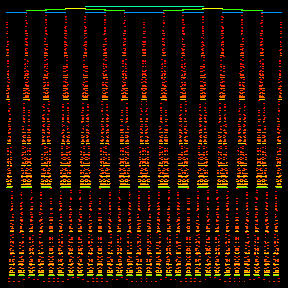 Note that k cannot decrease under a cellular automaton.
If k increases then the cellular automaton creates
additional symmetry.
Note that k cannot decrease under a cellular automaton.
If k increases then the cellular automaton creates
additional symmetry.
In the picture to the left we see an example of such a symmetry increase.
We started with a single
interval [1/2-tau,1/2+tau]
where (tau+1.2) 2 = 2 and iterated 200 steps.
The colors code the density of the configuration.
|
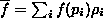
Strict ergodicity implies that for every continuous function
f on a circle subshift the average

exists uniformly in  and is equal to
  ,
where m is the strictly ergodic probability measure on X
(see e.g., [32], Section 6.5).
If f(x)=
,
where m is the strictly ergodic probability measure on X
(see e.g., [32], Section 6.5).
If f(x)=  then
then  can be
calculated as follows.
For each pattern
can be
calculated as follows.
For each pattern  of length 2l+1 that occurs in ,
there is a corresponding
of length 2l+1 that occurs in ,
there is a corresponding  (defined uniquely
up to translation; cf. the proof of Proposition 3.1).
If the Lebesgue measure of
(defined uniquely
up to translation; cf. the proof of Proposition 3.1).
If the Lebesgue measure of  is denoted by
  then
then
 .
Thus we see that certain macroscopic properties of a circle
subshift (the averages ) can be computed
exactly in finitely many steps.
The simplest example is the density, which is the average of
the function
.
Thus we see that certain macroscopic properties of a circle
subshift (the averages ) can be computed
exactly in finitely many steps.
The simplest example is the density, which is the average of
the function  .
.
Other macroscopic quantities of interest are the correlation
function  and its Fourier
transform, the power spectrum.
Note that both are independent of by strict
ergodicity.
The power spectrum is a positive measure on .
Li [23] has computed the power spectra of the r=1
cellular automata starting from random initial conditions
on a lattice of size 4096.
Since the spectrum of is discrete, the
power spectrum is a purely discrete measure, i.e., a
countable sum of weighted delta functions.
The delta functions live at the points of the spectrum determined
in Proposition 3.2.
The weights can be computed directly, without first computing
the correlation function.
Note that
and its Fourier
transform, the power spectrum.
Note that both are independent of by strict
ergodicity.
The power spectrum is a positive measure on .
Li [23] has computed the power spectra of the r=1
cellular automata starting from random initial conditions
on a lattice of size 4096.
Since the spectrum of is discrete, the
power spectrum is a purely discrete measure, i.e., a
countable sum of weighted delta functions.
The delta functions live at the points of the spectrum determined
in Proposition 3.2.
The weights can be computed directly, without first computing
the correlation function.
Note that

uniformly in  because the sequence
  is well distributed for every irrational
  [22].
This uniformity suffices to prove that the weights are
given by
[22].
This uniformity suffices to prove that the weights are
given by  (see [29], Section IV.3.1, or
[17], Theorem 3.4).
Thus the Fourier components of
(see [29], Section IV.3.1, or
[17], Theorem 3.4).
Thus the Fourier components of  fully determine the power
spectrum of .
fully determine the power
spectrum of .
This also shows that circle subshifts can be used to get information
about the attractor 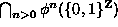 of the full shift.
Weak limit points of power spectra of
of the full shift.
Weak limit points of power spectra of  are power
spectra of ergodic components of the attractor of the full shift.
are power
spectra of ergodic components of the attractor of the full shift.


Next: A one-dimensional example: rule
Up: Cellular automata with almost
Previous: Cellular automata on subshifts
Oliver Knill
Fri Jun 26 16:29:39 CDT 1998