Next: Almost periodic lattice gas
Up: Complexity Growth in Almost
Previous: Complexity Growth in Almost
Generally speaking, any physical system that can have
periodic boundary conditions can also be considered in an
almost periodic setup. Almost
periodicity allows averaging and yields global translational
invariant quantities. While this is also possible in more
general ergodic setups, almost periodicity has the feature of strict
ergodicity so that the mean is defined by a single
configuration alone. The hull, the closure of all translates of an
almost periodic configuration, is a compact topological group
on which averaging with respect to the unique Haar measure gives
macroscopic quantities. Almost periodic configurations
can have more than the obvious
translation symmetry because the dimension of the hull of the function
is in general larger than the space on which the functions are defined.
The other modes of symmetry are internal symmetries of the system.
Almost periodicity appears in the literature
mostly for systems with an almost periodic time-dependent
forcing term or when almost periodic solutions of the systems are
considered. This is not the topic here. We consider
particle configurations which have spatial almost periodicity
and evolve them with a time-independent law. Actually, we are interested in
situations where the complexity grows during the evolution, making it
impossible that the solution is also almost periodic in time.
In section 2, we reconsider almost periodic lattice gas automata,
for which almost periodicity is understood in the sense of minimality.
In section 3, we look at spatial
Bohr almost periodic Vlasov systems in which context spatial almost periodicity
appears to be new. In both situations, the time evolution renders the
configuration increasingly hard to describe and there is
a measure for the growth of complexity.
First, we mention three other spatially
almost periodic dynamical systems, which belong to the same type we
are interested in but which we do not discuss any further in
this paper.
1. Almost periodic KdV and Toda systems.
The almost periodic Korteweg-de Vries (KdV) equation introduced in [12]
is an example where spatial almost periodicity appears in fluid dynamics.
It is defined as the isospectral deformation of a one-dimensional
almost periodic Schrödinger operator  , where V is a Bohr
almost periodic function. It is a model for an almost periodic fluid in
a shallow water channel. If V is periodic, one obtains the KdV equation
with periodic boundary conditions as a special case. A discrete version
of the almost periodic KdV is the almost periodic Toda system [7]
, where V is a Bohr
almost periodic function. It is a model for an almost periodic fluid in
a shallow water channel. If V is periodic, one obtains the KdV equation
with periodic boundary conditions as a special case. A discrete version
of the almost periodic KdV is the almost periodic Toda system [7]

on the space of continuous periodic functions f. It describes a chain
of oscillators with position 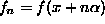 which are nearest neighbor
coupled by an exponential potential:
which are nearest neighbor
coupled by an exponential potential:

If  is rational, then
  and the system is the periodic
Toda lattice. It can be integrated by conjugating the flow to a linear flow
on the Jacobi variety of a Riemann surface defined by the isospectrally deformed
Jacobi matrix. In the almost periodic case, one still has an isospectral
deformation of an almost periodic Jacobi matrix. However, an infinite dimensional
generalization of the algebro-geometric integration
is expected to work only in very special cases.
and the system is the periodic
Toda lattice. It can be integrated by conjugating the flow to a linear flow
on the Jacobi variety of a Riemann surface defined by the isospectrally deformed
Jacobi matrix. In the almost periodic case, one still has an isospectral
deformation of an almost periodic Jacobi matrix. However, an infinite dimensional
generalization of the algebro-geometric integration
is expected to work only in very special cases.
2. Almost periodic discrete parabolic or hyperbolic PDEs.
Coupled map lattices are dynamical systems which are used to model
partial differential equations (PDEs).
They can be viewed as "CA with a continuum alphabet. "
Such systems appear in numerical
codes for PDEs. They became popular especially
with the work of Kaneko, Bunimovich, and Sinai because they provide
systems with "space-time chaos" which has an easy proof using
an idea of Aubry [6]. An almost periodic example of
a coupled map lattice is the evolution  on the space of continuous functions on the d-dimensional torus, where
 are translations. The aperiodic configuration
 with
with  evolves in time according to
  . The name "coupled map
lattice" comes from the fact that for
. The name "coupled map
lattice" comes from the fact that for  , the system is an array
of decoupled maps
, the system is an array
of decoupled maps  , which become coupled when
 . Again, if all
  are rational, these configurations
are periodic, if
are rational, these configurations
are periodic, if  is irrational the configurations are almost periodic.
Not only parabolic PDEs but also hyperbolic PDEs such as nonlinear wave
equations, have discrete analogues as symplectic coupled map lattices.
An example is
is irrational the configurations are almost periodic.
Not only parabolic PDEs but also hyperbolic PDEs such as nonlinear wave
equations, have discrete analogues as symplectic coupled map lattices.
An example is  on pairs of periodic functions on the torus.
This discrete PDE can be rewritten as
on pairs of periodic functions on the torus.
This discrete PDE can be rewritten as
 with
with  .
This is a discrete version of a nonlinear wave equation because
.
This is a discrete version of a nonlinear wave equation because
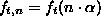 satisfies the discrete nonlinear wave
equation
satisfies the discrete nonlinear wave
equation
 ,
a discretization
,
a discretization  . For ,
it is an array of decoupled Henon type twist maps. For a
cubic polynomial W, it occurs as the Euler equations of a
natural functional [8].
. For ,
it is an array of decoupled Henon type twist maps. For a
cubic polynomial W, it occurs as the Euler equations of a
natural functional [8].
3. Almost periodic Riemannian geometry and Vlasov-Einstein dynamics.
Almost periodicity is also interesting in a differential
geometric setup, where interacting particles move along geodesics.
An almost periodic metric g on Euclidean space defines an almost periodic
Riemannian manifold on which one can average. In some sense, such a manifold
looks like a torus because the mean of the curvature gives zero.
Averaging through almost periodicity could be interesting in
general relativity, because the Hilbert action is
still defined by an almost periodic mean.
Without a compactness assumption on the manifold,
this would only be possible by assuming asymptotic flatness of the metric.
A metric solving the almost periodic Einstein equations
is a critical point of a well defined variational problem.
The classic Vlasov equation considered here
has as a relativistic analogue the Vlasov-Einstein equation
 , which describes
matter not interacting through a potential but through the metric:
the connection
, which describes
matter not interacting through a potential but through the metric:
the connection  is determined from a metric g solving the
Einstein equations
is determined from a metric g solving the
Einstein equations 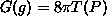 .
Existence results are only known in very special situations.
Solving the Einstein equations in the almost periodic case and a better
understanding of the geodesic flow in an almost periodic metric are
problems that have not yet been addressed.
.
Existence results are only known in very special situations.
Solving the Einstein equations in the almost periodic case and a better
understanding of the geodesic flow in an almost periodic metric are
problems that have not yet been addressed.
Next: Almost periodic lattice gas
Up: Complexity Growth in Almost
Previous: Complexity Growth in Almost
Oliver Knill
Mon Jun 29 14:18:53 CDT 1998