Next: Almost periodic particle dynamics
Up: Complexity Growth in Almost
Previous: Introduction
Lattice gas CA are used for numerical simulations of fluids. They provide
a reasonable numerical method when the fluid has complex geometric boundary
conditions. Almost periodic CA [4] can store and process large
periodic configurations in a compressed form and allow for dealing with
infinite aperiodic configurations. The size of the data used to store the
configuration measures the complexity of the fluid. The growth rate of
this information is a numerical quantity which can
be determined. As in the case of the entropy for smooth
dynamical systems, one cannot expect to compute it explicitly in general.
The term "almost periodicity" for CA is used as a synonym
for minimality, a common terminology in mathematical physics
that is different from the mathematical term of Bohr almost periodic
functions considered in section 3:
a configuration  is called
almost periodic if no nontrivial closed shift invariant subset
in the closure of the orbit of x exists. Almost periodicity is interesting
since it occurs in nature, for example, in quasi-crystalline materials, where
the centers of the atoms form almost periodic configurations.
Mathematically, almost periodic initial conditions are
a natural alternative to periodic or random initial conditions.
is called
almost periodic if no nontrivial closed shift invariant subset
in the closure of the orbit of x exists. Almost periodicity is interesting
since it occurs in nature, for example, in quasi-crystalline materials, where
the centers of the atoms form almost periodic configurations.
Mathematically, almost periodic initial conditions are
a natural alternative to periodic or random initial conditions.
CA are dynamical systems which evolve a
d-dimensional array of letters  in a finite alphabet
 using a translational invariant rule.
More precisely, a CA is a continuous map
using a translational invariant rule.
More precisely, a CA is a continuous map  on the compact
space
on the compact
space  which commutes with all translations
 with
with  .
By the Curtis-Hedlund-Lyndon theorem, the new state
.
By the Curtis-Hedlund-Lyndon theorem, the new state  at a grid
point
at a grid
point  depends only on
  ,
where F is a finite neighborhood of n.
As for any dynamical system , one is interested in
invariant sets such as attractors or periodic orbits.
Such invariant sets are crucial for understanding
the long term behavior of the dynamics and especially
the behavior of averaged quantities over time. Since
,
where F is a finite neighborhood of n.
As for any dynamical system , one is interested in
invariant sets such as attractors or periodic orbits.
Such invariant sets are crucial for understanding
the long term behavior of the dynamics and especially
the behavior of averaged quantities over time. Since  ,
also
,
also 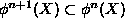 and the attractor
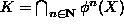 is a compact set on which
all invariant measures of have their
support. K decomposes in general to smaller
closed invariant sets.
The minimal invariant subsets are by definition almost periodic
and sometimes, we expect a minimal set that can be given by a Sturmean
configuration which can be stored with a small amount
of data. At a fixed time such a configuration is represented as a union
of half open intervals
is a compact set on which
all invariant measures of have their
support. K decomposes in general to smaller
closed invariant sets.
The minimal invariant subsets are by definition almost periodic
and sometimes, we expect a minimal set that can be given by a Sturmean
configuration which can be stored with a small amount
of data. At a fixed time such a configuration is represented as a union
of half open intervals 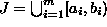 . Associated with each
interval
. Associated with each
interval  is a value
  .
For
.
For  , a Sturmean configuration is given by

where  is a vector of d rotation
numbers,
is a vector of d rotation
numbers,  is a parameter, and
  is
the location of a cell in the lattice
is
the location of a cell in the lattice  . Here
  is the characteristic function of a set H, which is 1 for
  and 0 for
  . Periodicity can be established by
taking rational numbers
. Periodicity can be established by
taking rational numbers  .
It can be seen in a constructive way that
the CA rule applies to the interval data J.
The translation back to the lattice
.
It can be seen in a constructive way that
the CA rule applies to the interval data J.
The translation back to the lattice  is only necessary when inspecting part of the phase space. Note also that
with a nondeterministic rule there is still an evolution on
the set of intervals.
is only necessary when inspecting part of the phase space. Note also that
with a nondeterministic rule there is still an evolution on
the set of intervals.
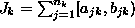
An interesting quantity is the growth rate of the number  of
intervals. It is a measure for the memory needed to store a
configuration. Of course, if the numbers are all rational, then
there is an upper bound for the number of intervals. If one rotation number
is irrational, the number of intervals will in general grow
indefinitely. How fast can it grow?
Let
of
intervals. It is a measure for the memory needed to store a
configuration. Of course, if the numbers are all rational, then
there is an upper bound for the number of intervals. If one rotation number
is irrational, the number of intervals will in general grow
indefinitely. How fast can it grow?
Let  be the influence region of and assume
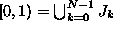 , where each
  is a finite union of half open intervals
 with
with  .
An interval configuration J consists of
.
An interval configuration J consists of 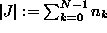 half open intervals. We claim that the number of intervals has a
polynomial upper bound
half open intervals. We claim that the number of intervals has a
polynomial upper bound  .
To prove this it is enough to show the claim
for n=1 and then replace by
.
To prove this it is enough to show the claim
for n=1 and then replace by
 . If
. If 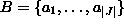 with
with
 is the set of boundary points of the
partition J, then the set of boundary points of the new partition
is the set of boundary points of the
partition J, then the set of boundary points of the new partition  is contained in the set
  which contains not more than
 elements.
If has radius r, then has a radius
elements.
If has radius r, then has a radius  and
and 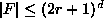 . We can therefore define a growth rate of
complexity
. We can therefore define a growth rate of
complexity

It satisfies  because
  .
The actual growth rate can of course be smaller. See [4]
for examples where
.
The actual growth rate can of course be smaller. See [4]
for examples where  and
and  .
From all of the numerical experiments that we have performed, it is
reasonable to believe that the limit actually exists.
Of course, if are all rational then . In this case,
the complexity bound shows that evolving
intervals is as efficient as evolving CA traditionally.
It is in general better, because evolving the intervals performs
the CA computations in a compressed way.
From the information point of view we should look at the number
of intervals as a measure of complexity because it is an upper bound for the
Chaitin complexity of the configuration. If
.
From all of the numerical experiments that we have performed, it is
reasonable to believe that the limit actually exists.
Of course, if are all rational then . In this case,
the complexity bound shows that evolving
intervals is as efficient as evolving CA traditionally.
It is in general better, because evolving the intervals performs
the CA computations in a compressed way.
From the information point of view we should look at the number
of intervals as a measure of complexity because it is an upper bound for the
Chaitin complexity of the configuration. If
 the dynamics is not recurrent even though it is
reversible.
the dynamics is not recurrent even though it is
reversible.
The number  seems not to be related to the entropy
defined in [9] because
looking at the CA dynamics on a thin subset of almost periodic configurations
changes the dynamical properties considerably. For example, the
one-dimensional shift on
seems not to be related to the entropy
defined in [9] because
looking at the CA dynamics on a thin subset of almost periodic configurations
changes the dynamical properties considerably. For example, the
one-dimensional shift on  has entropy
  ,
while in the almost periodic setup for every J because
,
while in the almost periodic setup for every J because
 implies that the number of intervals
does not change. Let us look at the
deterministic and reversible lattice gas automaton HPP
[2, 3], where up to four particles can be at a cell
moving along one of the basis vectors
implies that the number of intervals
does not change. Let us look at the
deterministic and reversible lattice gas automaton HPP
[2, 3], where up to four particles can be at a cell
moving along one of the basis vectors  .
During an iteration step, a particle is advanced one cell in the direction of
its velocity. When two particles collide with opposite
velocity, both particles are scattered by a
rotation of 90 degrees. This rule preserves the particle number,
the total momentum, and the total energy, quantities that are also
defined for aperiodic almost periodic situations.
Note that the automaton is reversible because has an inverse which
is obtained by evolving the particle configuration, where the directions of
the particles are reversed. The theoretical bound gives
.
During an iteration step, a particle is advanced one cell in the direction of
its velocity. When two particles collide with opposite
velocity, both particles are scattered by a
rotation of 90 degrees. This rule preserves the particle number,
the total momentum, and the total energy, quantities that are also
defined for aperiodic almost periodic situations.
Note that the automaton is reversible because has an inverse which
is obtained by evolving the particle configuration, where the directions of
the particles are reversed. The theoretical bound gives
 and
and  . Experiments
with almost periodic lattice gas automata were done in [4, 11].
We measured values
. Experiments
with almost periodic lattice gas automata were done in [4, 11].
We measured values  for the HPP model. The value
  seems to be quite independent of the initial condition J. If
  ,
the dynamics is not recurrent event hough the system is reversible. We observe a
weak convergence of the measures
,
the dynamics is not recurrent event hough the system is reversible. We observe a
weak convergence of the measures  to a multiple of the Lebesgue measure. This uniform mixing of intervals
is expected to hold whenever and indicate
that the system does approach equilibrium, a fact which is expected
to happen for some CA used in fluid dynamics [15].
to a multiple of the Lebesgue measure. This uniform mixing of intervals
is expected to hold whenever and indicate
that the system does approach equilibrium, a fact which is expected
to happen for some CA used in fluid dynamics [15].
Next: Almost periodic particle dynamics
Up: Complexity Growth in Almost
Previous: Introduction
Oliver Knill
Mon Jun 29 14:18:53 CDT 1998