 in the
Vlasov limit (see [5, 13]).
We prove here an existence result
in the almost periodic context. Vlasov dynamics are used especially in stellar
dynamics and plasma physics.
in the
Vlasov limit (see [5, 13]).
We prove here an existence result
in the almost periodic context. Vlasov dynamics are used especially in stellar
dynamics and plasma physics.
|
In this section almost periodicity appears in a
different way, particles no longer move on a discrete grid as before
but as a gas in in the
Vlasov limit (see [5, 13]).
We prove here an existence result
in the almost periodic context. Vlasov dynamics are used especially in stellar
dynamics and plasma physics.
A finite dimensional system of particles moving on a manifold  under a pairwise interaction given by a potential V evolve
according to the Newton equations
under a pairwise interaction given by a potential V evolve
according to the Newton equations
 which are the Hamilton equations with Hamiltonian
 .
We assume that the potential V is smooth and that the solutions
exist for all times. If the force is rescaled in the
limit
.
We assume that the potential V is smooth and that the solutions
exist for all times. If the force is rescaled in the
limit  so that it stays finite, then the dynamics can
be extended from point particles to a "particle gas" with an
arbitrary density m in the phase space
so that it stays finite, then the dynamics can
be extended from point particles to a "particle gas" with an
arbitrary density m in the phase space  . One evolves
then a map
. One evolves
then a map  , where
  gives the position
and momentum of the particle with initial condition
gives the position
and momentum of the particle with initial condition  .
The corresponding mean-field characteristic equations
.
The corresponding mean-field characteristic equations

are the Hamilton equation for the Hamiltonian

This is an ordinary differential equation (ODE) in an affine linear space of all
continuous functions  with
supremum norm for
with
supremum norm for 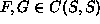 .
By the Cauchy-Piccard existence theorem for ODEs in Banach spaces and a Gronwall
estimate, there is
a unique global solution if the gradient
.
By the Cauchy-Piccard existence theorem for ODEs in Banach spaces and a Gronwall
estimate, there is
a unique global solution if the gradient  is smooth and bounded.
The density
is smooth and bounded.
The density 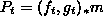 defined by
 satisfies then the Vlasov equation

This method of characteristics [1]
is a convenient way to prove the existence and uniqueness of the
solution of this integro PDE.
We extend now this setup. How general can the initial density  be?
It can be a finite measure or a signed measure representing charged particles
with different charges. One restriction is that
be?
It can be a finite measure or a signed measure representing charged particles
with different charges. One restriction is that
 should be finite.
Only if decays sufficiently fast at infinity can one allow
spatial infinite measures like the product of the Lebesgue measure on
with a compactly supported measure. For periodic V and when the
position space N is the torus
should be finite.
Only if decays sufficiently fast at infinity can one allow
spatial infinite measures like the product of the Lebesgue measure on
with a compactly supported measure. For periodic V and when the
position space N is the torus  , one deals with
particles in a box with periodic boundary conditions. Integration
over gives a finite force. We generalize this now to
the almost periodic case, where we evolve a gas on for which all
physical quantities are almost periodic in the position.
, one deals with
particles in a box with periodic boundary conditions. Integration
over gives a finite force. We generalize this now to
the almost periodic case, where we evolve a gas on for which all
physical quantities are almost periodic in the position.
We assume that the initial density  on
the phase space
on
the phase space  has the property that for any continuous function
h on , the function
has the property that for any continuous function
h on , the function  is a Bohr
almost periodic function on N and that there exists a constant r
such that m(x,y)=0 for |y|;SPMgt;r. To define a Vlasov evolution for such
measures, we proceed in a similar way as before.
Define (f,g)(x,y) = (x + F(x,y),y + G(x,y)), where
is a Bohr
almost periodic function on N and that there exists a constant r
such that m(x,y)=0 for |y|;SPMgt;r. To define a Vlasov evolution for such
measures, we proceed in a similar way as before.
Define (f,g)(x,y) = (x + F(x,y),y + G(x,y)), where
 are continuous with the property that they are
Bohr almost periodic functions in x when y is fixed.
Such functions form a closed subspace of
C(S,S) on which a finite mean
are continuous with the property that they are
Bohr almost periodic functions in x when y is fixed.
Such functions form a closed subspace of
C(S,S) on which a finite mean

is defined. Especially, when m is 1-periodic in x, one has
 .
.
An evolution can now be defined with the Hamilton equations

with initial conditions 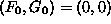 . The Hamiltonian is
 .
Because
.
Because  is both almost periodic in x
and x', we know that
is both almost periodic in x
and x', we know that  is
almost periodic in x. The map
is
almost periodic in x. The map  is differentiable so that by
the Cauchy-Piccard existence theorem, there is a solution in the Banach algebra
of almost periodic functions for small times.
A Gronwall estimate assures global existence
of the solution if the gradient satisfies a global Lipshitz estimate.
The corresponding Vlasov equation defines the evolution of spatial almost
periodic measures
is differentiable so that by
the Cauchy-Piccard existence theorem, there is a solution in the Banach algebra
of almost periodic functions for small times.
A Gronwall estimate assures global existence
of the solution if the gradient satisfies a global Lipshitz estimate.
The corresponding Vlasov equation defines the evolution of spatial almost
periodic measures 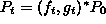 , where
  is the initial
measure. For any
is the initial
measure. For any  , the function
 on N is almost periodic.
Examples are the physically relevant moments
on N is almost periodic.
Examples are the physically relevant moments
 .
.
The Fourier transform of the almost periodic function  is a discrete measure
  on . One writes
 .
The measure
.
The measure  is supported on the frequency module
of the initial measure . This generalizes the fact that if
is supported on the frequency module
of the initial measure . This generalizes the fact that if  is periodic in x, then
  is also periodic with the same period.
While the frequency module does not
change under the evolution, the weights on the spectrum
change and are expected to shift towards higher and higher
frequencies.
is also periodic with the same period.
While the frequency module does not
change under the evolution, the weights on the spectrum
change and are expected to shift towards higher and higher
frequencies.
As in the case of almost periodic CA, there are macroscopic
quantities which are invariant under the Vlasov flow. Examples are the
energy H[f,g], the momentum M[g], or the angular momentum  .
.
We can also find almost periodic Bernstein-Green-Kruskal modes [10],
which are spatial almost periodic equilibrium measures for the actual Vlasov PDE.
These well known solutions are obtained with the separation ansatz
 , where
 . One gets an equilibrium measure if
Q solves the integral equation
. One gets an equilibrium measure if
Q solves the integral equation
 . With
  , one can find
an almost periodic potential V satisfying
, one can find
an almost periodic potential V satisfying
 such that P(x,y)=S(y) Q(x) is an equilibrium solution.
We define the Lyapunov exponent

Because

this is the Lyapunov exponent of the finite dimensional cocycle A(f,g) over
the flow  .
If
.
If  is globally bounded, then
  .
One can readily check that if the measure m is a finite Dirac measure
representing n particles, then this Lyapunov exponent is the classic
Lyapunov exponent of a test particle forming together with the n particles
a restricted (n+1)-body problem.
.
One can readily check that if the measure m is a finite Dirac measure
representing n particles, then this Lyapunov exponent is the classic
Lyapunov exponent of a test particle forming together with the n particles
a restricted (n+1)-body problem.
The dynamical entropy  is defined because
 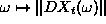 is spatial almost
periodic for any t. The number
is spatial almost
periodic for any t. The number  is a measure for the growth rate of complexity of the almost periodic fluid. If
 , the almost periodic Dirichlet integral
  grows
exponentially and the characteristic flow
grows
exponentially and the characteristic flow  is not recurrent
event hough the dynamics is reversible. If
is not recurrent
event hough the dynamics is reversible. If  for almost
all
for almost
all  ,
one expects that
,
one expects that  can converge in a weak sense to an equilibrium
solution of the Vlasov equations.
can converge in a weak sense to an equilibrium
solution of the Vlasov equations.
Acknowledgments.
E. Reed acknowledges a SURF research fellowship at
Caltech during the summer of 1995.
Next: References Up: Complexity Growth in Almost Previous: Almost periodic lattice gas
Oliver Knill