


|
 to the vertices so
that
to the vertices so
that  define the random walk.
For example, if every edge has d neighbours and
define the random walk.
For example, if every edge has d neighbours and  for every vertex
(w,v), we get a symmetric random walk on a regular graph.
The operator
for every vertex
(w,v), we get a symmetric random walk on a regular graph.
The operator  is selfadjoint and has norm 1. Let
  be a wave which is
localized initially at a vertex v. The quantum evolution
be a wave which is
localized initially at a vertex v. The quantum evolution
 should be compared with the random walk
  : while
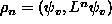 is the probability that the walker starting at
the vertex v returns to v in n steps,
is the probability that the walker starting at
the vertex v returns to v in n steps,
 is the probability that the wave
 returns back after n steps of the quantum evolution.
Opposite to the irreversible random walk,
the discrete time quantum evolution is invertible in the sense that
the pair
returns back after n steps of the quantum evolution.
Opposite to the irreversible random walk,
the discrete time quantum evolution is invertible in the sense that
the pair  determines
  .
The Fourier coefficients
.
The Fourier coefficients 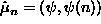 of
of  are easy to compute and determine the
measures
are easy to compute and determine the
measures 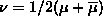 of
of  with respect to L.
In many examples of regular infinite graphs, one does not know
the spectral type. Aperiodic graphs defined by aperiodic tilings of
with respect to L.
In many examples of regular infinite graphs, one does not know
the spectral type. Aperiodic graphs defined by aperiodic tilings of
 (see [18, 17]) are examples, where the spectral type
is unknown. The spectrum of a graph can be
be pure point like in the case of a finite
graph or certain self-similar graphs, it can be
absolutely continuous like for
(see [18, 17]) are examples, where the spectral type
is unknown. The spectrum of a graph can be
be pure point like in the case of a finite
graph or certain self-similar graphs, it can be
absolutely continuous like for  or for Cayley graphs of
infinite Abelian discrete groups, it can also be singular continuous as has
been pointed out recently in [26].
or for Cayley graphs of
infinite Abelian discrete groups, it can also be singular continuous as has
been pointed out recently in [26].
In order to relate the return probability of the random walk with the
Fourier coefficients, we consider a one parameter family of operators
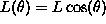 . Denote by
 the Fourier coefficients of the spectral measure on the circle
with respect to the operator
the Fourier coefficients of the spectral measure on the circle
with respect to the operator  .
.


A measure  is called uniformly
  -continuous if
 for all intervals [a,b).


