


|
 of spectral measures.
 The discrete spectrum. Wiener's theorem in Fourier theory

allows to determine, whether there is some discrete part in the spectral
measure  and so some eigenvalues of L.
This tool for detecting point spectrum is used in quantum dynamics
(see [1]). If the potential takes finitely many (rational) values,
then
and so some eigenvalues of L.
This tool for detecting point spectrum is used in quantum dynamics
(see [1]). If the potential takes finitely many (rational) values,
then 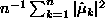 is a (rational) number which can
be computed exactly. Evolution (2.1)
allows so to treat the evolution of any bounded discrete Schrödinger
operators in one dimension with the same efficiency as
kicked quantum oscillators or kicked Harper models.
is a (rational) number which can
be computed exactly. Evolution (2.1)
allows so to treat the evolution of any bounded discrete Schrödinger
operators in one dimension with the same efficiency as
kicked quantum oscillators or kicked Harper models.
The  -absolutely continuous spectrum.
If there exists a constant C,
such that
-absolutely continuous spectrum.
If there exists a constant C,
such that  then
then  , because of Plancherel's theorem
 with
with  .
It is more difficult to detect other absolutely
continuous spectrum. While
.
It is more difficult to detect other absolutely
continuous spectrum. While  goes to zero by the Riemann-Lebesgue
lemma, if
goes to zero by the Riemann-Lebesgue
lemma, if  is absolutely continuous, the decay can be arbitary slow and
decay is also possible if is singular continuous.
The -absolutely continuous spectrum is important because by a
result of Kato, the closure of all vectors
is absolutely continuous, the decay can be arbitary slow and
decay is also possible if is singular continuous.
The -absolutely continuous spectrum is important because by a
result of Kato, the closure of all vectors  with -absolutely
continuous spectral measures is the absolutely
continuous subspace.
with -absolutely
continuous spectral measures is the absolutely
continuous subspace.
Singular continuous spectrum.
If  does not converge to zero, then by the
Riemann-Lebesgue theorem, must have some singular
spectrum. If also
does not converge to zero, then by the
Riemann-Lebesgue theorem, must have some singular
spectrum. If also  converges to zero, then L has purely singular continuous spectrum, a property,
which is generic in many situations (see [25, 27]).
However, if L has purely singular continuous
spectrum, it is still possible that
converges to zero, then L has purely singular continuous spectrum, a property,
which is generic in many situations (see [25, 27]).
However, if L has purely singular continuous
spectrum, it is still possible that
 . The question, whether
converges to zero or not can be
subtle and there are both singular continuous measures for which
does or does not converge to zero.
Singular continuous spectrum occurs often in solid state
physics. The dynamics of U on the singular continuous subspace is the
least understood. It follows from Wiener's theorem and Birkhoff's ergodic
theorem that the topological entropy of an unitary operator acting on the
weakly compact unit ball is zero [16].
. The question, whether
converges to zero or not can be
subtle and there are both singular continuous measures for which
does or does not converge to zero.
Singular continuous spectrum occurs often in solid state
physics. The dynamics of U on the singular continuous subspace is the
least understood. It follows from Wiener's theorem and Birkhoff's ergodic
theorem that the topological entropy of an unitary operator acting on the
weakly compact unit ball is zero [16].
Weak continuity properties.
A discrete version of a result of Stricharz [28] tells that if
there exists a constant C and a function  with h(0)=0
such that
with h(0)=0
such that  for
all intervals [a,b] with length ;SPMlt;1 on the circle
for
all intervals [a,b] with length ;SPMlt;1 on the circle  (here identified with
  ), then
for all n, where  is a constant independent of anything.
By a converse of Last [19], if Equation (4.1)
is satisfied, then
is a constant independent of anything.
By a converse of Last [19], if Equation (4.1)
is satisfied, then  for all intervals
[a,b]. In this sense, Hölder continuity properties of the distribution
function
for all intervals
[a,b]. In this sense, Hölder continuity properties of the distribution
function 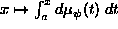 can be detected by computing
.
For recent developments in the quantum dynamics of operators with singular
continuous spectrum see [9, 5, 10, 19].
can be detected by computing
.
For recent developments in the quantum dynamics of operators with singular
continuous spectrum see [9, 5, 10, 19].
Hausdorff dimension.
The  -energy of a spectral measure on
  is
is
 with
with  .
A measure
.
A measure  has finite -energy, if and only if
 ([13]).
The Hausdorff dimension of ,
is the minimum of all Hausdorff dimensions of Borel sets S satisfying
([13]).
The Hausdorff dimension of ,
is the minimum of all Hausdorff dimensions of Borel sets S satisfying
 . It is bigger or equal to if has finite -energy
(see Theorem 4.13 in [6]).
By finding out, where the energy blows up, a lower bound on the
Hausdorff dimension of can be established
and so a lower bound on the Hausdorff dimension of the support of can
be obtained.
. It is bigger or equal to if has finite -energy
(see Theorem 4.13 in [6]).
By finding out, where the energy blows up, a lower bound on the
Hausdorff dimension of can be established
and so a lower bound on the Hausdorff dimension of the support of can
be obtained.
