Next: Sphere packings and dynamical
Up: Maximizing the packing density
Previous: Maximizing the packing density
Finding sphere packings in  with maximal density
are important mostly unsolved
problems with many applications (see [3]).
The problem is interesting in
geometry, group theory, crystallography or physics.
Here, we look at the problem from a dynamical system point
of view.
with maximal density
are important mostly unsolved
problems with many applications (see [3]).
The problem is interesting in
geometry, group theory, crystallography or physics.
Here, we look at the problem from a dynamical system point
of view.
|
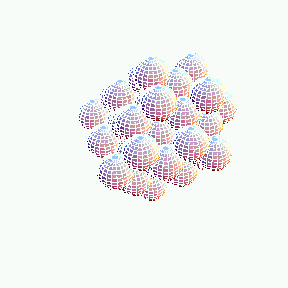
It is still controversial, whether the
Kepler conjecture claiming that
there is no sphere-packing in  with density higher
than with density higher
than  is open or proven
([8, 11]). is open or proven
([8, 11]).
|
Also
for dimensions bigger than 3, the best densities are still not known evenso
there is a list of candidates (see [2],[3]).
According to a general result of Groemer ([6] see also [7]),
there exists a sphere packing which has a maximal density.
Periodic packings and often lattice packings
have achieved the highest today known densities (see [3]).
Following an advise in [16] p. 188, we restrict us here
to a subclass of packings, where we know that
the density of the packing exists.
This family of quasicrystals,
almost periodic sphere-packings in
which form a part of the huge space  of all packings.
Quasicrystalline dense sphere packings are of interest in physics
(see for example [14, 1]).
The ergodic-theoretical side of
the problem comes natural in the context of aperiodic tilings.
Tilings and packings are closely related since to every strictly ergodic
sphere-packing is attached a tiling of
by Voronoi cells consisting of finitely many types of polytopes.
of all packings.
Quasicrystalline dense sphere packings are of interest in physics
(see for example [14, 1]).
The ergodic-theoretical side of
the problem comes natural in the context of aperiodic tilings.
Tilings and packings are closely related since to every strictly ergodic
sphere-packing is attached a tiling of
by Voronoi cells consisting of finitely many types of polytopes.
The quasicrystals in this article are defined by higher dimensional
circle sequences and have the property that the densities can
be computed explicitly from the parameters.
This allows for a machine to search through many of these packings
and to determine in each case the exact density.
The feature of being able to compute macroscopic quantities like densities
for aperiodic configurations
was also useful when we studied cellular automata on circle configurations
[10]. The main motivation for the present work
was to investigate dense packings with a new class of packings.
We could consider many packings with high periodicity which are close
to the best known packing.
A packing  can be described by a configuration
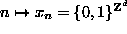 .
The closure Y of all the translates of x in
.
The closure Y of all the translates of x in  forms a subshift with time
  .
In general, there exist many shift-
invariant measures on Y and the density depends
on the choice of the invariant measure.
For the packings, we consider here,
the subshift Y has
a unique shift-invariant measure and it implies that the
density is well defined and can explicitly be determined.
Moreover, if we make a translation in the
i'th coordinate, we get a one-dimensional strictly ergodic subshift
for which the dynamical spectrum (and so the diffraction spectrum)
is known to be pure point. The packings are therefore crystals or
quasicrystals (see [13]).
.
In general, there exist many shift-
invariant measures on Y and the density depends
on the choice of the invariant measure.
For the packings, we consider here,
the subshift Y has
a unique shift-invariant measure and it implies that the
density is well defined and can explicitly be determined.
Moreover, if we make a translation in the
i'th coordinate, we get a one-dimensional strictly ergodic subshift
for which the dynamical spectrum (and so the diffraction spectrum)
is known to be pure point. The packings are therefore crystals or
quasicrystals (see [13]).
|
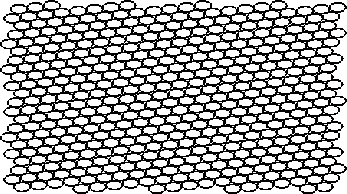
Fig. 1 Part of a two dimensional aperiodic packing
with spheres of radius 5 having centers
located on a subset of  . This packing is close to the
best existing packing in two dimensions. . This packing is close to the
best existing packing in two dimensions.
|
The organization of this article is as follows. In section 2, we relate
sphere packings with dynamical systems and point out, that the
uniquely ergodic packings have a well defined density.
In section 3, we consider a finite dimensional class of strictly
ergodic sphere packings and compute the density of the packings. We
show that the density functional takes its maximum on periodic packings.
In section 4, we give classes of such packings and relate the problem
to find dense packings to number theoretical questions. We also report
about packings found by numerical experiments.
In section 5, we will construct a one-parameter family
of isospectral sphere packings
which have a uniform positive density depending on constants in
simultaneous Diophantine approximation.
In section 6, we discuss a related construction for coverings.
Relations with other topics are outlined in section 7 and in section 8,
some open problems are summarized.
|
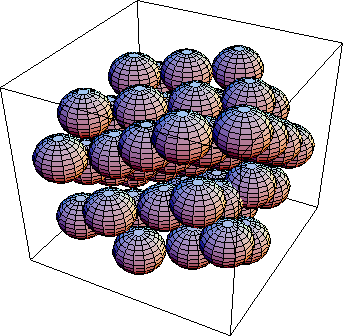
Fig. 2. Part of a three dimensional aperiodic packing
with density 0.717. The
spheres have radius r=5 and are located on a subset of
 . .
|


Next: Sphere packings and dynamical
Up: Maximizing the packing density
Previous: Maximizing the packing density
Oliver Knill
Mon Jun 22 17:57:55 CDT 1998