Next: Quasi-periodic sphere-packings
Up: Maximizing the packing density
Previous: Introduction
A r-sphere packing S is a countable set of points in  such that the minimal distance between two points is
  .
Let
.
Let  be the set of all sphere packings. Define a metric on
by
be the set of all sphere packings. Define a metric on
by  , where
  is the smallest number
such that
is the smallest number
such that  on the ball
  for some
  . With this metric, which is adapted from the metric for
tilings,
. With this metric, which is adapted from the metric for
tilings,  is a complete metric space. Let act
on by translations
is a complete metric space. Let act
on by translations  . Given a specific sphere packing S,
we can look at the closure
. Given a specific sphere packing S,
we can look at the closure  of the orbit
 . If
. If  compact in ,
we get a dynamical system
compact in ,
we get a dynamical system  , where
is a compact metric space on which acts by homeomorphisms. Such
a system is called minimal or almost periodic,
if for every
, where
is a compact metric space on which acts by homeomorphisms. Such
a system is called minimal or almost periodic,
if for every  , the orbit is dense in ,
it is called uniquely ergodic, if there exists exactly one -
invariant measure on , strictly ergodic,
if it is uniquely ergodic and minimal.
, the orbit is dense in ,
it is called uniquely ergodic, if there exists exactly one -
invariant measure on , strictly ergodic,
if it is uniquely ergodic and minimal.
Remarks.
1) A metric on , with respect to
which the subset of r-packings in becomes
compact is described in [5]. For our purposes,
the stronger metric d is good enough.
2) In the
statistical mechanics literature, a sphere packing is also called
a configuration with hard core restriction.
3) By normalization of the distance in , we could assume that a
sphere packing has radius r=1.
We keep the additional parameter r since
we are interested in packings  .
.
We call a sphere packing S rational, if all points of S belong
to a d-dimensional lattice  , where
U is an invertible
, where
U is an invertible  -matrix.
On a rational sphere packing, there is a
natural
-matrix.
On a rational sphere packing, there is a
natural  -action, by identifying with the maximal
subgroup of which
leaves the lattice invariant. The packing S consists then of
a subset of the lattice and every rational sphere packing defines so a
subshift
-action, by identifying with the maximal
subgroup of which
leaves the lattice invariant. The packing S consists then of
a subset of the lattice and every rational sphere packing defines so a
subshift  .
This set
.
This set  is is invariant under the -action.
A rational sphere packings is called
strictly ergodic, if the dynamical system
is is invariant under the -action.
A rational sphere packings is called
strictly ergodic, if the dynamical system  is strictly
ergodic.
If every shift of the -action is periodic, S is called periodic,
is strictly
ergodic.
If every shift of the -action is periodic, S is called periodic,
Remarks.
1) Clearly, a periodic packing
is rational and also strictly ergodic.
2) Periodic packings are dense in since we can
periodically continue a given packing outside a given box.
Periodic packings are also
dense in the set of rational packings.
3) The name almost
periodic which stands as a synonym for minimal
has no relation
with the usual almost periodicity of functions or sequences. The expression
almost periodic is however widely used in the topological dynamics
and mathematical physics literature.
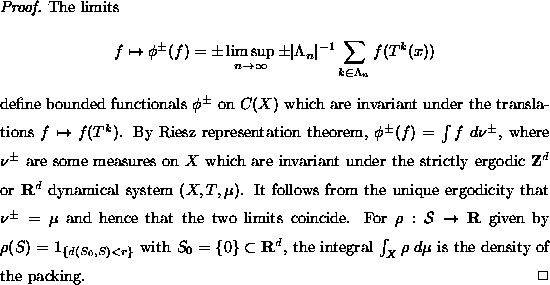
The lower and upper densities of a sphere packing S are defined as

where  . If
. If  , then
  is
called the density of S.
is
called the density of S.
Remarks.
1) The above lemma is well known and there are other proofs using more
theory. The result
follows for example also from a multi-dimensional version of
Birkhoff's ergodic theorem (see [4] Chapter VIII). The proof given here
uses only lightest tools.
2) There exists a dense set
of rational packings in which have no density.
Proof. Consider
a periodic packing S of radius r having
density . Take an other periodic packing S'
of radius r which has density  .
Take a first cubic box
.
Take a first cubic box  centered
at zero and fill it with spheres of radius r according to the first packing.
Take a second larger cubic box
centered
at zero and fill it with spheres of radius r according to the first packing.
Take a second larger cubic box  and fill
  with spheres according to the packing in
S'. Make so large that the density of the packing in this
finite box is smaller than
with spheres according to the packing in
S'. Make so large that the density of the packing in this
finite box is smaller than  .
Take a box
.
Take a box  and fill
  with spheres according to
  make so large that the density in the box is larger than
 . Continue inductively
so that the finite volume densities are alternatively below
and above
.
. Continue inductively
so that the finite volume densities are alternatively below
and above
.
Given  , we can make so large that the distance
between the original packing and the modified packing is smaller than
.
, we can make so large that the distance
between the original packing and the modified packing is smaller than
.
3) We are forced to define the packing problem on a subclass of packings
since the density is not a continuous function on the
set of all packings for which the density exists: take such a
packing S and define a sequence of packings  obtained from S
by deleting all balls in distance less than n from the origin.
The packings have all the same density but converges to
the
obtained from S
by deleting all balls in distance less than n from the origin.
The packings have all the same density but converges to
the  , which is a packing with zero density.


Next: Quasi-periodic sphere-packings
Up: Maximizing the packing density
Previous: Introduction
Oliver Knill
Mon Jun 22 17:57:55 CDT 1998