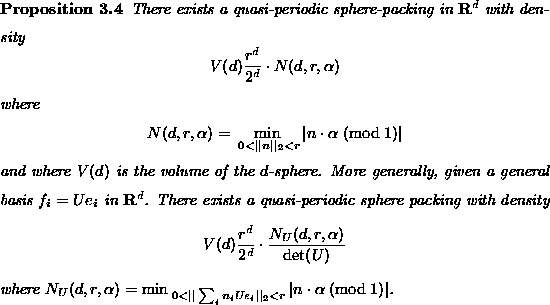
 , a
rotation vector
, a
rotation vector  , a radius r bigger than zero and the standard basis
 in
in  .
.
|
We consider now a specific class of almost periodic sphere packings.
These packings contain also periodic packings but the computations do not
rely on the distinction between periodic and aperiodic. In order to find
dense packings experimentally, it was sometimes
of advantage, not to distinguish between
periodic and aperiodic packings.
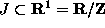
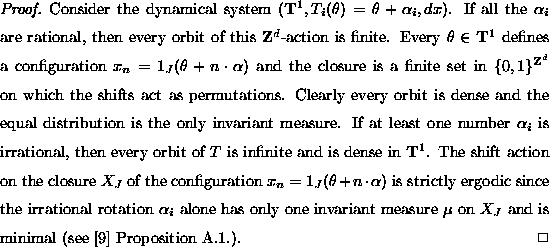
Take a finite union of disjoint half-open intervals , a
rotation vector , a radius r bigger than zero and the standard basis
in .
Define  ,
where
,
where  is the Euclidean
  -norm in .
If
-norm in .
If  ,
we get for any
,
we get for any  a sphere-packing

If we put a sphere of radius r/2 at each point of H, we get a
r-packing because the maximal distance between two different points in H is
by construction ;SPMlt;r.
This packing is not periodic if one of the numbers
 is irrational. We call such a packing quasi-periodic.

Remark.
The density of a quasi-periodic sphere-packing can be approximated
explicitly by periodic sphere-packings because every
vector  is a limit of rational vectors and the density depends
continuously on .
It is not excluded that in some dimension, the highest possible packing
is aperiodic, but we will see that
if J consists of a single interval,
the maximal density is obtained by a periodic packing.
is a limit of rational vectors and the density depends
continuously on .
It is not excluded that in some dimension, the highest possible packing
is aperiodic, but we will see that
if J consists of a single interval,
the maximal density is obtained by a periodic packing.
The center density  of a sphere-packing is defined as
 , where
  is the density and V(d) is the volume of
the unit sphere in .
is the density and V(d) is the volume of
the unit sphere in .


Remark.
Note that evenso the map  is not continuous, the
density is continuous.
is not continuous, the
density is continuous.
|
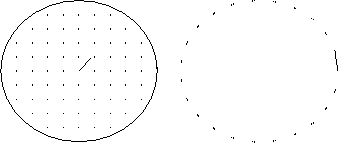
Fig. 3. The set
 with the vector
 .
On the right, we see the set .
On the right, we see the set
 and the interval
 . .
|
 with
with  .
.


Given , we find J consisting of one interval such that
.
Start with  and form the finite set

The points 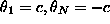 nearest to
  are symmetric to 0.
Form J=[0,c). We check that
are symmetric to 0.
Form J=[0,c). We check that  .
The center density of the packing with this interval is then
.
The center density of the packing with this interval is then  .
.
Remarks.
1) We can add a second interval J' as follows. Assume the interval
 of length
  is the largest interval disjoint from
  .
There are three cases. If
.
There are three cases. If  , take
 . If
. If  , define
 . In the other case, take
  .
We show now that,
.
We show now that,
 .
For
.
For  , we have
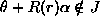 and
and 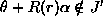 ,
since J' is disjoint from
,
since J' is disjoint from  . For
. For  , we have
also that
, we have
also that  is disjoint from J'.
It is also disjoint from
is disjoint from J'.
It is also disjoint from  , since
 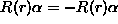 .
The center density of the packing is then
.
The center density of the packing is then 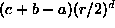 .
.
2) We could proceed as follows to get larger and larger sets J.
Given  , take any point
  outside .
If
is disjoint from ,
we can find a maximal interval which has the property
. Form
. Repeating this construction leads to a finite or
countable union
J of half-open intervals which has the property that
. In other words, we are adding spheres
until the covering is saturated, in the sense
that there is no longer room with positive density for adding additional
spheres. Usually, in our experiments if the first interval
is large enough, then J is already saturated and no second interval is
needed.
outside .
If
is disjoint from ,
we can find a maximal interval which has the property
. Form
. Repeating this construction leads to a finite or
countable union
J of half-open intervals which has the property that
. In other words, we are adding spheres
until the covering is saturated, in the sense
that there is no longer room with positive density for adding additional
spheres. Usually, in our experiments if the first interval
is large enough, then J is already saturated and no second interval is
needed.
3) For getting high densities, we have to choose r such
that the number of lattice points inside the ball of radius r is
just below a point of discontinuity. Necessary is
 , where
  and that there is a lattice point on
the boundary of the ball with radius r so that
a further increase of r
increases the number of lattice points.
By a theorem of Lagrange in number theory, this is always true
if
and that there is a lattice point on
the boundary of the ball with radius r so that
a further increase of r
increases the number of lattice points.
By a theorem of Lagrange in number theory, this is always true
if  and . In other words, by extending the variational
problem and varying r also, a packing which maximizes the density
has the property that
and . In other words, by extending the variational
problem and varying r also, a packing which maximizes the density
has the property that  is an integer.
4) We expected to get high densities for radii r, for which many
lattice points are on the boundary of a sphere of radius r because of
a possible large kissing number. The experiments
confirm this in some cases like r=5, d=2,3, but it was not the rule.

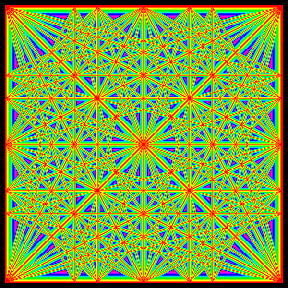
|
Fig. 4. The piecewise linear function
 in the case r=5.
As larger the value, as brighter is the point in the case r=5.
As larger the value, as brighter is the point
 .
On the black resonance lines, the value is zero. .
On the black resonance lines, the value is zero.
|
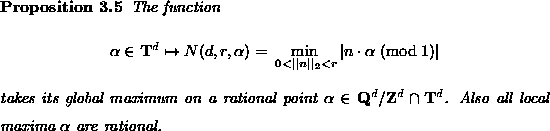
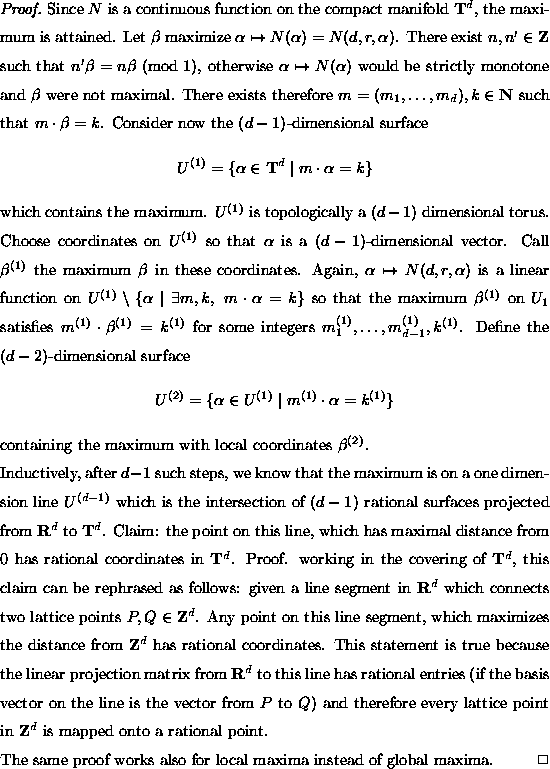
 over the d dimensional torus of parameters
,
when the dimension d and the radius r are fixed. The proposition
says that this variational problem has only rational "critical
points".
It means that on some finite dimensional manifolds of almost periodic
packings, the maximal density is achieved by periodic packings.
over the d dimensional torus of parameters
,
when the dimension d and the radius r are fixed. The proposition
says that this variational problem has only rational "critical
points".
It means that on some finite dimensional manifolds of almost periodic
packings, the maximal density is achieved by periodic packings.
Remark.
The same argument shows that for any finite set  not containing the origin, the function

takes its global maximum on a rational point  .
We can consider therefore any packing problem, where the spheres are
replaced by some compact set
.
We can consider therefore any packing problem, where the spheres are
replaced by some compact set  .
The analogues problem is to find for a given r, the densest
packing of with copies
.
The analogues problem is to find for a given r, the densest
packing of with copies 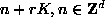 of
of
 . The same construction
gives a d-dimensional manifold of almost periodic packings
for which the density exists.
The maximal density on this manifold is obtained by periodic packings.
. The same construction
gives a d-dimensional manifold of almost periodic packings
for which the density exists.
The maximal density on this manifold is obtained by periodic packings.