Next: Symmetry and regularity of
Up: Billiards in the unit
Previous: Billiards in the unit
In this article, we study the one-parameter family of billiard
maps  on the
  -unit ball in
  ,
,
 , for
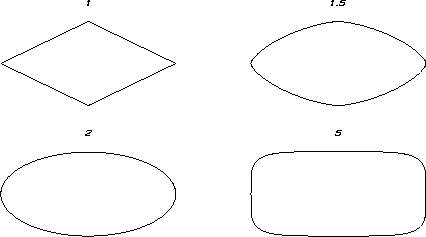
, for  . In Fig. 1 we see
examples of such tables.
For p=1,2 or
. In Fig. 1 we see
examples of such tables.
For p=1,2 or  , the map can be understood completely - for
p=1, or
, the map can be understood completely - for
p=1, or  , the table is a square, while for p=2, the table is
a circle. The family contains smooth algebraic curves for
p=2n with
, the table is a square, while for p=2, the table is
a circle. The family contains smooth algebraic curves for
p=2n with  . However, in general
the curves are not differentiable.
We prove that this family of billiard maps has positive
topological entropies for the
nonintegrable cases
. However, in general
the curves are not differentiable.
We prove that this family of billiard maps has positive
topological entropies for the
nonintegrable cases
 , and , and we
measure positive metric entropies, which indicates the
coexistence of stable and random motions on a set of positive measure.
, and , and we
measure positive metric entropies, which indicates the
coexistence of stable and random motions on a set of positive measure.
A few one-parameter families of billiard maps at convex tables
have been studied already:
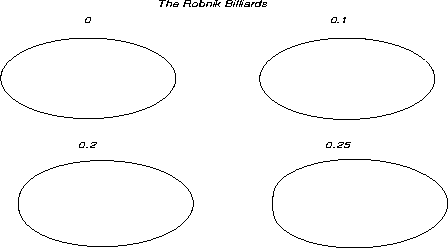
 The Robnik billiard tables
[18] are given by the convex curves
The Robnik billiard tables
[18] are given by the convex curves
 for
parameter values
for
parameter values  . This one-parameter family
of billiard maps contains the integrable case p=0, where
the table is a circle. It is known [8] that for p=1/4, the
map is not ergodic due to stable periodic orbits
even so there are no invariant curves.
. This one-parameter family
of billiard maps contains the integrable case p=0, where
the table is a circle. It is known [8] that for p=1/4, the
map is not ergodic due to stable periodic orbits
even so there are no invariant curves.
 .
Measurements show that the map has positive metric entropy for
some parameter values.
.
Measurements show that the map has positive metric entropy for
some parameter values.
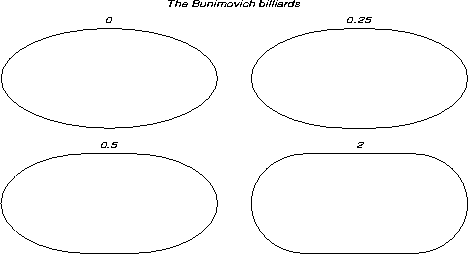
The Bunimovich stadium tables
are obtained by joining two
unit half circles with two parallel straight lines of length  .
Again, the case p=0 gives the circle. It is known that this billiard
has positive Lyapunov exponents almost everywhere for p;SPMgt;0 and
Wojtkowsky [23] showed quantitatively
that for sufficiently small p, the metric entropy is
.
Again, the case p=0 gives the circle. It is known that this billiard
has positive Lyapunov exponents almost everywhere for p;SPMgt;0 and
Wojtkowsky [23] showed quantitatively
that for sufficiently small p, the metric entropy is
 .
.
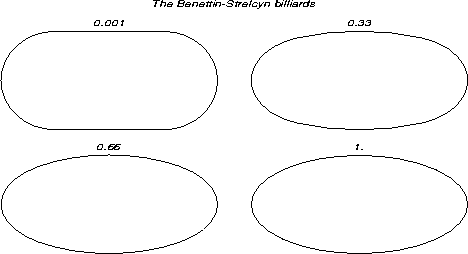
The Benettin-Strelcyn Billiard
[2],[9]
is a one parameter family of billiards where the curve
consists of four arcs interpolating a circle.
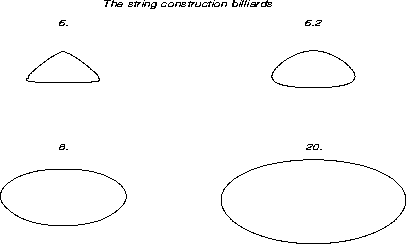
The string construction billiards is a
one-parameter family of billiard curves
obtained by making the string construction on a strictly convex
curve of length 1 [7].
For every string length  ,
one obtains a billiard table.
In the (limiting) case
the table is a circle.
The pictures below show
the string construction when
the given convex curve is an equilateral triangle.
,
one obtains a billiard table.
In the (limiting) case
the table is a circle.
The pictures below show
the string construction when
the given convex curve is an equilateral triangle.
In general, dynamical systems are neither integrable nor hyperbolic and
one has to deal with maps exhibiting both stable and unstable behavior
in the phase space. Coexistence of chaos and order seems to be the rule for
smooth convex billiards: only the ellipses are known to
be integrable and an old conjecture of Birkhoff states that this should be the
only case (compare [4] [3]).
No uniformly hyperbolic convex billiard is known.
However, the weaker condition of nonuniform
hyperbolicity (positive Lyapunov exponent almost everywhere)
can be achieved for convex billiards if one does not
require the table to be smooth.
A routine investigation of a family of
monotone twist maps can contain the following steps:
Establish symmetries and smoothness of the map.
Prove the existence or absence or destruction of invariant curves
or estimate the size of regions without invariant curves [6].
Investigate the (linear) stability of the periodic orbits in
dependence of the parameter and find bifurcations. Numerically
investigate the stability of some orbits.
Determine the length spectra (=set of lengths of periodic orbits)
and, related, the motion of the Dirichlet eigenvalues in dependence
of the tables.
Measure or estimate the metric entropy by numerical
calculations of the Lyapunov exponents.
Find horseshoes or homoclinic points in some cases.
Investigate the limiting behavior near integrable maps.
We followed a part of
this program in the case of our family given by the -
unit balls. Except for the trivial integrable cases, we can prove that the
topological entropy is positive, and measure positive metric entropies.
Measurements of the metric entropy
suggests that the Kolmogorov entropy  behaves roughly
like a piecewise
convex function and that near p=2, the entropy function
behaves roughly
like a piecewise
convex function and that near p=2, the entropy function
 has a discontinuity in the first derivative.
Next: Symmetry and regularity of
Up: Billiards in the unit
Previous: Billiards in the unit
Oliver Knill, Jul 10 1998