Next: Numerical computation of orbits
Up: Billiards in the unit
Previous: Introduction
Billiards is a dynamical system describing
the motion of a particle inside a smooth closed
curve  moving inside the enclosed region in straight lines
and bouncing off
the walls according the equal-angle-law of reflection
(see [21]
for a survey). Parameterizing the
point of impact by a curve-parameter
moving inside the enclosed region in straight lines
and bouncing off
the walls according the equal-angle-law of reflection
(see [21]
for a survey). Parameterizing the
point of impact by a curve-parameter  and the angle of impact with
  , the Poincaré
map
, the Poincaré
map 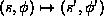 inherits all the information of the
billiard flow. The map
inherits all the information of the
billiard flow. The map  is a map on the annulus
 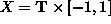 preserving the
Lebesgue area. The compact space X (also called the phase space)
has the invariant boundary
preserving the
Lebesgue area. The compact space X (also called the phase space)
has the invariant boundary  and
and  .
The billiard map T has been studied first by Birkhoff and
is a celebrated example of a monotone twist map,
a class of conservative dynamical systems introduced by Poincaré.
Every billiard map has the involutive
symmetry
.
The billiard map T has been studied first by Birkhoff and
is a celebrated example of a monotone twist map,
a class of conservative dynamical systems introduced by Poincaré.
Every billiard map has the involutive
symmetry  making T reversible:
 .
.
We are studying the family of billiard maps  defined by the one-parameter
family of curves
defined by the one-parameter
family of curves  . Since the tables are symmetric
by reflections at the x and y axes, this
. Since the tables are symmetric
by reflections at the x and y axes, this  symmetry is also present
in the phase space X. Together with the involutive symmetry S,
the whole phase space X has a dihedral symmetry.
We can factor this symmetry out by identifying points
symmetry is also present
in the phase space X. Together with the involutive symmetry S,
the whole phase space X has a dihedral symmetry.
We can factor this symmetry out by identifying points
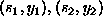 if
if  and
and  . In Fig. 2, we see numerical computations of orbits for
some values of p.
. In Fig. 2, we see numerical computations of orbits for
some values of p.
We investigate first the continuity and
smoothness of the maps as well as
of the map  from
from  to a topological space of maps. Note
that the billiard map in a convex domain is in general not continuous as the
example of a general triangle shows.
The billiard map has at least the degree of smoothness of the normal map
to a topological space of maps. Note
that the billiard map in a convex domain is in general not continuous as the
example of a general triangle shows.
The billiard map has at least the degree of smoothness of the normal map
 at the curve
  . By the symmetry, we can
restrict to the quadrant
. By the symmetry, we can
restrict to the quadrant  , where the curve is given by
 and where the normal is
  .
The map is
.
The map is  if (x(s),y(s)) is away from the coordinate
axes
if (x(s),y(s)) is away from the coordinate
axes  . Denote with C(X,X)
the space of homeomorphisms of X with the topology given by the metric
. Denote with C(X,X)
the space of homeomorphisms of X with the topology given by the metric
 . Define for
any compact set
. Define for
any compact set  and
and 

and the topology on  by
by  if and only
if
if and only
if 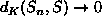 for all
  and all compact
.
and all compact
.

Proof.
A billiard map in a convex curve is in general not
a homeomorphism. In our case, the boundary has four symmetric points,
where the curvature may be infinite. By imposing
at these points the symmetric normal direction, we find for
 a continuous
continuation of the normal direction field on the whole curve
a continuous
continuation of the normal direction field on the whole curve
 . In the limiting cases p=1 and
  ,
the table is a square, and the billiard map can also be extended
to the singular set in the phase space by defining in the four
vertices of the square the normal
direction pointing to the center of the table.
For p=2n, the curve is algebraic and so real analytic which implies
that the map is real analytic.
Given a curve (t,f(t)), the curvature is given by
,
the table is a square, and the billiard map can also be extended
to the singular set in the phase space by defining in the four
vertices of the square the normal
direction pointing to the center of the table.
For p=2n, the curve is algebraic and so real analytic which implies
that the map is real analytic.
Given a curve (t,f(t)), the curvature is given by

This means for 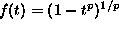

This is continuous as a function of t for p;SPMgt;2, leading to a continuously
differentiable map for p;SPMgt;2. The curvature is unbounded in places
for p;SPMlt;2, so that for p;SPMlt;2, the map is no longer continuously differentiable.
However, for  , the curvature depends continuously on p which
shows that
, the curvature depends continuously on p which
shows that  is continuous.
End of the proof.
Remark. The map 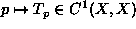 is not continuous at p=2, because
for p=2, the curvature at s=0 is 1 and for p;SPMgt;2, the curvature at
s=0 is vanishing. One can therefore not apply KAM theory to conclude that
for p;SPMgt;2, near enough to 2, the map has invariant curves.
Indeed, as we will see below, there are no invariant curves for p;SPMgt;2.
is not continuous at p=2, because
for p=2, the curvature at s=0 is 1 and for p;SPMgt;2, the curvature at
s=0 is vanishing. One can therefore not apply KAM theory to conclude that
for p;SPMgt;2, near enough to 2, the map has invariant curves.
Indeed, as we will see below, there are no invariant curves for p;SPMgt;2.
Next: Numerical computation of orbits
Up: Billiards in the unit
Previous: Introduction
Oliver Knill, Jul 10 1998