Next: Preliminaries
Up: Billiards that share a
Previous: Billiards that share a
Any closed, simple, piecewise  curve
curve  defines a Hamiltonian flow, the billiard flow inside the
billiard table T [29, 32, 31, 16].
The billiard map of the table T is the Poincaré map
defines a Hamiltonian flow, the billiard flow inside the
billiard table T [29, 32, 31, 16].
The billiard map of the table T is the Poincaré map  defined by the standard cross-section of the billiard flow.
The study of the billiard map for a convex table T goes back to
Birkhoff [2] and the theory is still far from being completed.
In this work we assume that T is convex and and use
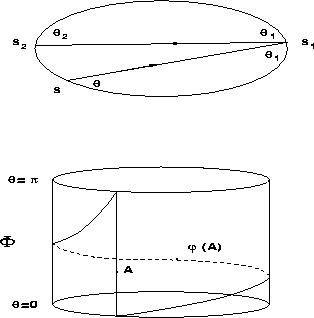
the standard facts about the phase space
defined by the standard cross-section of the billiard flow.
The study of the billiard map for a convex table T goes back to
Birkhoff [2] and the theory is still far from being completed.
In this work we assume that T is convex and and use
the standard facts about the phase space  of the billiard map
 .
.
A homotopically nontrivial
invariant circle  defines a
closed curve
defines a
closed curve  in the interior of T. It is called the
caustic. While in general the caustics of T may be a
complicated curve, the caustics in this paper are convex.
The invariant circle
in the interior of T. It is called the
caustic. While in general the caustics of T may be a
complicated curve, the caustics in this paper are convex.
The invariant circle  consists then of the supporting rays
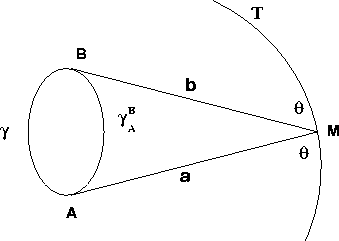
of and the table T is obtained from by
the string construction [29, 31]:
One takes an unstretchable string having length
consists then of the supporting rays
of and the table T is obtained from by
the string construction [29, 31]:
One takes an unstretchable string having length  ,
wraps it around , pulls it tight at a point M
and drags it around .
The point M then traces the boundary
,
wraps it around , pulls it tight at a point M
and drags it around .
The point M then traces the boundary  of the table.
The geometric description of an ellipse with given foci
is a special case of the string construction.
Let now  be a closed convex curve with perimeter
 . By varying the string length
  we obtain all billiard tables with the caustic
. The corresponding billiard maps
we obtain all billiard tables with the caustic
. The corresponding billiard maps  form a one-parameter family of twist maps which is determined by .
Our investigatigation of this family
emphasis on the relationship between the
geometric shape of and the dynamics of the family
form a one-parameter family of twist maps which is determined by .
Our investigatigation of this family
emphasis on the relationship between the
geometric shape of and the dynamics of the family
 of billiard maps.
Let  be the invariant circle of
corresponding to . Due to the time-reversal symmetry,
there are two invariant circles in associated with .
We make a choice of
be the invariant circle of
corresponding to . Due to the time-reversal symmetry,
there are two invariant circles in associated with .
We make a choice of  by requiring that the
rotation number of is less than or equal to
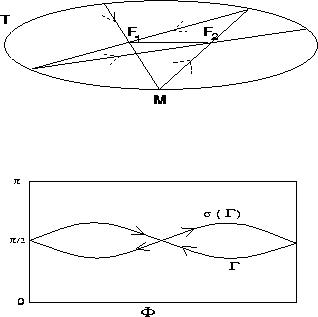
1/2. In the special case when
by requiring that the
rotation number of is less than or equal to
1/2. In the special case when  is an interval,
the tables
is an interval,
the tables 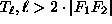 are the ellipses with foci
  and
and  .
The invariant circle is then the lower of the two invariant
circles in with the rotation number 1/2 (see Figure 3).
.
The invariant circle is then the lower of the two invariant
circles in with the rotation number 1/2 (see Figure 3).
Let
 be the restriction
of the twist map to . With a uniform parameter
on , the maps
be the restriction
of the twist map to . With a uniform parameter
on , the maps  form a continuous monotone family of orientation preserving
circle homeomorphisms. The rotation number
form a continuous monotone family of orientation preserving
circle homeomorphisms. The rotation number  is a continuous, nondecreasing function which
contains significant amount of information on the family
of twist maps. For instance,
is a continuous, nondecreasing function which
contains significant amount of information on the family
of twist maps. For instance,  is identically 1/2
if and only if is an interval or a point. In all other cases, one has
is identically 1/2
if and only if is an interval or a point. In all other cases, one has
 and
and  .
If is a polygon with n sites then
.
If is a polygon with n sites then
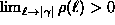 . Otherwise
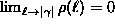 .
.
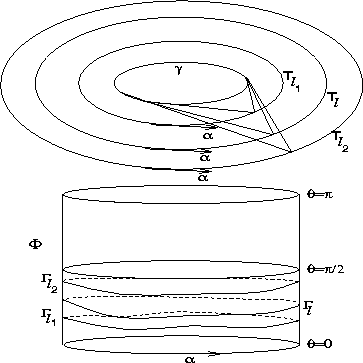
The invariant circle
moves monotonically upward in the phase space
as runs from to infinity (Figure 4).
For small , the curve is near the bottom
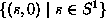 of . As increases,
moves up and approaches for
of . As increases,
moves up and approaches for  the equator
  . It remains in general
below the equator but not necessarily strictly as the ellipse shows.
. It remains in general
below the equator but not necessarily strictly as the ellipse shows.
We state now the main results of our work. There are two
theorems. Our first result
is that there is a Baire generic set  of caustics
for which the rotation function
of caustics
for which the rotation function
 is a devil's staircase. More precisely,
  has the property that for any rational p/q, the interval
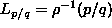 has a nonempty interior.
Some geometrical properties of imply that
has a nonempty interior.
Some geometrical properties of imply that
 has nonempty interior. We apply this to show that
contains all polygons and curves with a flat point.
has nonempty interior. We apply this to show that
contains all polygons and curves with a flat point.
In the second theorem, we
study then the motion of Birkhoff periodic orbits of a fixed rotation
number in the phase space .
Let be the interval of the set of parameters
for which there exists a Birkhoff periodic orbit on the curve .
For  , all Birkhoff periodic orbits with rotation number p/q are
above . For
, all Birkhoff periodic orbits with rotation number p/q are
above . For  , they are below .
Global index arguments imply that for
, they are below .
Global index arguments imply that for
 the curve separates the set
of Birkhoff periodic orbits into two nonempty subsets. We prove
that for near
the curve separates the set
of Birkhoff periodic orbits into two nonempty subsets. We prove
that for near  a Birkhoff periodic set
of index -1 approaches from above. This set continues as
a set of index +1 below for
a Birkhoff periodic set
of index -1 approaches from above. This set continues as
a set of index +1 below for  near .
At
near .
At  , a bifurcation occurs and two Birkhoff periodic sets of
index -1 are created on . The picture for near
, a bifurcation occurs and two Birkhoff periodic sets of
index -1 are created on . The picture for near
 is obtained by an obvious symmetry from the case at :
a Birkhoff periodic set of index +1 approaches from above the curve
, collides with two Birkhoff periodic sets on
and leaves as a Birkhoff periodic set of
index -1. (see Figures 12,13,14).
is obtained by an obvious symmetry from the case at :
a Birkhoff periodic set of index +1 approaches from above the curve
, collides with two Birkhoff periodic sets on
and leaves as a Birkhoff periodic set of
index -1. (see Figures 12,13,14).
The theme of relations between the shape of the billiard table and the
billiard dynamics is well reflected in the literature. Here, we mention
only a few papers which are especially close to our direction.
A problem which is closely related to our work is how to decide
whether a specific billiard table has an invariant circle or not.
We mention the theorem of Mather [19] about the global
absence of invariant circles in the case when the billiard table has a
flat point, the result of Hubacher [13] about the absence of
invariant circles near the table if the curvature of the table has a
discontinuity. An other related result is the theorem of Gruber
[6, 7] which tells that generically in the Hausdorff topology
on the set of convex tables, a billiard table has no caustics.
On the other hand, if the table is smooth enough and the curvature
is strictly positive, Lazutkin's result [17]
assures in this case the existence of infinitely many caustics near
the boundary of the table.
The inverse problem of finding billiard tables with a special
invariant circle or caustics is interesting both
from the geometrical and from the dynamical point of view.
Bialy [1] showed that if the phase space
of the billiard map is foliated by a continuous family of homotopically
non-trivial invariant circles, then the billiard table is a disc.
There are billiard tables with flat invariant circles different from
the equator [8]. The size of
the area which is free of caustics can be estimated from the shape of
the table [9].
For the billiard in an ellipse, there are caustics for any rotation number
and the table can be obtained from any of them
by the string construction. Elliptical billiards are believed
to be special. According to a conjecture attributed to Birkhoff
and stated by Poritsky [26], they are the only integrable billiards
in the sense that a subset of full Lebesgue measure of the phase space is
foliated by invariant circles. This Birkhoff-Poritsky problem is still open.
The paper is organized as follows. In section 2, we establish notation
and collect preliminary results. In section 3, we investigate the
rotation function and show that it is Baire generically a devil's staircase.
If there exists some for which
every orbit on is periodic, a caustic
is called exceptional. We will show in section 4
that this property is quite restrictive. While tables with exceptional caustics with
rotation number 1/3 have been constructed in [14] and his construction
probably generalizes to any possible rational number, it is not known whether a
table exists which has two exceptional invariant caustics.
In section 5, we investigate the passage of the Birkhoff periodic orbits
through the invariant circle as varies from
to  .
.
Next: Preliminaries
Up: Billiards that share a
Previous: Billiards that share a
Oliver Knill
Wed Jul 8 11:57:32 CDT 1998