Next: Devil's staircase
Up: Billiards that share a
Previous: Introduction
Let  be a closed convex and differentiable curve.
We denote by
be a closed convex and differentiable curve.
We denote by  the space of rays intersecting T.
The space
the space of rays intersecting T.
The space  is a closed cylinder
with coordinates
is a closed cylinder
with coordinates  , where
  is the arc-length
parameter on T and where
is the arc-length
parameter on T and where
 is the natural angle. The cylinder
 is the phase space for the billiard map
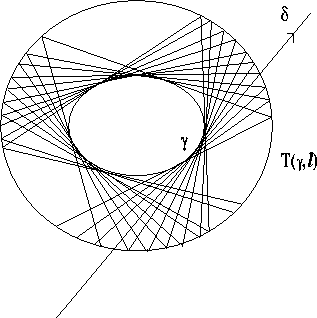
  of the billiard table T (compare Figure 1).
If T is
of the billiard table T (compare Figure 1).
If T is  and strictly convex then
is a twist diffeomorphism of class
and strictly convex then
is a twist diffeomorphism of class
 which preserves the area-form
  . The
time-reversal involution
. The
time-reversal involution  conjugates
  with
with  .
.
Let  be a closed convex curve with perimeeter
 . For any string length
  , the string construction
produces a closed convex curve
, the string construction
produces a closed convex curve  encircling
  . As
. As  varies from to
  , the curves
form a continuous foliation of the exterior of
in
, the curves
form a continuous foliation of the exterior of
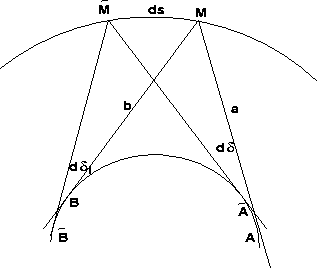
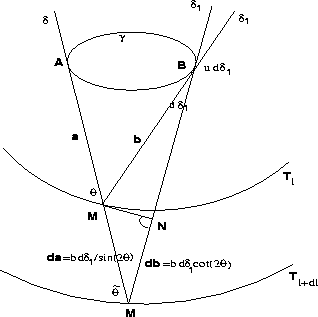
in  (see the Figures 2,4).
We denote by  the
billiard map of the table
the
billiard map of the table  . The set
 is a one-parameter family of area-preserving
twist maps of the phase cylinder .
is a one-parameter family of area-preserving
twist maps of the phase cylinder .
A homotopically nontrivial topological circle  in
the phase space of a twist map is called an invariant circle
if
in
the phase space of a twist map is called an invariant circle
if  .
The restriction of to is a Lipschitz homeomorphism,
isotopic to the identity.
We denote by
.
The restriction of to is a Lipschitz homeomorphism,
isotopic to the identity.
We denote by  its rotation number.
By construction, has a canonical invariant circle,
 . It is formed by the rays supporting ,
with orientation induced by the positive orientation
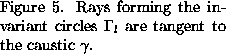
of (Figures 3,5). The opposite choice of the orientation yields the
invariant circle
. It is formed by the rays supporting ,
with orientation induced by the positive orientation
of (Figures 3,5). The opposite choice of the orientation yields the
invariant circle  . Thus, is the caustic
corresponding to the invariant circle
. Thus, is the caustic
corresponding to the invariant circle  ,
for any and the family
,
for any and the family
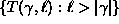 consists of
billiard tables with the same caustic .
consists of
billiard tables with the same caustic .
We denote by  the
induced homeomorphism. We choose a reference direction in and
parameterize by the directions
the
induced homeomorphism. We choose a reference direction in and
parameterize by the directions  of the supporting
rays (Figure 5). With this parameterization,
of the supporting
rays (Figure 5). With this parameterization,  becomes a
family of Lipschitz homeomorphisms of the circle
becomes a
family of Lipschitz homeomorphisms of the circle
 . We use the notation
  for the homeomorphisms and write
 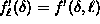 for the derivatives with respect to .
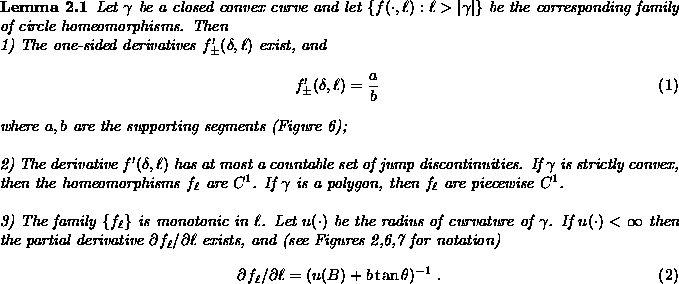
The following Lemma summarizes the elementary properties of the family
 of the circle homeomorphisms, determined by a
caustic .
of the circle homeomorphisms, determined by a
caustic .

If
is a closed convex curve, and
 is the
corresponding family of invariant circles, we set
is the
corresponding family of invariant circles, we set
 and
sometimes suppress the subscript .
and
sometimes suppress the subscript .


If is a convex n-gon, then
 .
In particular, if
is an interval with endpoints A, B, then
.
In particular, if
is an interval with endpoints A, B, then
 . The curves
  are then the ellipses
with foci A, B, see Figure 3 and circles if A=B.
Considering individual caustics , we will assume
are then the ellipses
with foci A, B, see Figure 3 and circles if A=B.
Considering individual caustics , we will assume
 . Then
 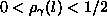 .
.
Next: Devil's staircase
Up: Billiards that share a
Previous: Introduction
Oliver Knill
Wed Jul 8 11:57:32 CDT 1998