Next: A Family of Circle
Up: Billiards that share a
Previous: Billiards that share a
Let  be the equilateral triangle with sidelength 1/3.
We construct tables T obtained from by
the so called string construction (see i.e. [11, 12]).
One takes an unstretchable string having length
be the equilateral triangle with sidelength 1/3.
We construct tables T obtained from by
the so called string construction (see i.e. [11, 12]).
One takes an unstretchable string having length  ,
wraps it around , pulls it tight at a point, M,
and drags it around . The point M then traces the table.
Varying the parameter
,
wraps it around , pulls it tight at a point, M,
and drags it around . The point M then traces the table.
Varying the parameter  , we get a one-parameter family
of billiard tables
, we get a one-parameter family
of billiard tables  . Each of these tables is composed of
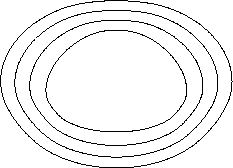
piecewise elliptic arcs. (See Fig. 1.).
. Each of these tables is composed of
piecewise elliptic arcs. (See Fig. 1.).
|
Fig. 1. Four examples of tables given by the string construction at
an equilateral triangle.
|
The corresponding billiard maps,  ,
form a natural one-parameter family of
twist maps. We investigate this family in the
present work.
,
form a natural one-parameter family of
twist maps. We investigate this family in the
present work.
We denote by  the space of unit vectors, with
foot points in , directed inwards.
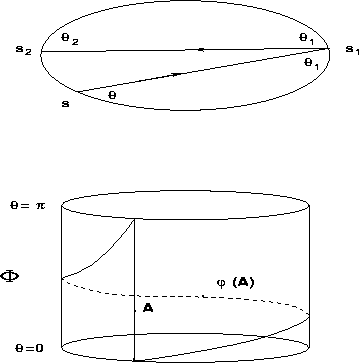
The space is a closed cylinder with natural coordinates
the space of unit vectors, with
foot points in , directed inwards.
The space is a closed cylinder with natural coordinates
 , where
  is the normalized
arc-length parameter on T, and where
is the normalized
arc-length parameter on T, and where
 measures the height in . The cylinder
is the phase space for the billiard map,
measures the height in . The cylinder
is the phase space for the billiard map,  ,
of the billiard table T (Fig. 2.).
,
of the billiard table T (Fig. 2.).
|
Fig. 2. The billiard map  and the phase space . and the phase space .
|
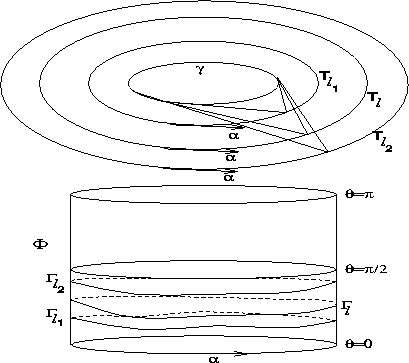
By construction, each billiard map  has a canonical invariant circle,
 . It is formed by the rays
supporting . Their orientation is induced by the positive orientation
of . The opposite choice of orientation yields an other
invariant circle
. It is formed by the rays
supporting . Their orientation is induced by the positive orientation
of . The opposite choice of orientation yields an other
invariant circle  .
The curve is the caustic
corresponding to the invariant circle
.
The curve is the caustic
corresponding to the invariant circle  ,
for any
,
for any  [2].
[2].
|
Fig. 3. A family of billiard tables obtained by the string
construction. (  ). The invariant circles are
moving up in the phase space as increases. ). The invariant circles are
moving up in the phase space as increases.
|
Thus the family
 , consists of
billiard tables with the same caustic .
, consists of
billiard tables with the same caustic .
|
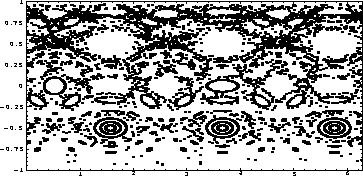
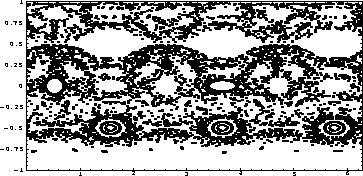
Fig. 4. Some orbits for the parameter  . .
|
|
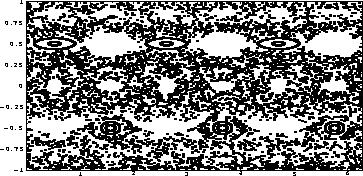
Fig. 5. Some orbits for the parameter  . .
|
|
Fig. 6. Some orbits for the parameter  . .
|
By our choice of ,
the rotation number  of satisfies
 .
.
Next: A Family of Circle
Up: Billiards that share a
Previous: Billiards that share a
Oliver Knill, Jul 8, 1998