Next: References
Up: Billiards that share a
Previous: Aubry-Mather Sets and the
Our numerical experiments provoke some open questions.
 We were especially interested in the parameter value
 , which is the supremum of all parameter values
  for which
  . The numerical experiments do not decide
clearly, if there exists a second caustics which is
different from the canonical caustics
. The numerical experiments do not decide
clearly, if there exists a second caustics which is
different from the canonical caustics  .
.
|
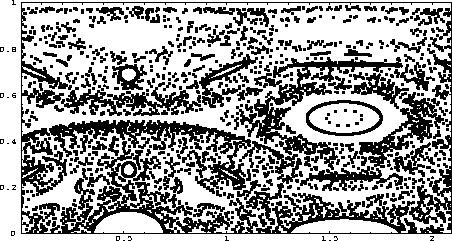
Fig. 12. The same picture as Fig. 5. Some orbits for  . This
time, we identified the dihedral symmetry of the phase space to see more
details. We see the parabolic periodic orbit (see around coordinates
(0.5,0.5)) which
is on the canonical invariant curve . On the same height to the right,
there is an elliptic periodic orbit also above .
The last invariant curve around that
island has a hexagonal shape. . This
time, we identified the dihedral symmetry of the phase space to see more
details. We see the parabolic periodic orbit (see around coordinates
(0.5,0.5)) which
is on the canonical invariant curve . On the same height to the right,
there is an elliptic periodic orbit also above .
The last invariant curve around that
island has a hexagonal shape.
|
It looks as if for in the interior of a phase locking
interval, there exists a neighborhood of the canonical invariant
circle , for which there exists no other invariant circle.
One can argue that the stable or unstable manifold of
the hyperbolic Birkhoff periodic orbits on the
caustics prevent this if they do cross transversely outside the canonically
invariant circle.
The curvature of the tables  has discontinuities.
Hubacher's result [4]
shows that near the boundaries of
has discontinuities.
Hubacher's result [4]
shows that near the boundaries of  , there exist no invariant
curves. A result of Angenent [1]
implies that for any
, there exist no invariant
curves. A result of Angenent [1]
implies that for any  , the topological entropy
  of the billiard at
is positive. It would be interesting to get quantitative results
about the topological entropy. Is it monotonically decreasing in ?
Is
of the billiard at
is positive. It would be interesting to get quantitative results
about the topological entropy. Is it monotonically decreasing in ?
Is  ?
?
|
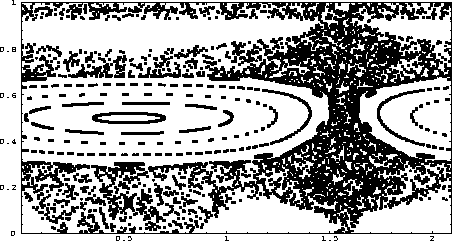
Fig. 13. Some orbits for  for which the billiard table is very
close to a triangle. Like in Fig. 12, we have identified
the dihedral symmetry. (The arc length parameter displaying the first coordinate
is slightly distorted since the program uses a convenient arc length
instead of the real arc length). for which the billiard table is very
close to a triangle. Like in Fig. 12, we have identified
the dihedral symmetry. (The arc length parameter displaying the first coordinate
is slightly distorted since the program uses a convenient arc length
instead of the real arc length).
|
Next: References
Up: Billiards that share a
Previous: Aubry-Mather Sets and the
Oliver Knill, Jul 8 1998