 with Birkhoff periodic orbits of type p/q if
the phase-locking interval
with Birkhoff periodic orbits of type p/q if
the phase-locking interval  has a nonempty interior.
|
In this section, we analyze the interaction of the moving invariant
circle with Birkhoff periodic orbits of type p/q if
the phase-locking interval has a nonempty interior.
It is a basic fact for monotone twist maps that for any  at least two Birkhoff periodic orbits of type (q,p) exist
(see e.g. [7, 5]).
In the billiard case, one of these orbits is a local maximum of the
functional |O|, the total length of the trajectory O.
Let
at least two Birkhoff periodic orbits of type (q,p) exist
(see e.g. [7, 5]).
In the billiard case, one of these orbits is a local maximum of the
functional |O|, the total length of the trajectory O.
Let  be the set of Birkhoff periodic orbits.
Let
be the set of Birkhoff periodic orbits.
Let  be irrational. An accumulation point
(in the Hausdorff topology) of sets
as
be irrational. An accumulation point
(in the Hausdorff topology) of sets
as  is called an
Aubry-Mather set and denoted by
is called an
Aubry-Mather set and denoted by  . Such a set
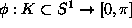
has the property that it is the graph of a Lipschitz continuous function
. Such a set
has the property that it is the graph of a Lipschitz continuous function
 and that a lift
  of
of
 preserves the order of the covering of M [5].
(In the following discussion, we fix the rotation number  .
Typically, Birkhoff periodic orbits are isolated. The case
of billiards shows however
that one has to deal in general with whole arcs of Birkhoff periodic orbits
If a connected set Y of periodic orbits
contains a Birkhoff periodic orbit, then every orbit in Y is a Birkhoff
periodic orbit and we will call such a set a Birkhoff periodic set.)
.
Typically, Birkhoff periodic orbits are isolated. The case
of billiards shows however
that one has to deal in general with whole arcs of Birkhoff periodic orbits
If a connected set Y of periodic orbits
contains a Birkhoff periodic orbit, then every orbit in Y is a Birkhoff
periodic orbit and we will call such a set a Birkhoff periodic set.)
Let C be a simple, contractible closed curve in  avoiding all
fixed points of
avoiding all
fixed points of  . The index
  of C with respect to is defined as
the Brower degree of the map
of C with respect to is defined as
the Brower degree of the map 
 .
where
.
where  is calculated in a chart.
The index is a homotopy invariant
and does not change if we deform C without intersecting
a fixed point of .
is calculated in a chart.
The index is a homotopy invariant
and does not change if we deform C without intersecting
a fixed point of .
If a curve C contains only one fixed point  of ,
of ,
 is called the index of . If C contains
a connected fixed-point set
is called the index of . If C contains
a connected fixed-point set  , we call
 the
index of this fixed point set.
If a curve C contains finitely
many fixed points
the
index of this fixed point set.
If a curve C contains finitely
many fixed points  (rsp. connected fixed-point sets
  )
of , then
)
of , then  .
.
We will use the fact that the
index of a fixed point of an area-preserving
homeomorphism is bounded above
by 1 [10] [9].
Given a one-parameter
family of monotone twist maps  parameterized by some interval I.
Assume C is a simple closed curve in such that for
parameterized by some interval I.
Assume C is a simple closed curve in such that for  ,
no fixed point of
,
no fixed point of  is on C and for all only finitely
many connected fixed point sets are inside C.
A parameter value for which
the number of connected components of fixed points of inside C
changes is called a bifurcation parameter.
is on C and for all only finitely
many connected fixed point sets are inside C.
A parameter value for which
the number of connected components of fixed points of inside C
changes is called a bifurcation parameter.
Index considerations limit the possibilities for bifurcations
of periodic orbits in monotone twist maps.
As the parameter  varies, the the invariant
circle
moves through the phase space .
Sets in the region between
the invariant circle and the boundary are called below
varies, the the invariant
circle
moves through the phase space .
Sets in the region between
the invariant circle and the boundary are called below  ,
the others are called above .
,
the others are called above .
For near  , the invariant circle is near the boundary
 of the phase space .
For
of the phase space .
For  , the invariant circle moves
towards the
equator
, the invariant circle moves
towards the
equator 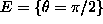 of .
Aubry-Mather sets with a fixed
rotation number pass through the moving circle .
of .
Aubry-Mather sets with a fixed
rotation number pass through the moving circle .
The passage of
with irrational is easy to describe: since each irrational
is a point of increase of  , the set of parameters
for which
intersects with consists of
exactly one parameter value
, the set of parameters
for which
intersects with consists of
exactly one parameter value  ,
for which
,
for which  .
The set is in general a Cantor set, for
.
The set is in general a Cantor set, for
 .
.
More interesting is when
Birkhoff periodic orbits  pass through if
the phase locking interval is nontrivial.
Since any periodic orbit on is a Birkhoff periodic orbit,
is the set of parameters for which intersects
with .
pass through if
the phase locking interval is nontrivial.
Since any periodic orbit on is a Birkhoff periodic orbit,
is the set of parameters for which intersects
with .
The following theorem is proven in [3] for a general convex caustic
 .
.

The idea of the proof is as follows:
for  and
and  , every
Birkhoff periodic set on is parabolic and has index -1. By
the symmetry of the situation, it suffices to study the bifurcation at
, every
Birkhoff periodic set on is parabolic and has index -1. By
the symmetry of the situation, it suffices to study the bifurcation at  .
For
.
For  , there exists no Birkhoff periodic set on and
all such sets are above . Local
index conservation implies that such a set must exist nearby.
Using properties of the
one-parameter family of circle map
, there exists no Birkhoff periodic set on and
all such sets are above . Local
index conservation implies that such a set must exist nearby.
Using properties of the
one-parameter family of circle map  for
for  with
near , we conclude that there exist 2 hyperbolic
Birkhoff periodic sets of index -1
on . Local index conservation implies that a Birkhoff periodic set
of index +1 must be nearby. By the global Poincaré index formula, we
argue that this set
with
near , we conclude that there exist 2 hyperbolic
Birkhoff periodic sets of index -1
on . Local index conservation implies that a Birkhoff periodic set
of index +1 must be nearby. By the global Poincaré index formula, we
argue that this set  is on the other side of .
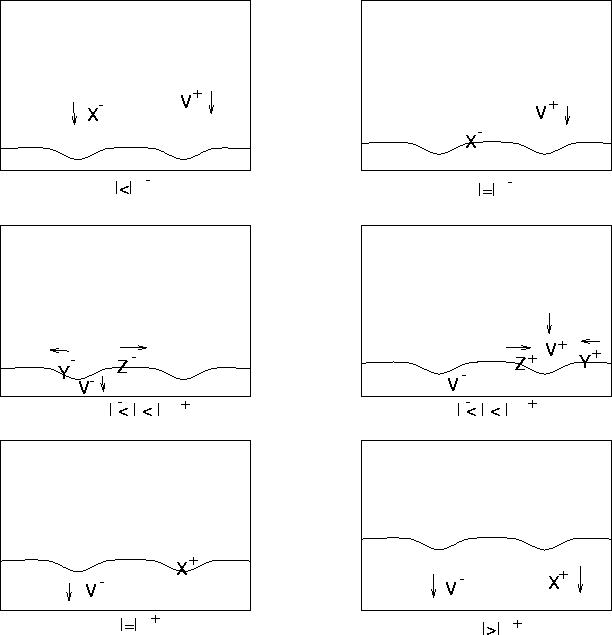
|
Fig. 11. Schematic illustration of
the passage of the Birkhoff periodic orbits through the moving invariant
curve .
|