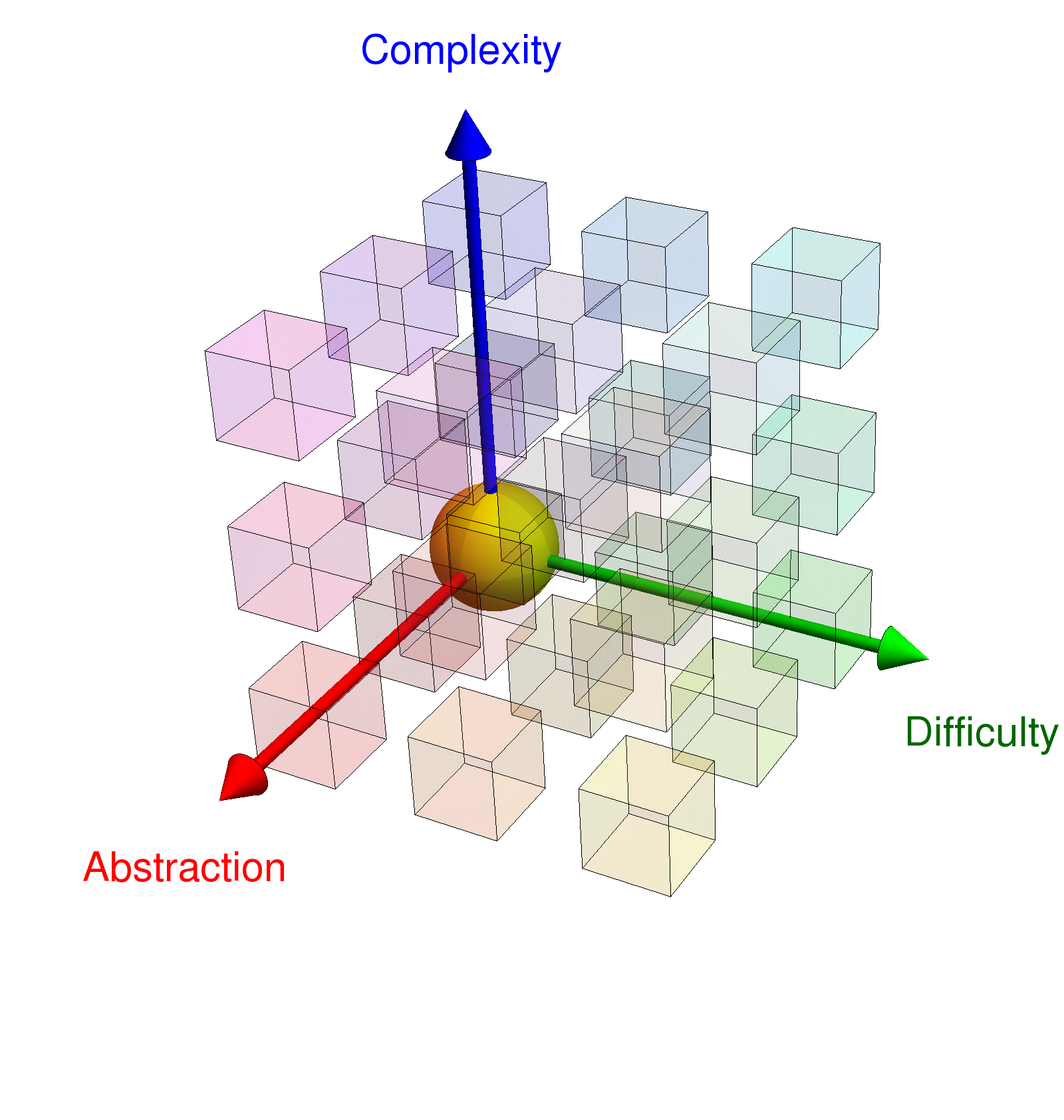
| The Abstraction-Difficulty-Complexity parameter space is a three dimensional space which allows to assess a topic, a course or an assignment. See this document on problem types [PDF] or this these notes while working with Paul Hermany on a project in taxonomy [PDF]. Homework problems, exam problems or problems used in lecture are usually taken from different parts of this space. In a lecture, we can be a bit more abstract, a homework question can be a bit more difficult or complex, exam problems however should have low complexity and be of moderate abstraction and difficulty. The Difficulty and the Complexity level is usually relatively easy to assess. The complexity is essentially the amount of effort needed to finish the task, the difficulty is the amount of new ideas are needed to solve a problem. The abstraction which measures how far the situation is from daily life. General structures are in general abstract, while concrete applications are usually less abstract. The question how abstract something is perceived can be more tricky and harder to assess. The reason is that the notion of abstraction depends on the pre-knowledge level. For somebody who knows a lot of mathematics already, it is easy to grasp the relatively abstract concept of category theory. However, as there are so many , (the nLab website has currently 13559 pages), things can also get difficult due to the vast amount of information. |
|
| Problem | Answer | Complexity | Difficulty | Abstraction |
|---|---|---|---|---|
| 1) Does in an algebraic structure associativity follow from commutativity? | The answer is no, as Jordan algebra show. A concrete example is the multiplication x*y = (xy+yx)/2 which is commutative but not associative. | 0.1 (we don't have to compute any thing if we see it) | 0.5 (we need to come up with an example) | 0.9 (it is a general axiomatic problem) |
| 2) What is 234132413244*231341324134512 ? | By multiplying out, we get 54164502502675714226276928. | 0.9 (it is just a damn amount of work to do this) | 0.1 (well, we have to know how to multiply numbers) | 0.1 (it is a very concrete problem) |
| 3) x^3 = 3 + 7y^2 has no integer solutions. | There is no solution because there is no solution modulo 8. | 0.2 (if the solution is seen there is little to do) | 0.8 (we need to see that one has to look at it modulo 8) | 0.1 (it is a concrete problem about numbers) |
| 4) How many digits does 234132413244^231341324134512 have? | The numbers are large but there is also a difficulty. We need to know the log laws. The answer is 2630226287706815` | 0.9 | 0.9 (a computer can not compute that) | 0.1 |