Point-E an Open AI modeling
Artificial intelligence also learns how to draw in space:
 Engadget
:
OpenAI 3D modeling is used across a variety industries and
applications. The CGI effects of modern movie blockbusters, video games,
VR and AR, NASA's moon crater mapping missions, Google's heritage site
preservation projects, and Meta's vision for the Metaverse all hinge on 3D
modeling capabilities. However, creating photorealistic 3D images is still
a resource and time consuming process, despite NVIDIA's work to automate
object generation and Epic Game's RealityCapture mobile app, which allows
anyone with an iOS phone to scan real-world objects as 3D images.

Text-to-Image systems like OpenAI's DALL-E 2 and Craiyon, DeepAI,
Prisma Lab's Lensa, or HuggingFace's Stable Diffusion, have rapidly
gained popularity, notoriety and infamy in recent years. Text-to-3D
is an offshoot of that research. Point-E, unlike similar systems,
"leverages a large corpus of (text, image) pairs, allowing it to follow
diverse and complex prompts, while our image-to-3D model is trained on a
smaller dataset of (image, 3D) pairs," the OpenAI research team led by
Alex Nichol wrote in Point·E: A System for Generating 3D Point Clouds
from Complex Prompts, published last week. "To produce a 3D object from
a text prompt, we first sample an image using the text-to-image model,
and then sample a 3D object conditioned on the sampled image. Both of
these steps can be performed in a number of seconds, and do not require
expensive optimization procedures."

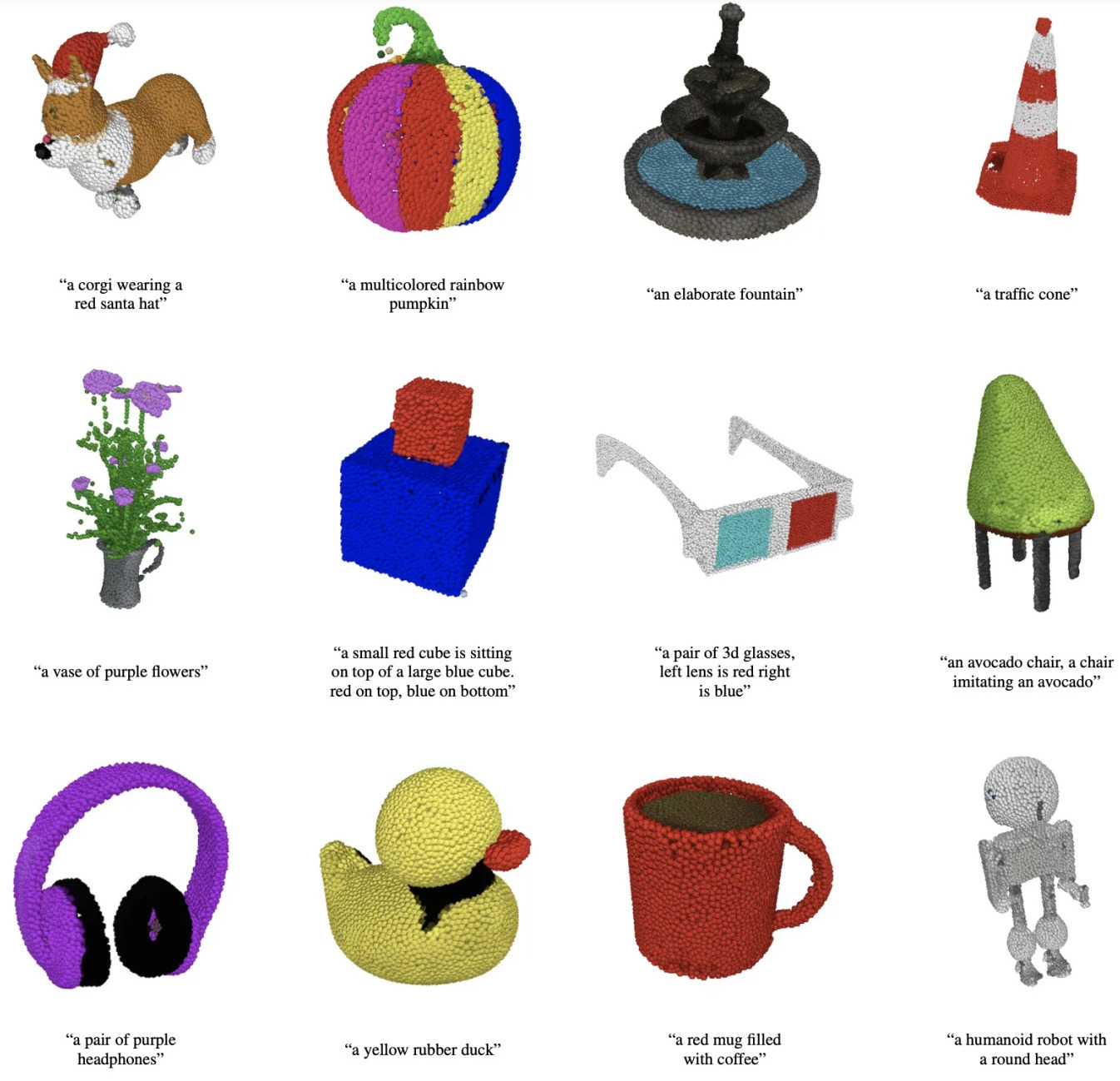
If you were to input a text prompt, say, "A cat eating a
burrito," Point-E will first generate a synthetic view 3D rendering of
said burrito-eating cat. It will then run that generated image through
a series of diffusion models to create the 3D, RGB point cloud of the
initial image - first producing a coarse 1,024-point cloud model, then
a finer 4,096-point. "In practice, we assume that the image contains the
relevant information from the text, and do not explicitly condition the
point clouds on the text," the research team points out.

These diffusion models were each trained on "millions" of 3d models, all
converted into a standardized format. "While our method performs worse
on this evaluation than state-of-the-art techniques," the team concedes,
"it produces samples in a small fraction of the time." If you'd like to
try it out for yourself, OpenAI has posted the projects open-source code
on Github.