Feigenbaum
Mitchell Feigenbaum, who died on June 30 2019, discovered about 50 years ago
an important universality: there are quantities in dynamics which do not depend on the rule
which produce the dynamics. Let us explain this with the circle
T
c(x) = c sin( π x) which maps the interval [0,1] into itself and can also
be seen as a map on the circle X=R/Z in which the point 0 and 1 are identified
forming a circle. Now, if c is very small, there is just one attractor 0. What
Feigenbaum discovered with experiments done on a calculator is that the bifurcation values
c
k at which the periodic attractors change accumulate in a universal
way. Universal means that it does not matter, what map we take. For T(x) = 4c x(1-x)
it would show a similar bifurcation structure near the threshold to chaos (which can
be defined as a situation, where the attractor is no more finite.)
A more precise definition of chaos is ``sensitive dependence of initial condition" meaning
that the Lyapunov exponent L(c) = liminf
n → ∞ log|(T
cnx)'|/n
is positive when integrated over all x in X).
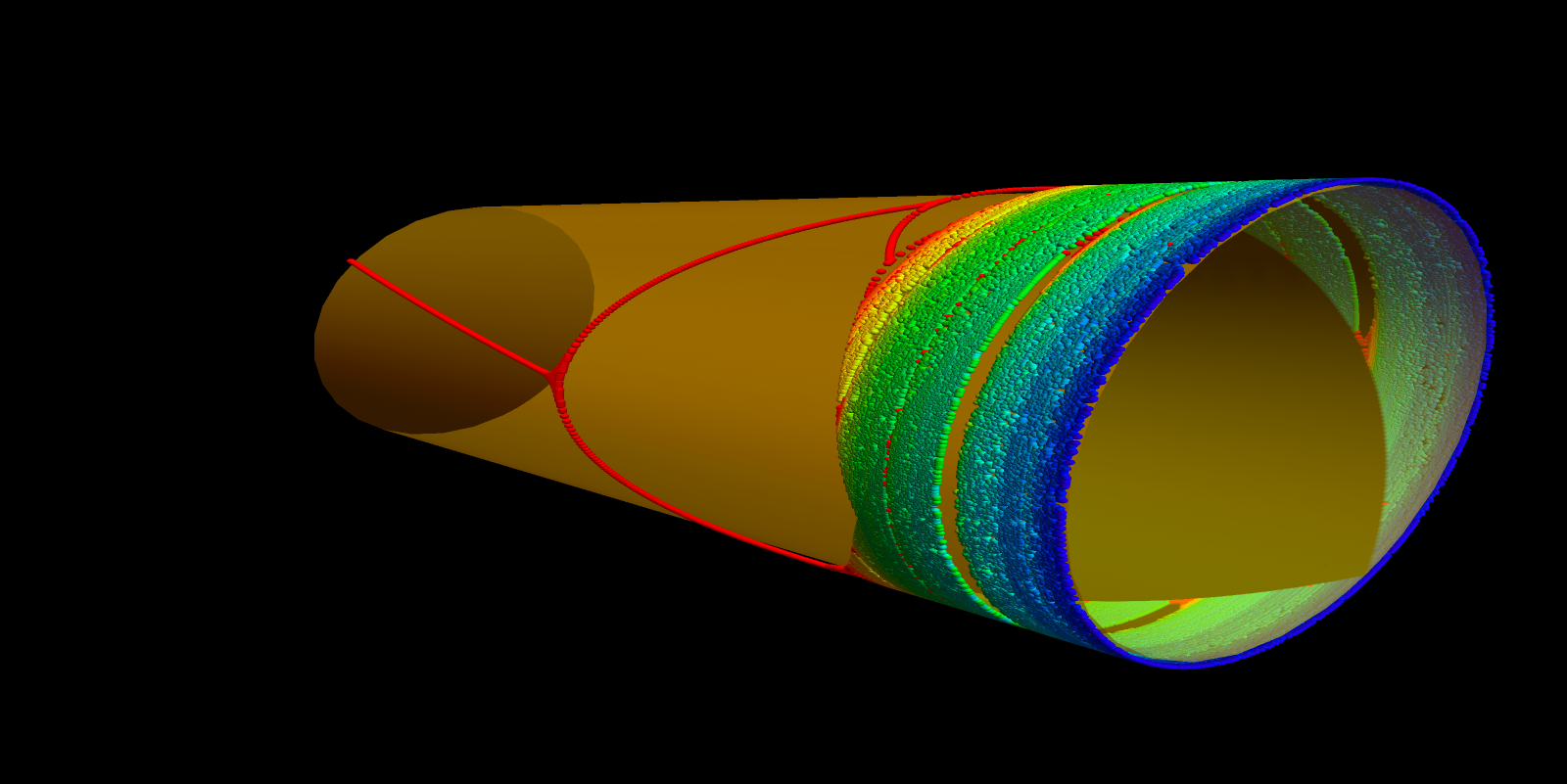
Here is a picture of one parameter circle map f_c(x) = c sin(pi x), where c ranges
from 0.55 to 1. If you slice the cylinder at some hight, you see the corresponding
atractor of the map f_c. At c=1, there is chaos. The route to chaos has come through
bifurcations, which show universality.
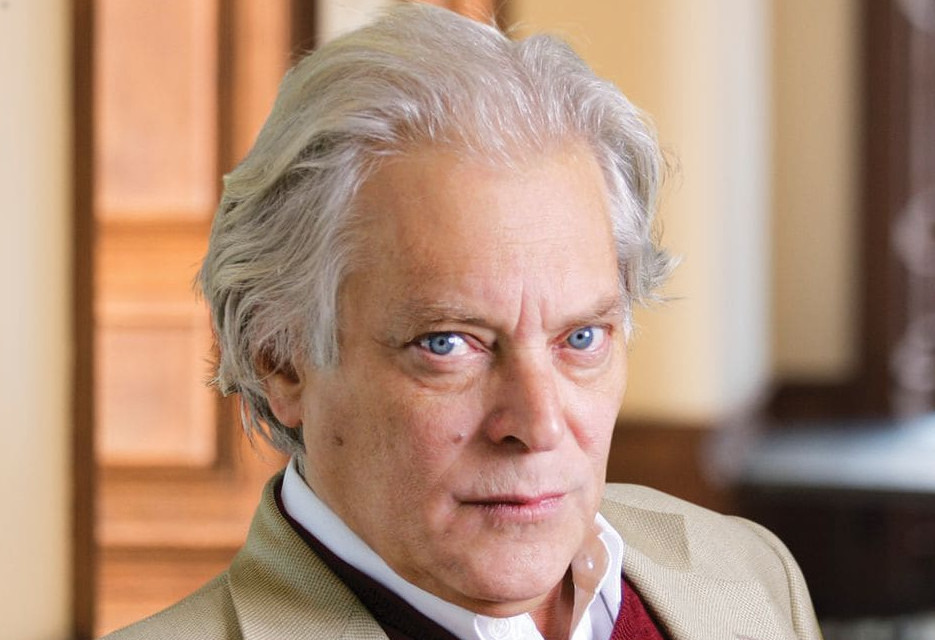
Here are pictures of Feigenbaum (parts of photographs on
Washington post and NYT):


Links:

