Math 21a Summer 2020
Multivariable Calculus

Area of the Mandelbrot set
For background, look at the Monte Carlo Mandelbrot exhibit from Fall 2019 with a bit of Write up on the area of the Mandelbrot set [PDF]. Or the Mandelbrot Zoom from 2018 which you have to see full screen! Here are the results reported by the rare element groups. We see that there is an obvious correlation between the number of iterations and the area. Of course, if one runs the iterations longer, more points are melted away from the set considered in the Mandelbrot set. The Decimal expansion of the area of the Mandelbrot set is called A098403. It is there reported to start with 1.506591. Here are the results reported by the rare elements:Group Iter Runs Result --------------------------------------------- Gadolinium 1000 1000000 1.51188 Actinium 10000 10000000 1.50818 Neodynimum 1000 7000000 1.51016 Terbium 5000 900000 1.50875 Yttrium 2000 5000000 1.50843 Ytterbium 1000 10000000 1.50791 Thorium 2000 1000000 1.50803 Dysposium 1000 2500000 1.51132 Lutetium 500000 1000000 1.50774 Erbium 1000 1000000000 1.51026 Europium 1000 10000000 1.50940 Samarium 4000 10000000 1.50869 Cerium 10000 10000000 1.50756 Praseodymium 1000 2500000 1.51132 Holmium 1000 10000000 1.50999 Lutetium 1000 1000000000 1.51036 Scandium 50000 10000000 1.50673 Lanthanum 5000 10000000 1.50687 Promethium 1000 10000000 1.50945Here is some comparison which I ran on three of my machines: (the knill12 job was running July 20 to July 28)
Oliver: knill12    2000   2262600000  1.50834
Oliver: knill12    2000   6742800000  1.50839  (August 11)
Oliver: knill27   12000   37730000    1.50768
Oliver: knill11    1200   395900000   1.50979
It uses code which does the computation in smaller steps and reports out. I save this as a file "mandelbrotarea.m", then run in a terminal "nohup math < mandelbrotarea.m > out &" which will continue running the job and continuously write onto the file out. This can then be distributed onto other machines.
T=0; Do[ m=10000; n=12000;
  M=Compile[{x,y},Module[{z=x+I y,k=0},
   While[Less[Abs[z],2] && Less[k,n],z=N[z^2+x+I y];++k];Floor[k/n]]];
  U=9*Sum[M[-2.0+3 Random[],-1.5+3 Random[]],{m}]/m;
  T=T+U; Print[{t,U,N[T/t]}], {t,1000000}]
|
Sebastian Ingino wrote some Python code for Google Colab and got the following result:
Samarium(Python) 20000 10000000 1.505724Here is the project page of Sebastian on Colab.research.google. Update of July 28: Sebastian has increased the speed using Tensorflow and running on Tensorflow-optimized hardware. . This is about 30x faster when using 2000 iterations and 1000000 samples and uses only 3 seconds to run. The Mathematica job, I have been running since more than a week would be done in 10 minutes. Here is the Python code (simplified from Sebastians page) without multi-processing: just save it as file mandelbrotarea.py and run python < mandelbrotarea.py on a terminal. mandelbrotarea.txt [TXT file]
from numpy import random
import math

iterations = 2000
samples = 100000

def M(x,y):
    z = x+y*1j
    k = 0
    while abs(z) < 2 and k < iterations:
      z = z*z+ x+y*1j
      k += 1
    return math.floor(k/iterations)

sum = 0
n = 0
while n < samples:
   n += 1
   sum += M(-2 + 3*random.rand(), -1.5 +3*random.rand())

final = 9*sum/samples
print(final);
|
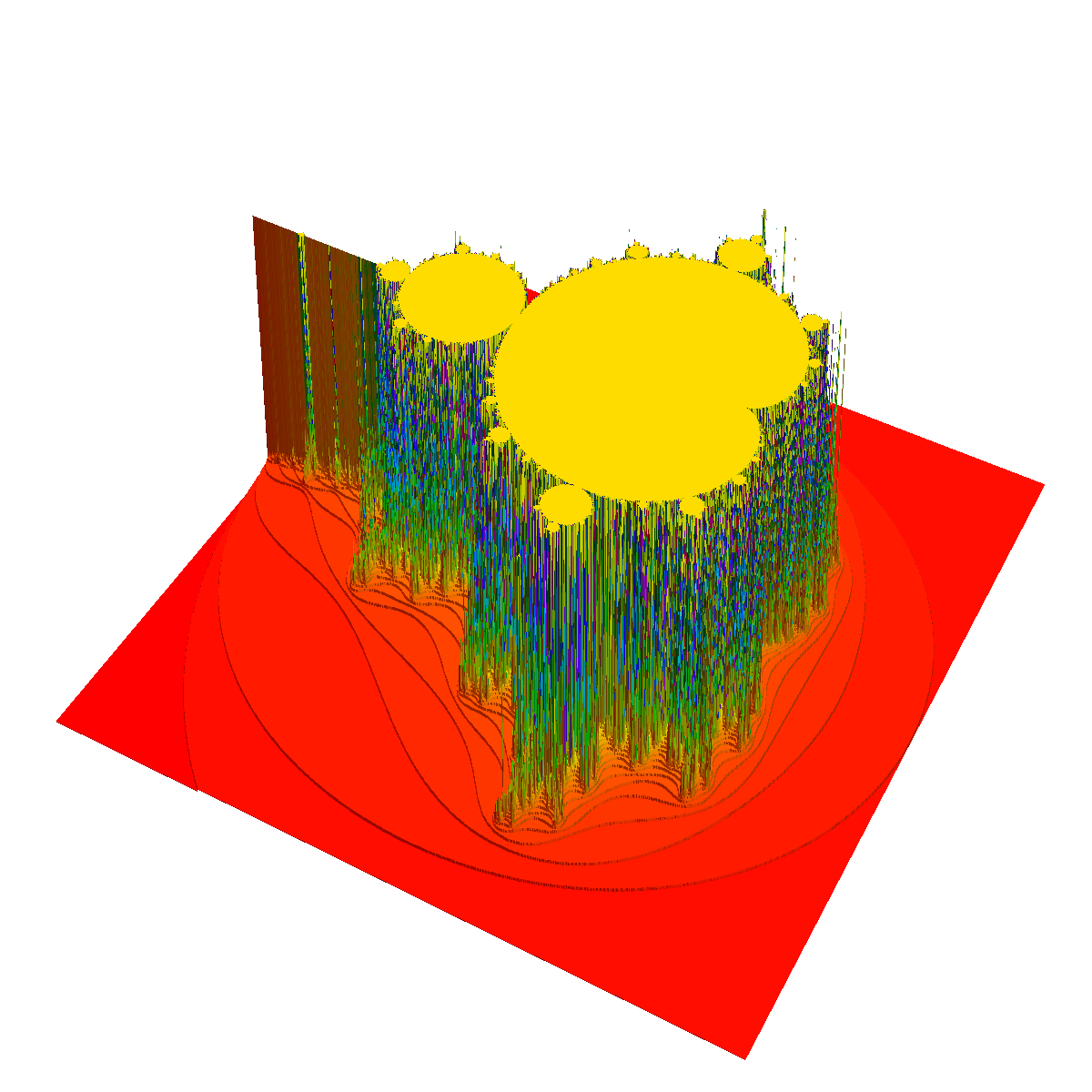
Here is a 3D plot of the Mandelbrot set
M=Compile[{x,y},Module[{z=x+I y,k=0,n=200},
   While[Less[Abs[z],2] && Less[k,n],z=N[z^2+x+I y];++k];k/n]];
Plot3D[M[x,y],{x,-2,1},{y,-1.5,1.5},PlotPoints->300,ColorFunction->Hue]